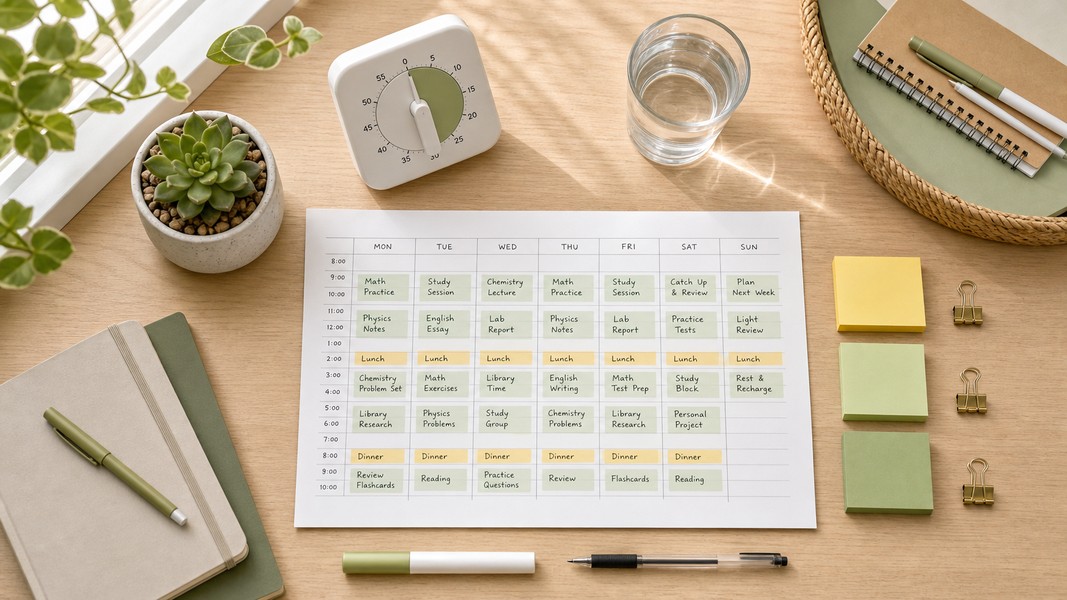
Time Management for Students: 7 Tactics That Work
July 22, 2026
Struggling to manage your time as a student? These 7 evidence-backed tactics fix the real reasons students fall behind and waste hours.


April 23, 2026
You've probably spent hours re-reading your notes before an exam and still felt unprepared. The problem isn't how much time you put in. It's the method.
Retrieval practice is the act of pulling information out of your memory rather than passively reviewing it. A landmark study by Karpicke and Blunt found students retained roughly 50% more information after retrieval practice than after elaborative studying like concept mapping, tested a week later. Yet most students default to re-reading because it feels easier and more familiar.
This post breaks down 7 practical retrieval practice techniques you can start using today, from free recall to interleaved testing.
Retrieval practice works through what researchers call the testing effect: when you struggle to retrieve something from memory, you strengthen that memory trace far more than any amount of passive review. Each time you successfully recall information, the path to it becomes clearer and more durable.
It also reveals gaps that re-reading conceals. When you re-read material, it all feels familiar, which tricks you into feeling prepared. Retrieval practice forces you to confront what you actually know versus what you simply recognize.
Cognitive scientists including Henry Roediger III, Jeffrey Karpicke, and Pooja K. Agarwal have built entire research programs around this approach. The UK's Education Endowment Foundation rates it as equivalent to 7+ months of additional learning progress, one of the highest-rated strategies in their toolkit.
Paired with spaced repetition, retrieval practice forms the backbone of evidence-based studying.
Free recall is the simplest form of retrieval practice. After reading a chapter or attending a lecture, close your materials and write down everything you remember on a blank page. No notes. No hints. Just what you can pull up from memory.
The process takes about five minutes but does more for retention than re-reading the same chapter three times. Without any cues to lean on, your brain has to reconstruct the memory from scratch, which is exactly what strengthens it.
A biology student reviewing mitosis would close their textbook, grab a blank sheet, and list every stage they can recall: prophase, metaphase, anaphase, telophase. Any gaps become their study focus rather than a surprise on the day of the exam.
Start every review session with free recall before you open your notes. What appears on that blank page is what you actually know. What's missing is what needs work.
Practice testing means completing low-stakes questions or past papers under exam-like conditions, then checking your answers. Unlike free recall, practice tests provide cues, so they bridge the gap between what you can recall with help and what you know cold.
Roediger's research found that students who took one low-stakes quiz performed a full letter grade higher on their final exams compared to students who simply re-studied the material. Research compiled by Agarwal's lab consistently shows this effect holds across subjects, age groups, and question formats.
The key is to treat errors as data. When you get something wrong, you know exactly what to review next. Correct answers give you confidence. Both outcomes move you forward in a way that passive review never can.
History students can use this by pulling past essay questions, setting a timer, and writing without their notes. When they review their answers afterward, they compare their retrieval attempt against the source rather than just re-reading the source.
Flashcards work best when you combine them with spacing: reviewing cards at intervals spread across days and weeks rather than running through the full deck every single day.
This combination of retrieval and distributed practice creates what researcher Robert Bjork calls "desirable difficulties." The slight effort you feel when a card comes up after a few days is precisely the mechanism that drives long-term retention. Massed review, running through every card every night, keeps information in short-term memory without moving it to long-term storage.
A psychology student studying Freud's defense mechanisms would go through their deck, sort cards into "confident" and "needs work" piles, then schedule the "needs work" cards for review two to three days later.
Voice Memos automates this process, generating flashcard decks from your voice recordings, PDFs, or lecture notes and scheduling reviews based on how you rate each card. You get the benefit of spaced retrieval without manually tracking intervals.
The brain dump is a metacognitive version of free recall. At the start of a study session, before you open any materials, set a timer for six to eight minutes and write down everything you remember about the topic you're about to review.
What makes this different from free recall is the intent. You're not just testing retention. You're using the gaps in your brain dump to plan the rest of the session. Whatever you couldn't recall is what you focus on most.
John Dunlosky's 2013 review of learning strategies rated retrieval-based methods as high-utility while finding that re-reading offers minimal benefit despite being the most commonly used student strategy.
Combine brain dumps with another retrieval cycle: dump first, review gaps with your notes, then close the notes and recall again. Two retrieval passes in one session beat one longer re-reading session.
Explaining a concept aloud, as if teaching it to someone unfamiliar with the topic, forces a different kind of retrieval than writing. You have to simplify, sequence, and translate ideas into plain language without leaning on technical vocabulary.
This is the cognitive mechanism behind the protégé effect and the Feynman technique. When you try to teach something, the gaps in your own understanding become immediately apparent. You cannot fake your way through an explanation the way you can while passively reviewing.
A college student studying organic chemistry might explain SN1 vs. SN2 reaction mechanisms to a friend who has never heard of them. Every moment they stumble is a precise signal about which part of the concept needs more work.
Paired with active recall strategies in your regular study routine, teach-back sessions create a powerful feedback loop between testing yourself and strengthening what you retrieve.
Most students study one topic at a time: all of Chapter 4, then all of Chapter 5. Interleaved practice mixes questions or problems from multiple topics in a single session.
The research on interleaving shows it outperforms blocked practice on delayed tests, even though it feels harder in the moment. The difficulty is the point. When you have to figure out which concept applies to each new problem, you're doing extra discrimination work that blocked practice skips entirely.
A math student preparing for finals might work a set of 20 problems mixing algebra, geometry, and calculus rather than grinding through 20 algebra problems in a row. The switching feels disorienting at first, but it builds a more flexible kind of knowledge.
Voice Memos' quiz mode can generate mixed-topic questions from multiple uploaded notes or documents, making interleaved practice sessions easy to set up without building the question sets manually.
Cued recall sits between the freedom of free recall and the guidance of multiple-choice tests. You use a partial prompt, a keyword, a question, or a heading, to trigger retrieval of the full concept without seeing the complete answer.
Cornell notes are built around cued recall: the narrow left column holds keywords and questions that prompt retrieval of the fuller notes on the right. Cover the right side and see how much you can reconstruct from just the cue.
The cognitive benefit is in the effort of reconstruction. When the cue triggers your attempt to recall and you compare your version to the correct answer, that comparison creates a stronger memory than either passive review or checking answers without attempting retrieval first. Even incorrect retrieval attempts followed by immediate feedback produce better long-term memory than no attempt at all.
The most common mistake is quitting too soon. Most students check the answer after a second or two of not remembering, short-circuiting the effortful retrieval that drives the benefit. Give yourself at least 20 to 30 seconds of genuine effort before checking.
The second mistake is relying on recognition. Multiple-choice questions that feel easy are often testing whether you recognize the correct answer rather than whether you can recall it independently. Mix in open-ended questions and free recall exercises to make your practice more demanding.
The third is neglecting spacing. Cramming through flashcards the night before triggers forgetting within 48 hours. Short, regular retrieval sessions spaced across days and weeks consistently outperform marathon review sessions on every delayed test researchers have run.
Retrieval practice works because memory is reconstructive: the more times you retrieve something, the stronger and more accessible that memory becomes. Re-reading gives you the illusion of mastery. Retrieval practice tests it.
The seven techniques here, free recall, practice testing, spaced flashcards, brain dumps, teaching, interleaving, and cued recall, operate through the same principle: make your brain work to produce the answer, then verify and correct. Start with free recall, which costs nothing and takes five minutes, and build from there.
Discover more insights and tips to enhance your productivity
Struggling to manage your time as a student? These 7 evidence-backed tactics fix the real reasons students fall behind and waste hours.

Fathom AI is great for free Zoom notes, but it has real limits. Here are the best fathom ai alternatives for meetings, students, and multi-format capture.

Learn what to include in a follow-up email after any meeting, when to send it, and how to write one that drives real action across every meeting type.