
Zettelkasten: How to Build a Knowledge System
July 24, 2026
Learn how the Zettelkasten method works, why linked notes beat linear notebooks, and how to build your own knowledge system from scratch.


March 22, 2026
Cornell notes is a structured note-taking system that divides your page into three zones: a narrow cue column on the left, a main note-taking area on the right, and a summary section at the bottom. The system was designed for a specific workflow: record during class, then review by testing yourself against your own cues. That review step is what separates Cornell notes from ordinary note-taking.
Developed in the 1950s by Walter Pauk at Cornell University and detailed in his book How to Study in College, the method has been used by students for decades. Its staying power comes from one thing: it forces you to interact with your notes after class, not just collect them.
The Cornell note-taking system is a structured approach to capturing and reviewing information. Walter Pauk designed it to solve a problem most students share: they write detailed notes during a lecture, then never look at them again in a useful way.
The system addresses this by building the review mechanism into the note-taking format itself. Your cue column becomes a self-quizzing tool. Your summary section forces synthesis. The layout doesn't just organize information; it creates a ready-made study session every time you sit down to review.
A 2010 study found Cornell notes outperformed guided notes for tasks requiring synthesis and application of knowledge. The system works best when you treat it as a complete workflow, not just a page layout.
The page is divided into three sections:
The note-taking area takes up roughly two-thirds of the page on the right side. This is where you capture information during a lecture or reading session. Use bullets and abbreviations, paraphrase rather than transcribe, and leave space between ideas so you can add context later.
The cue column runs down the left side, about 2.5 inches wide. You fill this in after class, within 24 hours while the material is fresh. Cues should be questions or keywords that prompt you to recall the information in the note-taking area. "What caused the 15% revenue drop?" is a useful cue. "Revenue" on its own is not.
The summary section sits at the bottom of the page, roughly 2 inches tall. In two to four sentences written in your own words, summarize the key idea of that entire page. The act of writing this summary forces a moment of reflection that passive notes skip entirely.
Step 1: Set up the page. Draw a vertical line about 2.5 inches from the left edge. Draw a horizontal line about 2 inches from the bottom. Label the three zones: Cues, Notes, Summary.
Step 2: Record during class. Focus on main ideas, not every word. Use abbreviations, shorthand, and symbols. Leave gaps between topics so you can add clarification later. Your goal during this phase is capture, not polish.
Step 3: Add cues within 24 hours. After the lecture or reading session, go back through your notes and write questions or keywords in the cue column. Frame them as retrieval prompts: "What are the three stages of..." or "Why does X lead to Y?" The sooner you do this after class, the stronger the connections.
Step 4: Cover and recite. Fold the page or cover the note-taking area, leaving only your cue column visible. Answer each cue from memory. Speak the answer out loud or write it. This recitation step is the core of the Cornell system: it converts passive review into active recall, which research consistently shows improves long-term retention over rereading.
Step 5: Reflect and summarize. After reciting, write or review the summary at the bottom. If you can't summarize the page in two to four sentences, that's a signal the material needs more review time, not less.
Most students review notes by rereading them. The Cornell method does something more powerful: it turns every review session into a low-stakes test.
When you cover your notes and work through your cue questions, you're doing the same thing as using flashcards, but without the extra setup. The cue column IS the flashcard deck, built into the page where the material lives.
For this to work well, your cues need to be specific. Vague labels ("Economics," "Chapter 4") don't prompt retrieval. Questions that push you to reconstruct an explanation or apply a concept do.
Pair with spaced repetition for maximum effect. The Cornell format handles the active recall side; spaced repetition handles the timing. Review your Cornell notes one day after class, then three to four days later, then a week out. Each session should be short, focused on the cues you got wrong, and spaced farther apart as your confidence grows.
If you use Voice Memos to record lectures, you can generate quiz questions directly from your transcribed notes. The AI identifies key concepts and turns them into questions that mirror the Cornell cue format, saving the manual step of writing cues while keeping the active recall structure intact.
It's also worth noting that the recitation step works best when spaced out over time rather than crammed into one session. Retrieval practice research from cognitive psychology consistently shows that spacing out review sessions, even by a day or two, produces substantially stronger retention than massed review.
The system works across subjects but benefits from small adjustments depending on what you're studying.
For STEM courses, your cue column does its best work when it holds concept definitions, formula derivations, or "when to use this" prompts rather than just topic labels. A cue like "Derive the quadratic formula" is more useful than "Quadratic formula."
For humanities and social science courses, the cue column handles cause-and-effect questions and argument structures well. "What was the main argument against X?" or "What three factors led to Y?" are strong cue formats for essay-heavy subjects.
For medical and nursing students, the Cornell format suits the high-volume memorization demands of clinical training. A 2023 nursing study found positive effects on student performance when Cornell notes were used systematically. The cue column works particularly well for clinical reasoning: "What distinguishes X from Y presentation?" keeps the material actionable rather than just factual. If you're processing dense textbook chapters, Voice Memos can convert PDFs directly into structured notes, which you can then reorganize into the Cornell format without starting from a blank page.
For law students, the cue column can hold issue-spotting prompts and rule statements. "What are the elements of negligence?" or "What triggers strict liability?" translates the Cornell format directly into exam preparation.
The most common failure mode is treating the Cornell layout as a filing system rather than a study tool. Students set up the columns correctly but then never use the recitation step. That turns the cue column into decoration.
Second most common: cues that are too vague to be useful. Generic labels prompt recognition, not recall. Make your cues questions that require you to reconstruct an answer, not just recognize a fact when you see it.
Third: delaying the cue-writing step. Research supports completing your cues within 24 hours of the original session. Waiting until exam week means you're writing cues from cold memory instead of recent encoding, and the connections are weaker.
A few other patterns to watch for: writing full sentences during the lecture instead of bullets (slows you down and produces harder-to-scan notes), cramming the note-taking column so tightly that there's no room to add context later, and skipping the summary step because it feels redundant after writing detailed notes. It isn't. The summary is where compression happens.
Outline method: Hierarchical, fast for structured lectures and textbooks. Works well when material is delivered in a clear logical order. The key gap is that outline notes have no built-in testing mechanism. You end up with well-organized material and no systematic way to check whether you actually know it.
Mind mapping: Visual, effective for big-picture connections and brainstorming. Better suited to topics where understanding relationships matters more than sequential recall. Less effective for detail-heavy content where linear organization is more practical.
Charting: Strong for comparison-heavy subjects like law or history, where you need to track multiple attributes across multiple cases or categories. The Cornell system can accommodate some of this within the cue column, but for content that is fundamentally comparative, a table or chart format often works better.
Cornell notes sit in the middle ground: flexible enough to work across subjects, structured enough to enforce a review process, and research-backed enough to trust for high-stakes content. For most lecture and reading-based courses, it outperforms the alternatives on retention, particularly when you commit to the recitation step.
The Cornell method works because it separates note-taking from studying. Most note-taking systems stop at capture. Cornell adds the structure to review, test, and retain.
The five steps are straightforward: set up the page, record during class, write cues within 24 hours, cover and recite, then summarize. The recitation step is where the method pays off. Treat your cue column as a self-quiz, not an index, and the format earns its reputation.
Discover more insights and tips to enhance your productivity
Learn how the Zettelkasten method works, why linked notes beat linear notebooks, and how to build your own knowledge system from scratch.
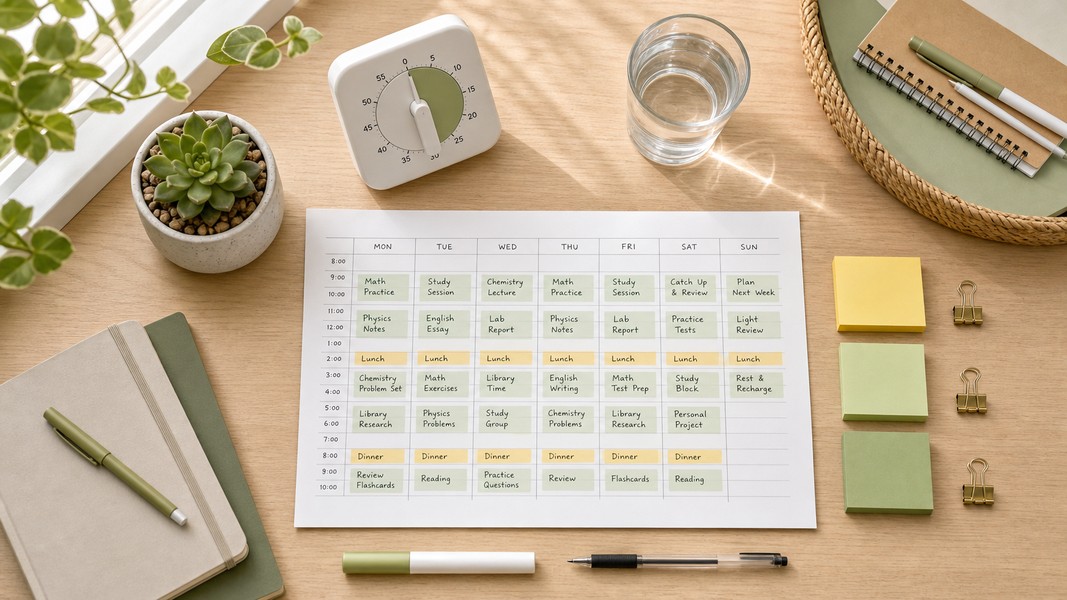
Struggling to manage your time as a student? These 7 evidence-backed tactics fix the real reasons students fall behind and waste hours.

Fathom AI is great for free Zoom notes, but it has real limits. Here are the best fathom ai alternatives for meetings, students, and multi-format capture.