
Fathom AI Alternatives: Best Note Takers Compared
July 21, 2026
Fathom AI is great for free Zoom notes, but it has real limits. Here are the best fathom ai alternatives for meetings, students, and multi-format capture.

July 22, 2026
Time management for students isn't really about planners or color-coded calendars. It's about understanding why your brain resists the work and building systems that remove those obstacles before they derail your day.
Most students already know they should study earlier and procrastinate less. Knowing isn't the problem. The problem is having no system that makes the right behavior easier than the wrong one. These seven student time management tactics address that gap.
Generic time management advice treats students like small professionals. "Block your time." "Prioritize ruthlessly." "Set goals."
That advice misses what's actually happening. Students face a specific combination of pressures: high cognitive load from complex material, constant context-switching between subjects, irregular schedules that shift weekly, and very little experience estimating how long academic tasks actually take.
Psychologists call this last problem the planning fallacy: the well-documented tendency to underestimate task duration even when you've been wrong the same way before. Kahneman and Tversky first identified this bias in the 1970s, and decades of follow-up research confirm it applies universally, with students consistently underestimating task completion time by significant margins. When your estimate collapses, the whole day collapses with it.
Most time management tactics also fail because they address symptoms rather than causes. Students who procrastinate don't need more motivation; they need reduced friction around starting. Students who feel overwhelmed don't need a longer to-do list; they need a clearer map of what actually matters today.
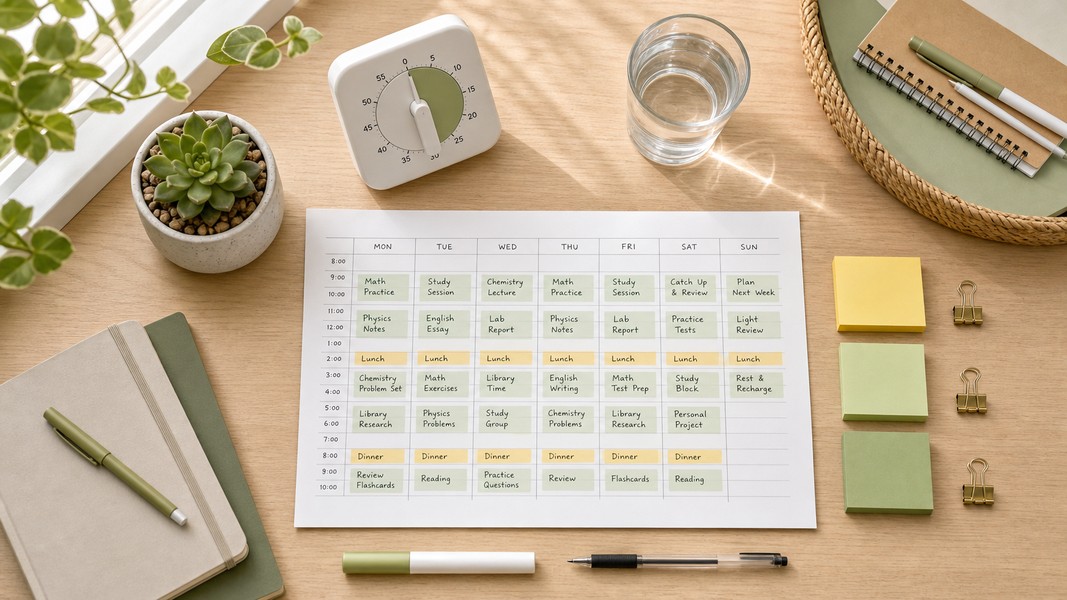
A to-do list tells you what to do. A time block tells you when you'll do it. That difference is enormous.
When you write "study bio chapter 7" on a task list, you've created an intention. When you write "study bio chapter 7, Tuesday 2-4pm," you've created a commitment backed by a concrete plan. Research consistently shows that implementation intentions, the if-then plans that specify when and where you'll act, dramatically increase follow-through compared to vague goals.
Time blocking works because it forces you to confront capacity limits directly. You only have so many usable hours in a day. When you assign tasks to specific slots, you quickly discover that your to-do list is two days of work crammed into one. That's uncomfortable to see, but it's far better than being surprised by it at 11pm.
Start with anchors: class times, sleep, meals. Then fill the remaining slots with study blocks before anything else. Protect those blocks like appointments you can't reschedule. Distractions feel less urgent when you can tell yourself "I'm handling that at 4pm" rather than trying to hold it in your head.
Not all deadlines are equal, and not all important work is urgent. Confusing the two is how students spend an entire afternoon on a low-stakes quiz while a major paper sits untouched.
The Eisenhower Matrix gives you a simple filter. Before you start each day, sort your pending work into four buckets: urgent and important, important but not urgent, urgent but not important, and neither. Most students live in the first bucket, constantly firefighting. The real gains come from spending more time in the second bucket, working on high-value tasks before they become urgent.
In practice, this means identifying one or two "depth tasks" per day: work that moves important projects forward and requires real cognitive effort. Schedule those in your best energy window, usually morning for most students, and handle administrative urgencies around them. A structured study schedule makes this easier to maintain across the whole semester, not just during exam season.
Every time you shift between different types of mental work, your brain pays a switching cost. Reading a complex paper, then answering emails, then working through problem sets, then writing an essay: each shift forces your brain to reload a different mental context. Research on multitasking costs shows that this constant switching significantly reduces the quality and efficiency of each task.
Batching means grouping similar tasks together to minimize those switches. Do all your reading in one block. Handle all short administrative tasks (replying to professors, updating your calendar, reviewing notes) in a separate shorter block. Write when you're in writing mode.
The gains are concrete. You get deeper into complex material without repeatedly warming up. Your comprehension improves when it's not constantly interrupted by context switches. And you'll notice that tasks take less total time when you're doing one type of cognitive work at a stretch rather than jumping between modes.
Long study sessions rarely produce proportional output. After 45-60 minutes of intense focus, cognitive performance degrades noticeably. Most students experience this as the "I'm reading but not absorbing anything" sensation that signals it's time to stop, not push through.
The Pomodoro Technique structures this naturally: 25 minutes of focused work, then a 5-minute break. After four cycles, take a longer break. The constraint isn't arbitrary; it's designed to match the brain's natural attention arc.
The key is treating the sprint as a complete unit. Before you start each 25-minute block, write one specific outcome you'll accomplish: "finish reading section 3.2 and write a 3-sentence summary." This makes the session measurable and gives you a clean stopping point. When you know the end is 25 minutes away, the urge to check your phone becomes much easier to ignore, because there's a defined moment of relief in sight.
One of the biggest time drains most students never notice is mental overhead: the background processing required to hold loose commitments, deadlines, and ideas in your head. Every unwritten task occupies working memory that should be available for learning.
The fix is a capture system with zero friction. The moment a professor mentions an assignment, the moment you think of a question you need to look up, the moment you realize you need to email someone: capture it immediately, in one trusted place. David Allen's Getting Things Done framework calls this the "open loop," and the research backing it is straightforward. Unclosed open loops create persistent cognitive load until they're externalized.
This is where a voice-first tool has a real advantage. Voice Memos lets you record any thought the instant it arrives, then automatically extracts tasks, events, and reminders from the recording. You don't have to type, switch apps, or remember to write it down later. You speak, the AI categorizes it, and your mental slate is clear.
The capture system only works if it's truly fast. If capturing a thought takes more than five seconds, you'll skip it. Find the method with the least resistance and use it consistently.
Daily execution is downstream of weekly planning. Students who only plan day-by-day are always reacting. Students who step back once a week to review the coming days avoid most deadline surprises entirely.
A weekly planning session takes 20-30 minutes, ideally on Sunday evening. Review what happened last week (what got done, what slipped and why), then preview the coming week. Note every deadline, class, and commitment. Assign study blocks in your time-blocked schedule for everything that needs attention. Identify the one or two most important outcomes for the week.
This practice exposes capacity problems early. If Thursday has three major assignments due, you see it on Sunday. You can redistribute the preparation work across earlier days instead of discovering the collision at 8pm on Wednesday. The weekly session is where reactive fire-fighting gets replaced by deliberate planning. Most students who try it report it changes how the whole week feels, not just how they schedule it.
Student time is increasingly eaten by tasks that are necessary but don't require real cognitive effort: re-reading notes to find one piece of information, rewriting messy lecture notes into something usable, creating flashcards from dense textbook passages, summarizing long readings to identify key concepts.
These tasks feel like studying, but they're largely mechanical. They consume hours that could go toward higher-value work: solving problems, writing, discussing ideas, testing your knowledge.
AI tools can handle most of this overhead. Voice Memos, for example, can take a voice recording of your lecture notes, transcribe them, structure them, and generate quiz questions or flashcards automatically. What would have taken 45 minutes of reprocessing after class takes a few seconds of capture during it. That reclaimed time goes back to actual learning.
Reserve your cognitive energy for the work AI can't do: understanding concepts, forming arguments, practicing problems, connecting ideas across subjects. Use AI to eliminate the overhead that drains you before you get there.
Most students who try one of these tactics in isolation see temporary gains and then drift back. The reason is simple: isolated tactics are fragile. One stressful week is enough to abandon a new habit when it's not integrated into a larger structure.
The tactics above work best when they build on each other. Time blocking gives you a structure. The priority matrix fills it with the right work. Batching makes execution more efficient. Sprints protect your focus within each block. Capture keeps your mental load low. Weekly planning maintains the whole thing over time. AI handles the overhead so the system stays sustainable.
Start with two: the weekly planning session and one capture method. Once those feel automatic (usually two to three weeks), layer in time blocking. Add batching next. Build gradually rather than overhauling everything at once. A system you actually use every week beats a perfect system you abandon after day four.
Good time management for students isn't about discipline or willpower. It's about designing your environment and workflow so that the productive choice is consistently the path of least resistance.
Discover more insights and tips to enhance your productivity
Fathom AI is great for free Zoom notes, but it has real limits. Here are the best fathom ai alternatives for meetings, students, and multi-format capture.

Learn what to include in a follow-up email after any meeting, when to send it, and how to write one that drives real action across every meeting type.

Cognitive load theory explains why some study methods overwhelm you. Learn the three load types and practical strategies to study more efficiently.