
Cognitive Load Theory: How It Shapes Better Learning
July 19, 2026
Cognitive load theory explains why some study methods overwhelm you. Learn the three load types and practical strategies to study more efficiently.


March 5, 2026
The problem with most ADHD study tips is that they were written for neurotypical brains. "Make a schedule." "Remove distractions." "Study in short bursts." These are fine ideas in theory, but they skip the root issue: ADHD isn't a focus problem you can solve with a timer.
Students with ADHD face real neurological challenges: working memory deficits that make it hard to hold information while taking notes, dopamine dysregulation that makes future deadlines feel unreal, and executive function gaps that turn "just start studying" into an impossible instruction. Around 16-17% of college students have ADHD, and they maintain GPAs roughly half a grade lower than peers on average, not because they're less capable, but because standard study methods work against their brain's wiring.
These nine ADHD study tips are different. Each one targets a specific neurological challenge and gives you a concrete workflow you can use today.
Most study advice assumes you can hold information in mind while taking notes, sustain motivation for distant rewards, and start tasks without external prompting. For ADHD brains, all three are genuinely difficult.
Working memory deficits are at the center of it. Research from Frontiers in Neuroscience confirms that students with ADHD show impairments across all working memory elements, with the most significant impact on the central executive system. This means that while a lecture is happening, your brain is spending most of its resources just trying to hold onto what was said two sentences ago.
Passive strategies like re-reading notes and highlighting don't require active recall, so they feel productive without actually encoding information. For ADHD students, they're especially ineffective: without active engagement, information exits working memory quickly. The strategies below replace passive review with systems designed to work with how your brain actually processes and retains information.
The single most effective change you can make is to stop relying on your working memory to hold lecture content while you're in class.
When you try to listen, understand, evaluate, and write notes simultaneously, you're asking four competing processes to share a limited mental workspace. For ADHD brains, that workspace is smaller than average. Dr. Russell Barkley's research describes working memory as the brain's GPS: when it's overwhelmed, you lose navigation entirely. The fix is externalization: get the information outside your brain immediately, so your brain doesn't have to hold it.
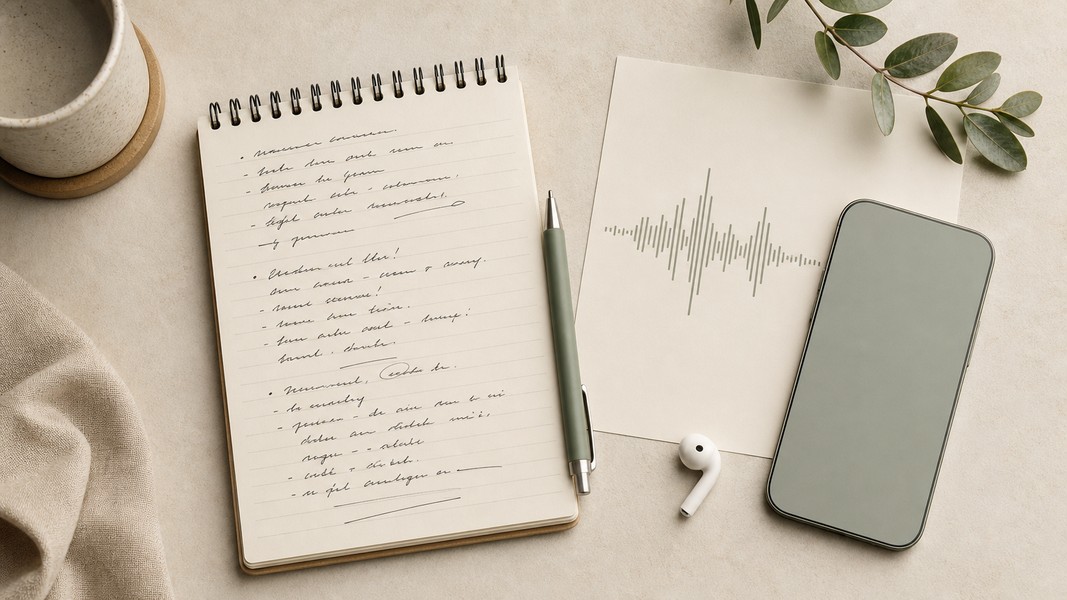
Record lectures. Record your own explanations after reading. Record a voice note the moment an idea surfaces. You can process, organize, and study from recordings later, but you can't recover information you never captured. The capture step should require zero effort, so you'll actually do it.
ADHD brains generate ideas constantly, often at inconvenient times: mid-lecture, mid-conversation, or at 11pm before bed. The problem isn't generating ideas; it's that without immediate capture, they're gone before you can act on them.
Deficits in verbal working memory, common in ADHD, mean that tasks requiring you to retain and process verbal information feel significantly harder than they do for neurotypical students. A thought that surfaces during a lecture competes with incoming information and loses. A thought at 11pm competes with sleep and usually loses.
The solution is a zero-friction capture system. Voice Memos lets you record a voice note, paste a document, or capture a photo in seconds, with AI that automatically organizes the content into structured notes, extracts tasks, and flags important information. You capture once; the app handles the organizing. This matters for ADHD because the more steps between "I have a thought" and "it's captured," the less likely you are to complete the capture.
Linear notes ask you to process information in a sequence. ADHD brains don't naturally work that way: they jump between ideas, connect concepts non-linearly, and get overwhelmed when one long list is the only navigation tool available.
Mind mapping is one of the best-studied organizational approaches for ADHD learners. A visual map places the central concept at the center and lets related ideas branch outward, which mirrors how ADHD cognition actually moves between topics. Research cited by Agave Health explains that mind maps reduce overwhelm by showing the big picture while allowing focus on one branch at a time, leveraging spatial memory rather than demanding linear recall.
Practically: after a class or a reading session, convert your notes into a mind map. Put the topic in the center. Branch out to main concepts. Branch again to supporting details, examples, and connections. The process of building the map is itself a form of active recall, and the result is a study tool you can actually navigate.
Voice Memos includes a built-in mind map mode that generates visual concept maps from your notes automatically, so you don't have to build them from scratch every time.
Flashcards are one of the most effective study tools for ADHD students, but only if you actually have them ready before the exam. The problem is the creation step: making flashcards from lecture notes takes time and executive function, which means most ADHD students skip it.
The workaround is to generate flashcards directly from your recordings and notes. After a lecture, let your notes or transcript feed into a flashcard generator. The concepts become cards. The definitions become answers. You didn't have to decide what to include, format anything, or manually type each entry.
Spaced repetition flashcards created from your own lecture content are more effective than pre-made decks because they reflect the exact phrasing and context you learned. They also reinforce the material in your voice, which helps auditory learners and students who benefit from self-referential encoding.
Re-reading is the most popular study technique and one of the least effective, especially for ADHD students. It feels like studying, but passive exposure without retrieval creates a false sense of familiarity without actual memory consolidation.
Active recall, the practice of retrieving information from memory rather than reading it again, consistently outperforms restudying in research. A Harvard study on active learning found that students who were tested on material retained more than students who reviewed it passively, even when the passive group felt more confident about their learning. For ADHD students, the immediate feedback from a correct answer also provides a small dopamine reward, which maintains engagement in a way that re-reading never does.
The most practical implementation is AI-generated quiz questions. Instead of creating the questions yourself (another executive function demand), have them generated automatically from your notes. You open a quiz, answer questions, see which areas need more review, and move on. The external structure of a quiz also reduces the decision overhead that often stops ADHD students from starting a study session in the first place.
Cramming works for ADHD students in the short term. The approaching deadline activates urgency, and urgency produces dopamine. But the information learned through cramming disappears quickly, and the stress of doing it damages focus and sleep quality, which further impairs the memory consolidation you need for exams.
Research consistently shows that spaced practice can be up to twice as effective for long-term memory encoding compared to cramming. The spacing effect works by reviewing information at increasing intervals: first after one day, then three days, then a week, then two weeks. Each review session strengthens the memory trace before it fully fades, which is exactly the opposite of what cramming does.
The challenge for ADHD students is that spaced repetition requires initiation on days when no exam is imminent. This is where time blindness becomes an obstacle: students with ADHD often experience time as either "now" or "not now," which makes a review session two weeks before an exam feel optional and abstract. The solution is to automate the scheduling so you don't rely on self-motivation to initiate it. Apps and tools that send review reminders at the right intervals convert a willpower problem into a notification response.
Body doubling is the practice of having another person present while you work, even if they're not helping with the task directly. It's one of the most consistently reported ADHD productivity strategies, and the research supports it.
ADHD support research confirms that the presence of another person provides external structure and accountability that compensates for the internal regulation systems ADHD brains struggle with. A study from the Cleveland Clinic confirms that body doubling helps people with ADHD maintain focus during tasks that they would otherwise abandon or postpone.
Body doubling doesn't require a study partner in the same room. Virtual body doubling works similarly: join a video call with someone who is also working, work silently alongside them for a set time, then check in briefly before the next block. The social presence activates enough accountability to change the start equation from "I don't feel like it" to "someone's expecting me to be working right now."
A significant source of lost time for ADHD students isn't distraction during studying; it's the organizational layer between studying and having study materials ready to use. After a lecture, before you can start reviewing, you need to find your notes, organize them, decide what to study, and create the materials. Each of those steps requires executive function, and for ADHD students, the overhead is often enough to derail the entire session.
The fix is to standardize the capture routine so it requires no decisions. The routine looks like: record the lecture, let the recording get transcribed and organized automatically, and end up with structured notes and study materials ready to use. No sorting step. No deciding what mattered. No formatting before you can study.
The ADDitude research on working memory and executive function explains that reducing decision points at the start of a task is one of the most effective interventions for ADHD productivity. A capture system that produces ready-to-use study materials with no manual processing step eliminates the friction that most often prevents ADHD students from studying consistently.
Voice Memos handles this for multi-modal input: record a voice note, upload a PDF, photograph handwritten notes, or paste a YouTube lecture URL. The AI transcribes, organizes, and tags the content automatically. You end each class with study materials, not raw recordings you need to process later.
Consistency is where ADHD study systems break down. You can capture everything, build flashcards, and schedule spaced reviews, but if the review system requires you to remember to use it, initiate it unprompted, and sustain it over weeks, it will fail. Not because of laziness, but because all three of those actions require executive function that ADHD brains deplete faster.
The goal is a review system that runs with minimum input from you. Flashcard apps with built-in spaced repetition scheduling send notifications when review is due. Study tools that generate quiz questions from your notes mean you're never waiting for the right materials before you can practice. The fewer decisions between "study time" and "actually studying," the more likely you are to maintain the habit.
This connects directly to the Feynman technique: the best measure of whether you've actually learned something is whether you can explain it from memory, not whether you've reviewed it. Building explanations into your review routine, even short ones you record as voice notes, tests your actual understanding rather than your recognition of familiar material.
These nine strategies are most effective when they work as a sequence, not as isolated tactics you try one at a time.
Capture immediately (Tip 1 and 2). Convert to visual and structured formats (Tip 3 and 4). Practice active retrieval instead of passive review (Tip 5 and 6). Add external accountability and structure (Tip 7 and 8). Automate the review loop so it doesn't require willpower to sustain (Tip 9).
The research on ADHD learning consistently points to the same underlying principle: effective study strategies for ADHD don't ask you to have better attention or stronger willpower. They design around the neurological realities of working memory limits, dopamine regulation, and executive function capacity. Each of these nine strategies reduces the cognitive overhead of studying, replaces internal demands with external structures, and creates more immediate feedback loops that keep the ADHD brain engaged. Start with one, build the habit, then layer in the next.
Discover more insights and tips to enhance your productivity
Cognitive load theory explains why some study methods overwhelm you. Learn the three load types and practical strategies to study more efficiently.

A complete one on one meeting template with agendas, discussion questions, and follow-up formats to help managers run more effective 1:1s.
The best voice notes app does more than record. Compare top AI-powered picks for students and professionals, including transcription, summaries, and study tools.