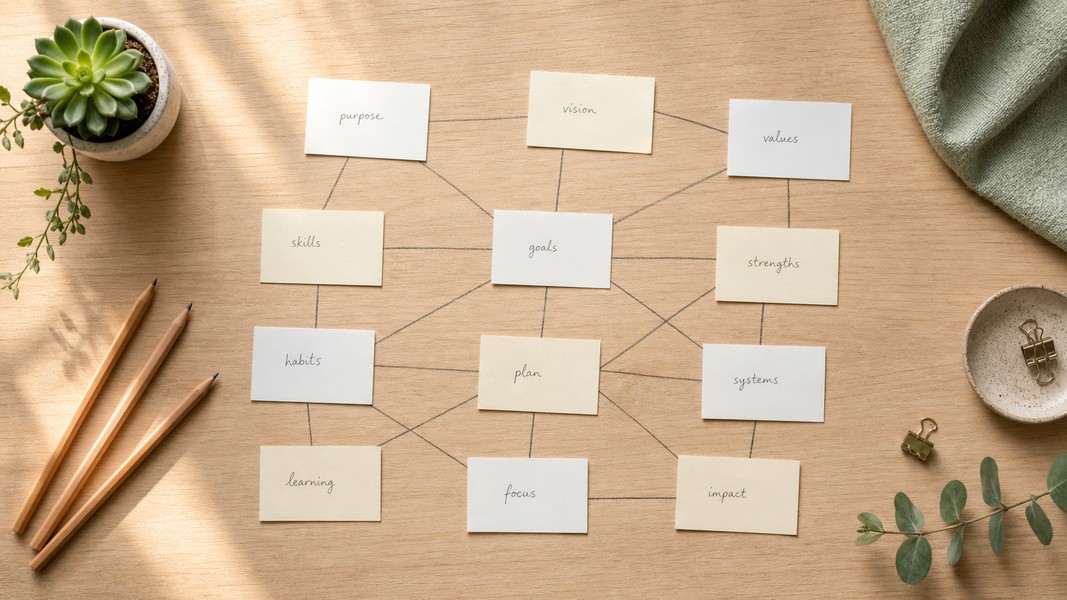
Zettelkasten: How to Build a Knowledge System
July 24, 2026
Learn how the Zettelkasten method works, why linked notes beat linear notebooks, and how to build your own knowledge system from scratch.


May 20, 2026
To create flashcards free, you have three options: handwritten index cards, free digital tools like Quizlet or Anki, or AI apps that generate cards automatically from your notes, PDFs, or recordings. Each method works. The best choice depends on how you study, what material you're covering, and how much time you want to spend making the cards.
This guide walks you through all three, and covers the card design rules that actually determine whether your flashcards help you remember.
Flashcards work because they force you to pull information out of memory instead of just looking at it. That mental effort is called retrieval practice, and it produces significantly better retention than rereading or highlighting.
In a landmark study, students who tested themselves on material remembered 61% of it a week later, while those who only reread the text remembered around 40%, a substantial gap from the same study time, according to Roediger and Karpicke. A comprehensive review of ten common study techniques by Dunlosky et al. rated practice testing as highly effective, while rereading and highlighting were rated as having low utility.
The second reason flashcards outperform other methods is spaced repetition: reviewing cards at increasing intervals, right before you would naturally forget them. Research on distributed practice has found that spaced review can roughly double long-term retention compared to massed review in a single session. Most digital flashcard tools now build this scheduling in automatically.
What most students get wrong is the card itself. Putting too much on one card, copying text verbatim, or reviewing in the same order every time neutralizes the benefit. The methods below show you how to avoid these traps.
The simplest way to create flashcards free is with index cards or cut paper. Nothing else is required.
The single most important rule: put a question or prompt on the front, not just a term or heading. The back holds the answer. A question forces your brain to retrieve something; a bare term invites passive recognition instead.
Good front: "What is the derivative of sin(x)?" Bad front: "sin(x) derivative"
The first forces recall. The second lets you guess by visual pattern.
Beyond the question format, three other practices improve the cards you make by hand. Keep one concept per card. If the answer takes more than two sentences, split the card. One idea per card gives you clean feedback: you know something or you don't, with no ambiguous "I kind of got it."
Use color coding for organization. Blue for formulas, green for definitions, red for exceptions. The visual cue helps memory and makes sorting faster.
Build in spaced practice with a simple three-box system (the Leitner method). Box 1 holds cards you get wrong, reviewed daily. Box 2 holds cards you get right occasionally, reviewed every two to three days. Box 3 holds cards you know well, reviewed weekly. Move cards up when you answer correctly, back when you miss. This low-tech system approximates what spaced repetition software does automatically.
When you're working from Cornell notes, your review column already contains the prompts. The left-side questions become card fronts; the corresponding notes become card backs. This makes converting notes to flashcards fast without starting from scratch. You already did the hard thinking in class; the cards just formalize it.
If you want digital cards you can study on your phone, two tools stand out from the free options.
Quizlet is the easiest starting point. Sign up free, click "Create," enter terms and definitions, and your deck is ready in minutes. You can paste in text from your notes, which speeds up card creation significantly. The free plan gives you flashcard mode, learn mode, and match mode, which is enough for most subjects. Quizlet also has an enormous library of shared public sets, though the quality varies considerably; creating your own cards typically produces better learning than using someone else's.
Anki is more powerful and completely free on desktop and Android (the iOS app has a one-time purchase cost). Its spaced repetition algorithm schedules each card individually based on how you rated your recall. Hard cards come back sooner; easy ones are shown less often. Medical and law students use it heavily because it's built for long-term retention over months or years, not just the next exam. The trade-off is a steeper learning curve and an interface that feels dated compared to modern apps.
A practical approach: use Quizlet for short-term exam prep when you need decks quickly. Move to Anki if you're building knowledge you need to retain over a long period. Both are genuinely free to start, with no commitment required.
If you already use Voice Memos to record lectures or process PDFs, it generates flashcard decks directly from your captured content with spaced repetition already included. No need to switch between apps or manually re-enter what you've already recorded.
AI flashcard generators take your existing study material and identify the key concepts, terms, and relationships worth testing on. You provide the content; the AI writes the cards.
The typical workflow: upload a PDF or paste in your notes, choose your focus (definitions, conceptual questions, formulas), and the tool outputs question-answer pairs within seconds. A chapter that would take 45 minutes to card manually is done in under a minute.
The main limitation is quality control. AI-generated decks tend to include too many low-value cards on minor details, and the wording can miss the nuance your professor emphasized. Treat AI output as a first draft: delete anything trivial, rewrite key cards in your own phrasing, and add extra cards for the specific points that come up on your exams.
What separates useful AI tools is the range of inputs they accept. Some work only from pasted text; others handle PDFs, images of handwritten notes, or YouTube transcripts. Voice Memos accepts all of these input types. You can feed in a lecture recording, a textbook PDF, a scanned notebook page, or a YouTube link, and the app generates a flashcard deck with spaced repetition already scheduled, no extra setup required.
For a comparison of the top AI-powered options, the AI flashcard generators guide covers the major tools and where each works best.
The format you use to create flashcards matters less than the quality of each card. These rules apply whether you're writing by hand, typing in Quizlet, or editing AI-generated output.
One concept per card. This is the most consequential rule. When a card tests multiple things, you can't identify exactly what you know and don't know. Split anything that requires more than two sentences to answer.
Write answers in your own words. Research on the generation effect shows that self-generated text is retained better than copied text. If you're working from AI-generated cards or direct textbook definitions, edit the wording so it sounds like you explaining it to a classmate. Even small changes activate deeper processing.
Use questions, not statements, on the front. "What does homeostasis maintain in the body?" demands active recall. "Homeostasis" or "Homeostasis: definition" invites recognition instead of retrieval. The extra words on the front are worth it.
Keep answers short. If you dread flipping a card because the back is dense, split the card. Concise answers also make self-grading cleaner: a long back lets you rationalize partial credit.
Add visual anchors for complex material. A labeled diagram on the back of an anatomy card beats a paragraph of text. A mnemonic encodes a list into something retrievable. "King Philip Came Over For Good Spaghetti" for taxonomic ranks takes two seconds to recall; the list from memory takes effort without it.
Mix topics in each study session. Reviewing all your chemistry cards, then all your history cards, then all your biology cards is a form of blocked practice. Your brain starts pattern-matching the sequence rather than genuinely retrieving. Shuffle your deck, or combine cards from different subjects in a single session. Research on interleaved practice consistently shows it produces stronger long-term retention than blocked topic-by-topic review, even when it feels less efficient in the moment.
Flashcards work because they turn passive review into active recall, and when you space that recall over time, the retention compounds. Whether you make them by hand on index cards, build decks in Quizlet or Anki, or use an AI tool to generate a first draft from your notes and recordings, the core principle stays the same. The quality of each card determines the outcome more than the tool you use to create it. One concept per card, a question on the front, and answers in your own words: that combination does most of the work.
Discover more insights and tips to enhance your productivity
Learn how the Zettelkasten method works, why linked notes beat linear notebooks, and how to build your own knowledge system from scratch.
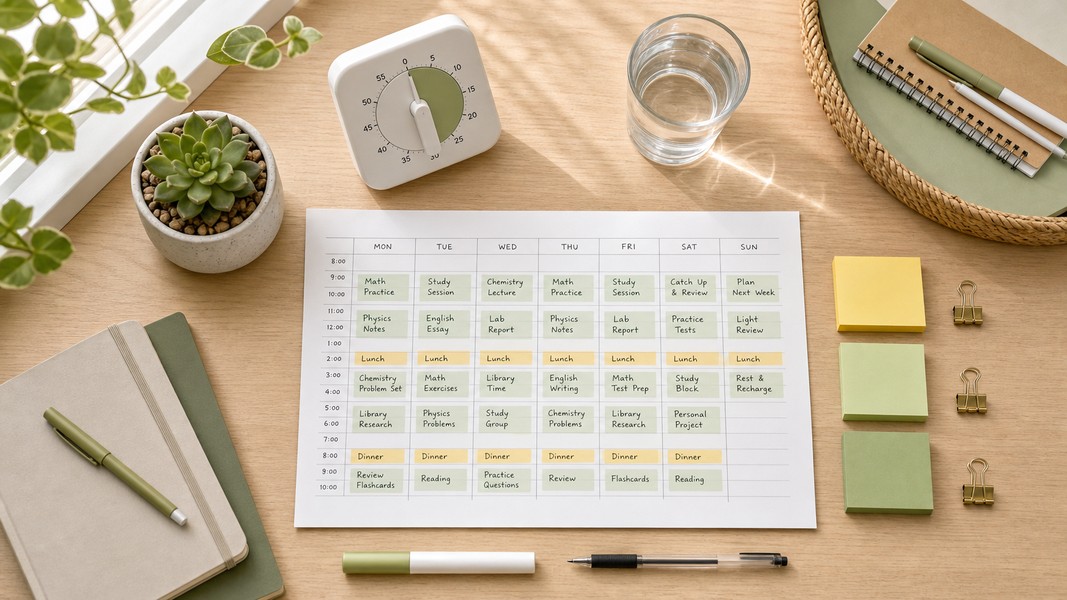
Struggling to manage your time as a student? These 7 evidence-backed tactics fix the real reasons students fall behind and waste hours.
Fathom AI is great for free Zoom notes, but it has real limits. Here are the best fathom ai alternatives for meetings, students, and multi-format capture.