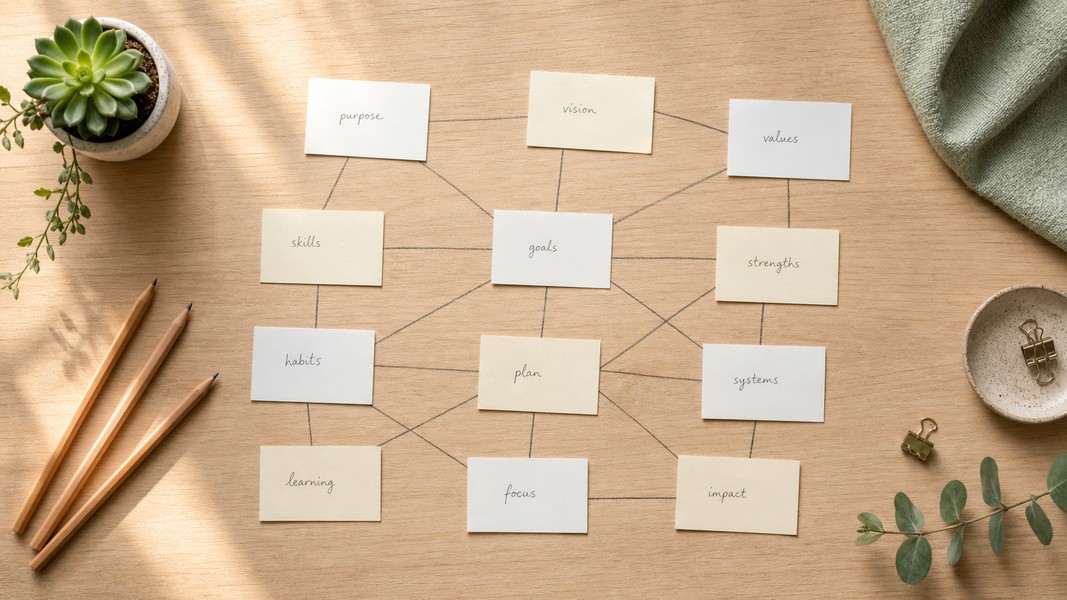
Zettelkasten: How to Build a Knowledge System
July 24, 2026
Learn how the Zettelkasten method works, why linked notes beat linear notebooks, and how to build your own knowledge system from scratch.

May 18, 2026
A graphic organizer is a visual tool that arranges information using shapes, lines, and spatial layout instead of plain text. Instead of working through dense paragraphs, you map ideas into a format your brain can scan and process at a glance.
Graphic organizers appear across nearly every academic subject: Venn diagrams for comparison in English class, flowcharts in math, timelines in history, concept maps in biology. Once you understand the core types and when to use each one, you can match the right format to any assignment and work through material more efficiently.
This guide covers what graphic organizers are, the eight most useful types with concrete student examples, how to choose the right one, how to build one from scratch, and how to make them genuinely useful as a study habit.
A graphic organizer is any visual structure that helps you organize, connect, and display information. The key word is visual: the layout itself carries meaning. An arrow shows direction or cause. Overlapping circles show shared traits. Branching lines show hierarchy or subtopics.
They work because of how the brain learns. Schema theory explains that new information sticks when it connects to mental frameworks you already have. Graphic organizers make those connections explicit by placing them on the page. Dual coding theory adds another layer: combining words with a visual structure encodes information both verbally and visually, which improves understanding and long-term retention compared to text notes alone.
Research consistently shows that students who use graphic organizers demonstrate better comprehension and recall, especially for expository texts and topics with many interrelated concepts. They also reduce cognitive load for students with learning differences and make implicit relationships explicit for English language learners.
You can use them at any stage of studying. Before a reading, a KWL chart activates prior knowledge and sets focused questions. During a lecture, a concept map or T-chart captures information in organized form rather than a wall of bullet points. Before an exam, converting chapter notes into a graphic organizer is an active retrieval exercise that also creates a compact study sheet.
Voice Memos includes a mind map feature that builds visual maps automatically from your notes and voice recordings, so you can capture a lecture first and organize it visually afterward without redoing the work.
A Venn diagram uses overlapping circles to show similarities and differences. The overlap contains shared traits; the outer sections contain distinctions.
Best for compare-and-contrast tasks across any subject. In English class, compare two characters or texts. In history, compare the causes of two events. In math, classify sets of numbers, placing shared properties (like "natural numbers") in the overlapping area.
A two-circle Venn covers most student tasks. For three-way comparisons, a three-circle version adds a shared center zone.
A T-chart splits a page into two labeled columns under a horizontal bar, simple, fast, and easy to fill in.
Best for sorting information into two categories: pros vs. cons, for vs. against, facts vs. opinions, examples vs. non-examples. It's one of the most practical organizers for essay prep because it forces you to organize evidence on both sides before you write.
For more complex arguments, extend the T to three columns: claim, evidence, and reasoning.
A flowchart traces a process from start to finish using boxes (steps) and diamonds (decision points) connected by arrows. It shows sequence and branching logic.
Best for multi-step procedures, problem-solving, and scientific processes. In math, a flowchart for solving a multi-step equation keeps every step visible and ordered. In science, the scientific method maps cleanly to a flowchart. In computer science, it's essential for planning an algorithm before writing code.
Decision trees are a related format that emphasize branching choices over linear sequence.
A mind map starts with a central idea and branches outward, each branch representing a subtopic and its details. Unlike a flowchart, it's non-linear: you can add ideas anywhere without committing to order first.
Best for brainstorming, essay planning, and reviewing large amounts of material before an exam. Place the subject name in the center and branch to each unit for a full course overview. Place your thesis in the center and branch to supporting arguments when drafting an essay.
Voice Memos can generate mind maps directly from audio recordings or uploaded PDFs, which makes it straightforward to turn a recorded lecture or reading into a visual overview you can explore and expand. A dedicated guide to mind mapping for students covers the technique and research in more depth.
A concept map places concepts in labeled boxes or circles, connected by lines with relationship labels: "causes," "leads to," "is a type of," "depends on." It's more structured than a mind map and forces you to think carefully about how ideas actually connect.
Best for theory-heavy subjects where relationships between ideas matter: biology, psychology, economics, philosophy. A concept map for a biology chapter might show "cell" connected to "organelles," with each organelle connected to its function.
The key difference from a mind map: concept maps label the relationship between nodes, not just the connection. That extra step deepens understanding. See how concept maps work for a full walkthrough of the format.
A fishbone diagram (also called an Ishikawa diagram) places the main effect at the right side of the page, with categories of causes branching off a central horizontal line like the bones of a fish. Sub-causes attach to each branch.
Best for analyzing why a complex event happened. In history, it maps multiple categories of causes for a major event. In science, it diagrams possible sources of experimental error. In health sciences, it breaks down contributing factors to a public health problem.
For simpler tasks, a two-column cause-and-effect chart, with causes on the left and effects on the right, handles most student use cases without the complexity.
A timeline arranges events in chronological order along a horizontal line with dates and brief descriptions. A story map applies the same sequencing logic to narrative structure: exposition, rising action, climax, falling action, and resolution.
Best for history, literature, and any science process with clear stages: mitosis, the water cycle, geological eras. Story maps are particularly useful for literary analysis because they require you to actively identify structure rather than passively read for plot.
For non-narrative sequences, like a lab procedure or a cooking process, a simple numbered box chart communicates the same information without the narrative framing.
A KWL chart has three columns: K (what I Know), W (what I Want to know), and L (what I Learned). You fill in K and W before studying and complete L afterward.
Best for activating prior knowledge before a new topic, setting focused learning questions, and reinforcing what you covered after a lecture or reading. The W column is especially useful because it converts passive reading into targeted searching: your W questions become your focus during study.
A variant is the KWLH chart, which adds a fourth column, How I'll find out, useful when planning a research project rather than reviewing assigned material.
Identify your goal before choosing a format.
Comparing or classifying two things? Start with a Venn diagram or T-chart. Showing steps in a process? Use a flowchart or timeline. Brainstorming without a predetermined structure? A mind map. Exploring how ideas connect within a topic? A concept map. Analyzing why something happened? A fishbone diagram. Setting up a reading or research task? KWL chart.
For quick homework and note-taking, simpler formats win. T-charts, basic webs, and KWL charts are fast to set up and hard to overthink. For major projects and exam review, invest in richer structures like concept maps and detailed mind maps that can hold more information.
Don't overthink the selection. A less-than-perfect organizer you complete is worth far more than the ideal format you spend twenty minutes choosing.
Sketch the structure first: overlapping circles for a Venn, a horizontal and vertical line for a T-chart, a central spine for a fishbone. Leave room between nodes for content.
Use keywords and short phrases instead of full sentences. One idea per shape or box. For concept maps, label every connecting line: "causes," "results in," or "is a type of" all work. Add arrows to show direction where sequence matters.
Use color as a functional cue, not decoration. Red for causes, blue for effects, or different colors per unit in a mind map. Color-coded organizers are faster to review under exam pressure.
Revise freely. Cross things out, draw arrows to move ideas, add branches. The point of a hand-drawn organizer is speed and flexibility.
Digital tools remove the friction of erasing and redrawing. MindMeister offers templates for mind maps and visual organizers you can customize for any subject or assignment. Creately provides editable templates for Venn diagrams, T-charts, flowcharts, concept maps, and comparison matrices, many with classroom-ready examples. Google Docs and Google Slides support shape-based organizers through their drawing tools, which is useful for submitting assignments or sharing with group members.
For word processors, Microsoft Word's SmartArt covers flowcharts, hierarchies, and cycles with minimal setup. You can add text boxes for labels and use the Format panel to adjust colors and line styles.
If you use Google Drawings, it integrates directly with Docs and Slides, which simplifies collaboration. Voice Memos supports the workflow from the input side: upload a PDF, paste a YouTube link, or record a voice note, and the app processes it into structured notes you can then build a graphic organizer from.
Match the format to the task. Before starting, decide: am I comparing, sequencing, brainstorming, or analyzing causes? The answer drives which organizer to use. A mismatched format creates friction without the comprehension benefit.
Keep it visual, not verbal. If your organizer is mostly full sentences, it's a rewritten outline, not a graphic organizer. Push yourself toward keywords, symbols, and short phrases. The visual structure should carry most of the meaning; the words fill in the specifics.
Integrate organizers into your existing workflow instead of treating them as extra work. Spend three minutes with a KWL chart before a reading. Dump ideas into a mind map before outlining an essay. Convert chapter notes into a concept map per section before an exam. Each of these takes less time than it saves.
Revisit and revise. Each time you update an organizer as your understanding deepens, you re-encode the material and strengthen recall. Digital tools make this cost-free because moving nodes requires no redrawing.
For group projects, a shared digital organizer aligns everyone on structure before anyone starts writing. Assign each person a branch or section, review the full map together, then proceed to individual work. This reduces duplicate effort and catches gaps early.
A graphic organizer is one of the most practical tools for making complex information visible and manageable. The eight types covered here handle most academic situations: Venn diagrams and T-charts for comparison, flowcharts and timelines for sequence, mind maps and concept maps for relationships and structure, cause-and-effect diagrams for analysis, and KWL charts for reading and research.
The core skill is matching format to task. Pick a structure that fits what you're trying to do, keep content concise, and update the organizer as your understanding develops. That habit, applied consistently, turns graphic organizers from a classroom exercise into a durable study tool.
Discover more insights and tips to enhance your productivity
Learn how the Zettelkasten method works, why linked notes beat linear notebooks, and how to build your own knowledge system from scratch.
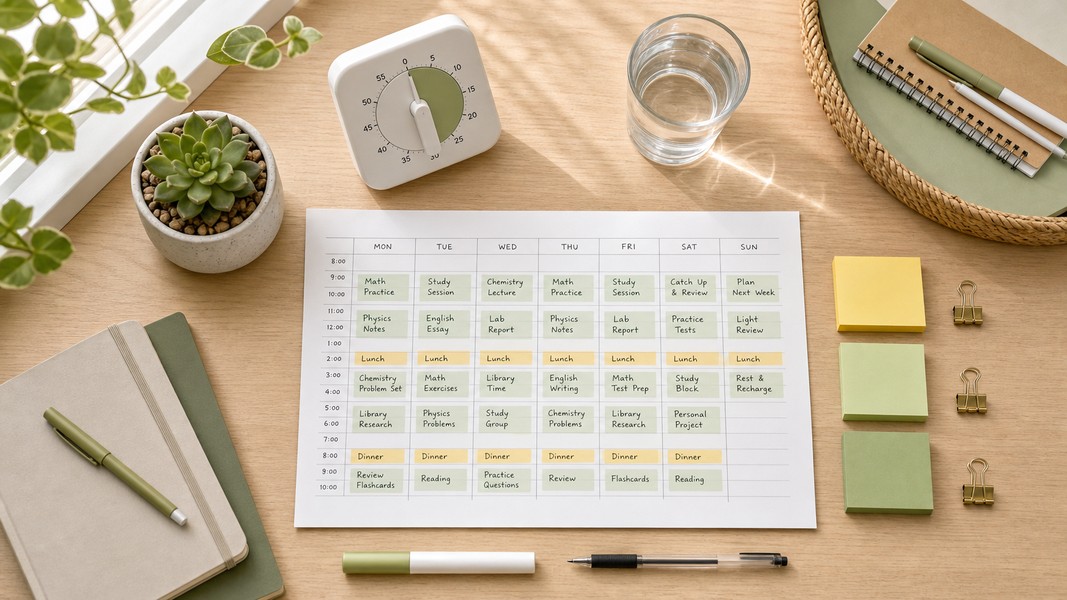
Struggling to manage your time as a student? These 7 evidence-backed tactics fix the real reasons students fall behind and waste hours.

Fathom AI is great for free Zoom notes, but it has real limits. Here are the best fathom ai alternatives for meetings, students, and multi-format capture.