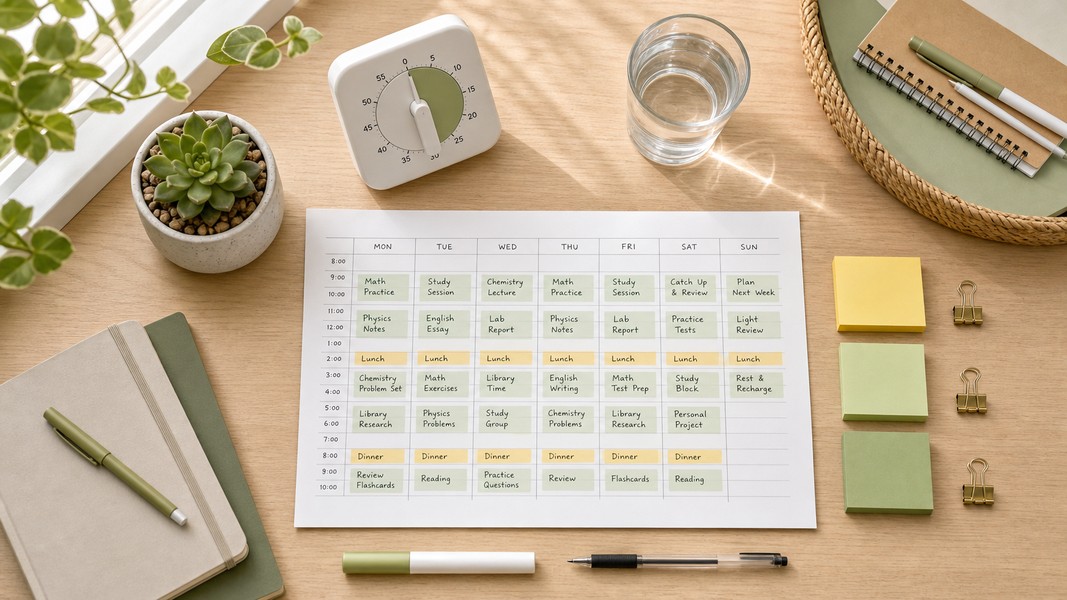
Time Management for Students: 7 Tactics That Work
July 22, 2026
Struggling to manage your time as a student? These 7 evidence-backed tactics fix the real reasons students fall behind and waste hours.


April 24, 2026
Bloom's Taxonomy is a hierarchical framework that classifies learning into six cognitive levels, from basic recall to complex creation. Originally developed by educational psychologist Benjamin Bloom in 1956, it gives students and educators a shared vocabulary for describing what learning actually requires. For students, it's one of the most practical tools available for understanding what an exam is testing and how to direct study effort accordingly.
If you've ever spent hours memorizing definitions only to struggle on an essay question, Bloom's Taxonomy explains exactly why that happens. The verbs in your assignment prompts, the structure of your exam questions, and the cognitive demand of different study methods all map directly onto this framework. Understanding it lets you read those signals clearly.
This guide covers the full revised taxonomy: all six levels, the action verbs that signal each one, how to match study methods to cognitive demands, subject-specific examples across disciplines, and how modern AI tools align with different levels of the hierarchy.
Bloom's Taxonomy is a classification system for educational objectives, organized into a hierarchy of cognitive complexity. At the bottom are simple recall tasks. At the top are original, generative thinking tasks. The framework was designed to give educators and students a shared language for describing what learning at different levels actually looks like.
Benjamin Bloom was a professor of education at the University of Chicago. In the late 1940s and early 1950s, he convened a committee of educational psychologists to address a persistent problem: educators at different institutions described learning goals using completely different language, making it nearly impossible to compare assessments or share curriculum materials across schools.
The committee's solution was published in 1956 as "Taxonomy of Educational Objectives: Handbook I: Cognitive Domain." The original taxonomy organized cognitive learning into six noun-based categories: Knowledge, Comprehension, Application, Analysis, Synthesis, and Evaluation. Each level was intended to be more complex than the previous one, so mastering lower levels was assumed to be a prerequisite for higher-level thinking.
The framework spread quickly through education and became one of the most widely used tools in curriculum design. Instructors used it to write clearer learning objectives. Test designers used it to calibrate question difficulty. Students began using it to understand what was expected of them.
The original taxonomy remained largely unchanged for more than four decades. In 2001, educational researchers Lorin Anderson and David Krathwohl published a substantially revised version that addressed several limitations of the original.
The most visible change was a shift from nouns to action verbs. The renamed levels in the revised taxonomy are Remember, Understand, Apply, Analyze, Evaluate, and Create. This shift made the framework feel more dynamic, reflecting the view that learning is an active process rather than a static state.
The second major change was the reordering of the two highest levels. In the original taxonomy, Synthesis (assembling parts into a new whole) was below Evaluation (making judgments about value). The 2001 revision moved Create to the top, reflecting an emerging consensus that generative thinking represents the most demanding cognitive work.
The revision also introduced a two-dimensional framework. Where the original taxonomy was a single list of six levels, the revised version separated cognitive processes from types of knowledge: factual, conceptual, procedural, and metacognitive. This made it possible to describe more precisely what a learning objective requires, combining a cognitive level (e.g., Analyze) with a knowledge type (e.g., conceptual knowledge).
For students, the practical impact of the revision is mostly felt in the verb shift. The six action verbs in the revised taxonomy map directly to the verbs you'll find in exam questions and assignment descriptions, making the framework immediately useful for exam preparation.
Each level of the revised taxonomy describes a different type of cognitive work. They're arranged from lower-order thinking at the bottom to higher-order thinking at the top. Understanding what each level demands is the first step to matching your study effort to the actual requirements of your assessments.
Remember is the foundation level. Students operating here retrieve specific facts, definitions, dates, formulas, or sequences from memory. There's no interpretation, no application, and no judgment: just accurate retrieval.
This is the level that most traditional memorization techniques target. Reviewing flashcards, reading summaries, and reciting formulas all build Remember-level competence. It's the necessary starting point, but it's also where students who underperform often stop.
The key signal of a Remember-level question is a verb like "define," "list," "name," "state," "identify," or "recall." A question asking you to "name the bones of the human hand" or "list the causes of World War I as discussed in lecture" is testing at the Remember level.
Remember-level knowledge is necessary but rarely sufficient. An exam made entirely of Remember-level questions is testing whether you showed up and paid attention. Most university-level assessments require much more.
Understand is the level at which students start to make sense of what they've memorized. It involves interpreting, summarizing, classifying, explaining, and drawing connections between ideas.
A student who has memorized a definition is working at the Remember level. A student who can paraphrase that definition in their own words, explain why it matters, and give a novel example is working at the Understand level. The difference matters enormously for exam performance.
Teaching the material to someone else is one of the most reliable ways to develop Understand-level competence. When you try to explain a concept clearly to someone who doesn't know it, gaps in your understanding surface immediately. This is the core mechanism behind the Feynman Technique, which uses deliberate explanation as a diagnostic and learning tool.
Key verbs at this level include: explain, summarize, describe, interpret, classify, discuss, illustrate, and paraphrase.
Apply is where students take knowledge from the context where they learned it and use it in a new context. Solving a math problem you haven't seen before, writing code to solve a new problem using a familiar algorithm, or diagnosing a patient with a condition you've only seen in a textbook: all of these are Apply-level tasks.
The defining characteristic of Apply-level thinking is transfer. You can't Apply what you only Remember. The knowledge has to be understood well enough to be used in an unfamiliar situation, which is why students who only memorize formulas without understanding them tend to struggle on application problems.
Practice problems are the most effective tool at this level. Working through large numbers of varied problems in slightly different contexts is what builds the Apply-level competence that engineering, science, and math courses rely on. The same principle applies in case-based courses like law and medicine, where applying legal rules or clinical frameworks to new fact patterns is the core skill.
Key verbs at the Apply level include: solve, demonstrate, apply, calculate, show, use, execute, and illustrate.
Analyze is the level at which students break down complex material into its component parts and examine how those parts relate to each other and to the whole. Comparing and contrasting, identifying patterns, examining cause-and-effect relationships, and drawing inferences are all Analyze-level activities.
Analysis requires holding multiple ideas in mind simultaneously and reasoning about their relationships. It's the level at which critical thinking begins in earnest. A student who can accurately summarize an argument is working at the Understand level. A student who can identify the unstated assumptions behind that argument, recognize where the evidence is weakest, and explain why the logical structure holds or fails is working at the Analyze level.
Exam questions at this level often take the form of case studies, compare-and-contrast essays, or prompts that ask you to explain why something happened or how two concepts are related. Verbs to watch for include: compare, contrast, distinguish, examine, differentiate, categorize, infer, and identify patterns.
One practical study habit for developing Analyze-level skills: after reviewing material, create a list of "how" and "why" questions and write out your answers. Don't just ask "what is X": ask "why does X happen" and "how does X relate to Y." Forcing yourself to answer these questions in writing is more demanding than highlighting text, and it builds the kind of deep understanding that Analyze-level assessments test.
Evaluate is the level at which students make judgments based on criteria and evidence. Critiquing an argument, assessing the quality of a solution, defending a position, and recommending a course of action are all Evaluate-level tasks.
This is the level at which most academic writing operates. An argumentative essay requires you to judge the strength of competing claims and defend a position with evidence. A case brief requires you to assess whether a legal argument is persuasive. A lab report discussion section requires you to evaluate whether your results support or contradict the hypothesis.
Studying for Evaluate-level work means spending time forming and defending opinions on the material. You need to be comfortable saying "I think X is the stronger explanation because..." and backing that up with specific evidence. Practice writing short argumentative pieces, anticipate the strongest objections to your position, and develop the habit of justifying your conclusions explicitly.
Key Evaluate-level verbs include: judge, critique, assess, defend, justify, argue, prioritize, and recommend.
Create sits at the top of the taxonomy and involves synthesizing elements into something original that didn't exist before. Designing an experiment, developing a hypothesis, constructing a model, writing an original analysis, or producing a novel solution to a problem: these are all Create-level tasks.
Create-level work requires drawing on all five lower levels simultaneously. You need foundational knowledge (Remember), conceptual understanding (Understand), the ability to apply relevant frameworks (Apply), skills for examining relationships (Analyze), and judgment about which approaches are worth pursuing (Evaluate) before you can produce anything genuinely new.
This is why major projects, dissertations, and capstone assignments tend to be demanding: they're testing all six levels of the taxonomy at once, not just one. Students who have only developed lower-order skills feel overwhelmed by Create-level tasks not because they lack intelligence, but because they haven't built the layered competence that creation requires.
Key Create-level verbs include: design, construct, develop, invent, produce, formulate, compose, and hypothesize.
The action verbs in exam questions and assignment prompts are one of the most reliable signals of what cognitive level you're being tested at. Learning to read them before you study is a genuinely useful skill.
Below is a comprehensive list of verbs organized by level, drawn from the Iowa State CELT framework. Scan this list when you receive a new assignment or review past papers. The verb tells you not just what to do, but how deeply you need to understand the material.
Remember level: define, list, recall, name, identify, state, match, recognize, reproduce, repeat, select, label, memorize.
Understand level: explain, summarize, describe, interpret, classify, discuss, paraphrase, translate, convert, distinguish, estimate, generalize, give examples, restate.
Apply level: apply, solve, demonstrate, calculate, show, use, illustrate, execute, implement, compute, construct, modify, prepare, produce, relate, sketch.
Analyze level: analyze, compare, contrast, distinguish, examine, differentiate, categorize, infer, outline, separate, break down, investigate, question, test, attribute.
Evaluate level: evaluate, judge, critique, assess, defend, justify, argue, prioritize, recommend, rate, support, measure, select, verify, appraise.
Create level: design, construct, develop, invent, produce, formulate, compose, hypothesize, plan, assemble, create, generate, synthesize, devise, imagine.
The most common exam mistake is misreading the cognitive level. A student who prepares "define" when the question asks "evaluate" will produce an accurate but incomplete answer. A student who tries to "argue" when the question asks "describe" will write too much and answer the wrong question. Reading the verb carefully before writing saves time and earns points.
One habit worth developing: the moment you sit down to an exam, underline or circle the key verb in every question before you answer any of them. This primes your thinking for the appropriate cognitive mode and prevents the common error of answering at the wrong level.
The taxonomy becomes a practical study tool when you use it to diagnose where your current understanding sits and identify what type of work will move you to the next level.
Build foundational knowledge first. Using spaced repetition for definitions, formulas, and key terms frees up cognitive space for the analytical work that determines final grades. You can't analyze what you don't understand, and you can't understand what you haven't remembered.
Once Remember-level knowledge feels solid, shift to Understand-level activities: rewriting definitions in your own words, explaining concepts aloud, drawing diagrams that show relationships between ideas. The goal is to stop treating the material as something to be stored and start treating it as something to be understood.
Different study methods are more effective at different levels of the taxonomy. This matters because students often apply lower-order methods to higher-order assessments and wonder why their performance doesn't improve.
For Remember and Understand: flashcards, summary sheets, concept maps, re-reading annotated notes, and explaining concepts to study partners.
For Apply: practice problems, worked examples, case study walkthroughs, and simulations.
For Analyze and Evaluate: compare-and-contrast writing, debate preparation, case study analysis, argumentative essays, and structured note-taking that explicitly asks "why" and "how" questions.
For Create: independent projects, original writing, design exercises, and tasks that ask you to synthesize ideas from different sources into something new.
Before studying for a specific exam, collect past papers and analyze the verb distribution across questions. An assessment that predominantly uses Remember and Understand verbs is fundamentally different to study for than one that emphasizes Analyze and Evaluate verbs.
This takes about 15-20 minutes and can completely change how you allocate your study time. If 70% of marks in a past paper come from questions using Analyze or Evaluate verbs, spending most of your study time on flashcards is a poor return on effort.
Active recall techniques like practice testing and teaching are especially effective because they force you to produce knowledge rather than passively recognize it. But you can make them even more effective by calibrating the level of recall you're practicing.
Start with Remember-level self-testing: cover your notes and try to list key concepts from memory. Once that feels comfortable, shift to Understand-level self-testing: close your notes and write a paragraph explaining the concept in your own words. Then move to Apply-level testing: work a practice problem without looking at examples. Proceeding systematically through the levels ensures you're actually ready for higher-order assessment, not just comfortable with the material at a surface level.
Understanding how the taxonomy applies in your specific discipline makes it more concrete. The same hierarchical logic holds across every subject, but the tasks at each level look very different depending on the field.
At the Remember level, a question asks you to state the sine, cosine, and tangent ratios. At the Understand level, you'd explain the relationship between the unit circle and trigonometric functions. Apply-level work means solving numerical problems using trigonometric ratios in an unfamiliar context. An Analyze question might ask you to compare two different methods for solving a trigonometric equation and identify which is more efficient for a given type of problem. At the Evaluate level, you'd assess which method produces a correct solution and justify your reasoning. A Create-level task might ask you to model a real-world physical system using trigonometric relationships.
Remember: List the key figures and dates of the American Civil War. Understand: Explain the economic factors that drove Southern secession. Apply: Use your understanding of 19th-century economic systems to explain a different historical conflict. Analyze: Compare and contrast the political interests of Northern and Southern states in 1860. Evaluate: Was it justified to try Confederate leaders for treason after the war? Defend your position with specific historical evidence. Create: Develop an original argument about why South Carolina was the first state to secede, and identify what evidence would support or challenge your interpretation.
Medical students routinely move across all six levels within a single clinical topic. At the Remember level: name the mechanism of action of a class of antibiotics. At the Understand level: explain why that mechanism is effective against gram-positive but not gram-negative bacteria. At the Apply level: select the appropriate antibiotic for a patient presenting with specific symptoms. At the Analyze level: evaluate why a patient might not be responding to a standard treatment regimen. At the Evaluate level: compare two treatment protocols and recommend one based on patient-specific factors. At the Create level: design a treatment plan for a patient with multiple co-morbidities that haven't been covered directly in coursework.
Law education is almost entirely focused on the upper levels of the taxonomy. Remember: state the holding of a landmark case. Understand: explain the legal principle the case established. Apply: apply that principle to a new fact pattern. Analyze: distinguish between two cases that seem to establish conflicting rules. Evaluate: critique a court's reasoning and identify where the argument is weakest. Create: develop a novel legal argument for a client whose situation hasn't been addressed by existing case law.
Understanding which level a coursework task sits at is the key to knowing what kind of preparation is worthwhile. Reading cases once and summarizing them is Remember and Understand-level work. Practicing issue-spotting exercises is Apply-level work. Writing moot court arguments is Evaluate and Create-level work. Law students who only do the first two will struggle on the assessments that require the last three.
One genuinely useful development in educational technology is that many AI-powered study tools now align explicitly with Bloom's Taxonomy, giving students the ability to target specific cognitive levels rather than defaulting to recall-heavy preparation.
Flashcard apps that use spaced repetition are the most efficient tools at these levels. AI platforms that convert lecture recordings, PDFs, and textbook content into structured flashcards and summaries map directly to building foundational knowledge. Voice Memos, for example, processes uploaded recordings, documents, and PDFs and automatically generates organized notes and flashcard decks. Students working through a lecture recording can move from raw audio to structured, testable Remember-level material without manual note-taking.
Quiz generators that allow students to specify cognitive level are particularly useful here. Platforms like Quizbot.ai let students generate practice questions at specific Bloom's levels, shifting from simple recall to application and analysis questions. ClassPoint AI, designed primarily for classroom use, similarly allows question generation across cognitive levels including higher-order analysis questions. The key advantage is that these tools produce targeted practice questions rather than generic multiple-choice sets that default to Remember-level testing.
Voice Memos' quiz mode generates questions from captured content, which can push students beyond passive review into active retrieval practice. When content includes complex case studies or analyzed materials, the AI-generated questions naturally reflect that complexity.
General-purpose AI assistants are most useful at these levels, where the task is open-ended judgment and synthesis rather than structured recall. AI research tools that expand on captured notes with additional sources, context, and counterarguments support the kind of evidence synthesis that Evaluate-level work requires.
Voice Memos includes a Deep Research mode that extends captured notes with additional context, sources, and related information. Students using this to research a topic for an argumentative essay or project are working at the Evaluate and Create levels, supported by an AI tool that brings in the breadth of information needed for genuine synthesis.
The broader principle is that AI study tools are not interchangeable. Choosing the right tool for the cognitive level you're targeting is as important as choosing the right study method. A flashcard app is excellent for Remember-level work and the wrong tool for Create-level preparation. Matching the tool to the level, and the level to the assessment, is what makes study time genuinely productive.
Understanding the framework is one thing; applying it consistently is another. A few patterns come up repeatedly among students who know the taxonomy but still underperform.
Stopping at Remember and Understand. This is the most common error. Students who feel comfortable with their notes after reviewing them have usually built solid Remember-level knowledge. Comfort at this level can create a false sense of readiness if the exam tests higher-order skills. Always check the verb distribution in past papers before trusting your intuition about how prepared you are.
Misreading exam questions. Especially under time pressure, students often answer the question they were expecting rather than the question on the page. A one-word verb difference between "describe" and "analyze" changes what a full-mark answer looks like entirely. Reading every question carefully for its key verb before writing is a reliable way to avoid this.
Using lower-order study methods for higher-order assessments. Highlighting and re-reading are passive, low-effort activities that build some Remember-level knowledge and very little else. Students who rely on these methods for assessments that test Analyze and Evaluate skills are preparing at the wrong level. The solution isn't to work longer hours; it's to replace low-order study methods with higher-order ones that actually match the assessment demands.
Skipping levels when moving up. The taxonomy is hierarchical for a reason. A student who tries to evaluate an argument without first understanding it thoroughly will produce shallow judgments. The levels build on each other, and gaps lower down in the hierarchy create real problems higher up.
Bloom's Taxonomy gives you a precise framework for understanding what learning actually requires. The six levels describe the full range of cognitive demands your education will place on you, and each level responds to different study methods.
The practical payoff is straightforward. Read exam questions for their verbs before you study or write. Match your study activities to the cognitive level your assessment targets. Build foundational knowledge first and work up the hierarchy deliberately. Choose study tools that align with the level you're working at. And recognize that the gap between average and excellent academic performance is usually found not in effort, but in cognitive level alignment.
Students who apply this framework don't study harder. They study at the right level for the task in front of them.
Discover more insights and tips to enhance your productivity
Struggling to manage your time as a student? These 7 evidence-backed tactics fix the real reasons students fall behind and waste hours.

Fathom AI is great for free Zoom notes, but it has real limits. Here are the best fathom ai alternatives for meetings, students, and multi-format capture.

Learn what to include in a follow-up email after any meeting, when to send it, and how to write one that drives real action across every meeting type.