
Best Voice Notes Apps: Top Picks Tested
July 17, 2026
The best voice notes app does more than record. Compare top AI-powered picks for students and professionals, including transcription, summaries, and study tools.

July 16, 2026
Dual coding theory is the principle that you learn and retain information better when it's encoded in two forms simultaneously: words and visuals. Introduced by psychologist Allan Paivio in 1971, the theory holds that the brain has separate but connected systems for language and imagery, and activating both creates stronger, more retrievable memories.
In practical terms, a diagram paired with written notes typically sticks better than text alone. Not because visuals are inherently superior, but because combining two formats gives your brain two distinct retrieval routes to the same knowledge.
If you've ever noticed that you remember something more clearly after sketching it out, you've experienced dual coding. This guide breaks down the science, explains the common mistakes, and gives you a routine you can use today.
Paivio proposed that the mind processes information through two separate but interconnected systems: one for verbal material (words, labels, definitions) and one for nonverbal imagery (pictures, diagrams, spatial layouts). These systems can work independently, but they're most powerful when they work together.
His 1986 revision refined the model: when you encounter words and images that refer to the same concept, you form linked representations in memory. Each representation becomes a cue that can trigger the other during recall. According to the APA dictionary, dual coding is defined as "the theory that linguistic input can be represented in memory in both verbal and visual formats."
That last part matters. The goal isn't just to see both formats: it's to build separate but connected memory traces for each. A concept encoded twice is accessible from two directions, which makes retrieval faster and more reliable when you need it under pressure.
One important point to clarify: dual coding is not learning styles theory. The claim is not that some people are visual learners and should always use diagrams. It's that most learners benefit from combining formats when the visual meaningfully represents the same idea as the text, regardless of how they prefer to study.
The brain's working memory is limited. Cognitive load theory, developed by John Sweller, explains that poorly structured study materials can overwhelm this capacity, leaving little room for genuine understanding. Dense text pages, walls of definitions, and unstructured notes all compete for the same limited cognitive bandwidth.
Dual coding works within these constraints. When a visual and the corresponding text are meaningfully integrated, you can process the relationship between them without splitting your attention across disconnected sources. Richard Mayer's multimedia learning research reinforces this point: words and pictures work best when learners can connect them in working memory simultaneously, not when they're separated across pages or time.
The practical result is multiple retrieval routes. A concept encoded through both written notes and a diagram is accessible through either. During an exam, a verbal cue in a question might trigger your written notes. A structural question about processes or relationships might trigger the diagram. Having both encodings increases the odds that something fires.
Research consistently shows that pairing text with meaningful visuals improves both recall and comprehension compared to text-only study. The effect is especially strong for science and technical subjects, where structure and sequence are central to understanding. But the principle applies to any content where relationships, hierarchies, comparisons, or processes are involved.
Understanding the theory is straightforward. The harder part is choosing the right technique for the content in front of you.
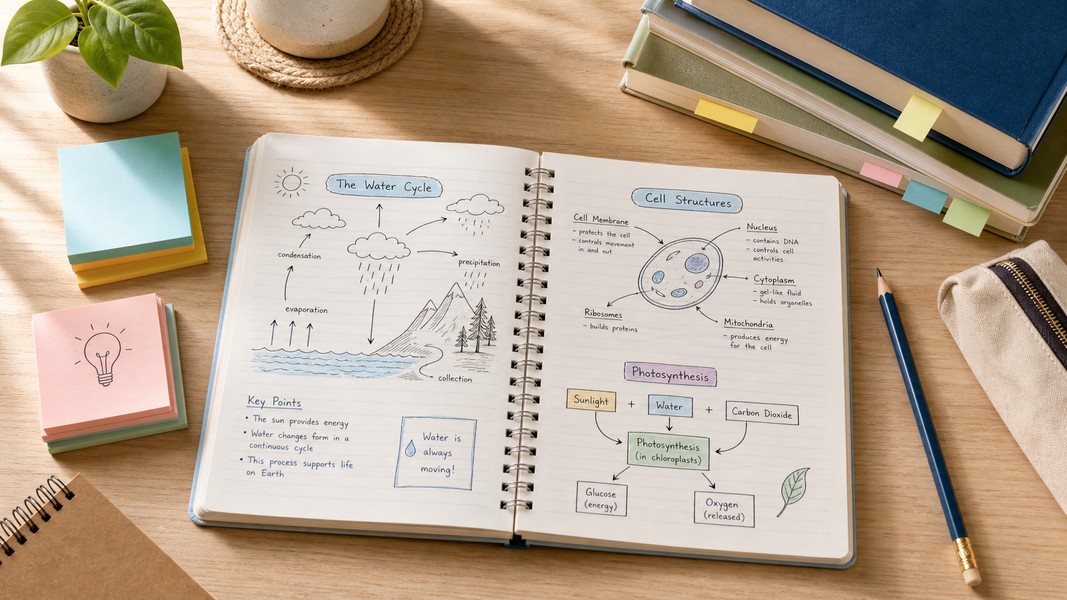
Labeled diagrams for systems and processes. The most direct form of dual coding is drawing and labeling a process. Sketch how photosynthesis works, annotate each stage, and write a short explanation of what's happening at each step. The diagram gives you spatial and relational cues; the labels give you verbal ones. Both are linked to the same concept.
This approach works well for biology, chemistry, anatomy, physics, and any content where understanding how something works requires seeing its parts in relation to each other.
Timelines for sequence and causality. History, literature, case law, and any chronological content maps well onto a timeline. Place events or story beats on a horizontal line, note dates or causes, and add one-sentence explanations for each. The spatial layout shows relationships that a numbered list can't.
Mind maps for broad topics before exams. Mind mapping is particularly effective during review, when you want to see how a large topic fits together. Start with a central concept, branch into subtopics, and connect related ideas with labeled arrows. The act of deciding what connects to what forces active processing of the relationships, not just recognition.
Voice Memos generates mind maps directly from your notes, recordings, or PDFs. If you've captured a lecture or uploaded a textbook chapter, you can produce a structured visual map from that content without building it manually from scratch.
Direct annotation on diagrams and figures. Rather than keeping your written notes separate from a textbook diagram or lecture slide, add short notes directly to the visual. Keep the verbal and visual elements physically connected on the page so you process them together. When you review, both modes are always present.
Sketch-noting during lectures or video lessons. Combine short keywords, arrows, boxes, and simple drawings as you listen. You don't need artistic skill. A box with an arrow and a two-word label does the same cognitive work as an elaborate illustration. The goal is to impose structure on information while you encounter it, not to produce a clean document afterward.
Most students study in a single mode, almost always text, and don't realize it limits retention. Three patterns come up repeatedly.
Re-reading without converting. Reviewing a chapter multiple times can feel productive, but if you're not converting the content into a different format, you're not creating new retrieval pathways. You're reinforcing the same verbal traces you already have. The solution isn't to read less; it's to follow reading with a conversion step, even a quick sketch or diagram, before moving on.
Passive highlighting. Highlighting is single-mode processing. You're marking text, but you're not building any structure around it or encoding it visually. Pairing highlighting with a quick diagram or summary sketch after each section changes what sticks at the end of a session.
Decorative visuals. A stock photo next to a paragraph is not dual coding. An image needs to explain the concept, not just accompany it. A flowchart that shows how one event caused another is dual coding. A photograph that matches the topic but doesn't reveal any structure is not. If the visual could be removed without losing any understanding, it's not doing the job.
Dual coding is an encoding strategy, not a standalone system. It works best alongside other techniques that address different parts of the learning process.
Think of it this way: dual coding makes the initial memory trace richer and more structured. Active recall, which means testing yourself without looking at notes, strengthens that trace by forcing your brain to locate and reconstruct a memory. Spaced repetition determines when you revisit the material to maximize long-term retention.
A practical combination: create a diagram or mind map when you first encounter a topic, then cover it and try to redraw it from memory, then revisit it a few days later. Each step serves a different function. Dual coding improves what you encode. Retrieval practice consolidates the encoding. Spacing ensures it stays accessible over weeks and months.
Voice Memos supports this sequence: capture lecture audio or import a PDF, generate a mind map or structured notes from the material, then use the flashcard and quiz modes to practice retrieval from the same source. The workflow moves naturally from initial capture through visual organization to active testing.
You don't need to redesign every set of notes. A practical starting point is to apply dual coding to one difficult topic at a time.
After a lecture or reading session, pick one idea you found hard to grasp. Write a one-sentence explanation. Then ask yourself whether the concept has structure, sequence, comparison, or relationship. If it does, it can be shown visually.
Choose a format that fits the content. Timelines work for sequence. Diagrams work for structure or parts. Mind maps work for networks of related ideas. Comparison tables work for evaluating options side by side. Once you've created the visual, add a few key labels or short annotations so the verbal and visual elements stay connected.
On review, go in both directions. Look at your diagram and explain what it shows out loud. Look at your written notes and sketch the diagram from memory without checking. Each direction tests a different retrieval pathway.
For students managing multiple subjects, applying dual coding to one subject per session produces better results than a superficial sketch across five. Depth on one concept will outperform breadth on five shallow ones.
If you want to combine this approach with different note structures, the guide to note-taking methods covers how charting, outline, and Cornell formats can complement a visual encoding strategy for different subjects and lecture styles.
Dual coding theory holds up because it's grounded in how memory actually works, not how students feel about studying. Pairing text and visuals creates two retrieval routes where most approaches create one. The techniques are straightforward: diagrams, timelines, mind maps, annotations, and sketch-notes. What makes them effective is the meaningful connection between the words and the visual, and the habit of testing yourself on both.
The learning science here is consistent across decades of research: encoding information in multiple connected formats makes it more retrievable than encoding in a single mode. Start with one difficult topic from your current course, convert it into a visual form, and practice accessing both representations from memory. The difference shows up in comprehension and retention over time, not in how organized your notes look.
Discover more insights and tips to enhance your productivity
The best voice notes app does more than record. Compare top AI-powered picks for students and professionals, including transcription, summaries, and study tools.

Learn how the Pomodoro Technique works, how to use it for studying, why it boosts focus, and how to adapt it for ADHD and different subjects.

A complete breakdown of Otter.ai pricing plans: free tier limits, Pro vs Business features, and what each plan actually gives you.