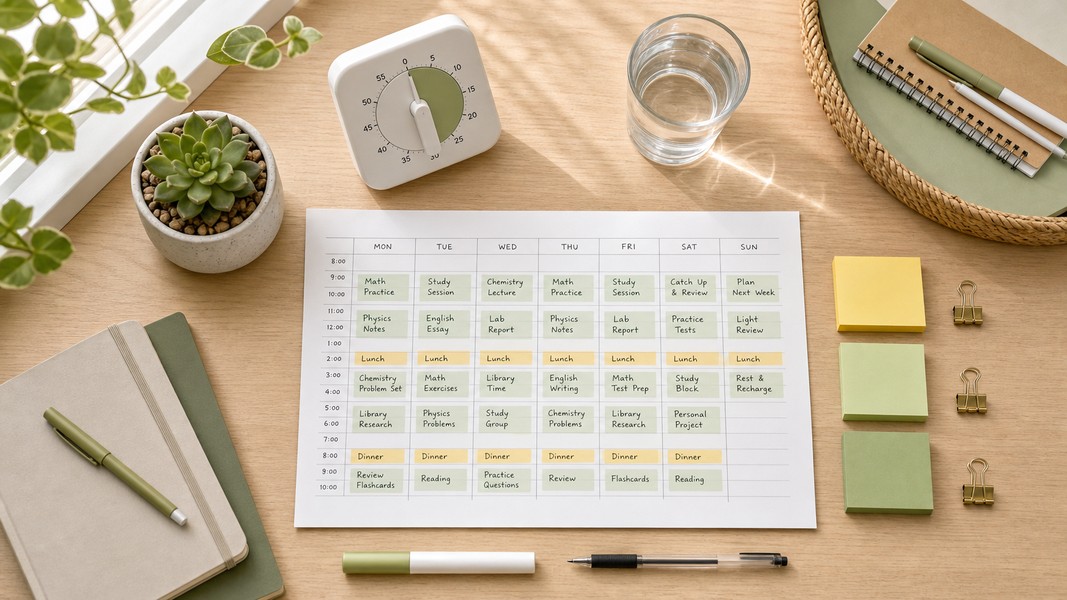
Time Management for Students: 7 Tactics That Work
July 22, 2026
Struggling to manage your time as a student? These 7 evidence-backed tactics fix the real reasons students fall behind and waste hours.
July 24, 2026
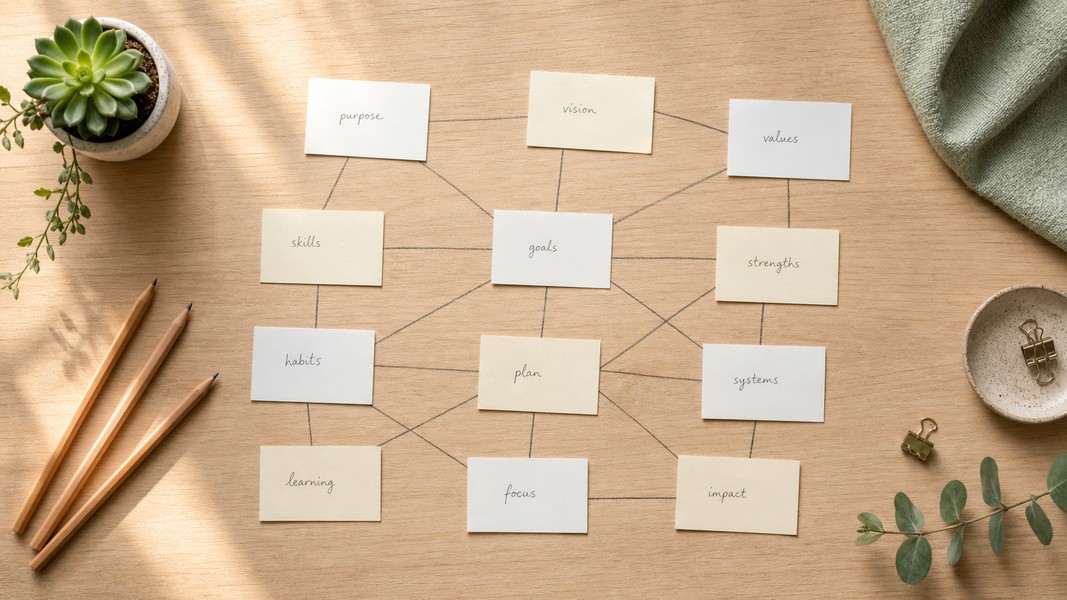
Zettelkasten is a note-taking system built around small, atomic notes that link to each other rather than sitting in folders. Instead of storing information in a rigid hierarchy, you build a network where the connections between ideas are what give the system its power. The word itself is German for "slip box," referring to the wooden box of index cards that sociologist Niklas Luhmann used to write over 70 books and 400 academic articles.
If your notes feel like a graveyard of ideas you never revisit, Zettelkasten offers a different model. This guide covers exactly what the method is, how it works, and how to build one from scratch, whether you prefer index cards or an app.
The basic premise is simple: every note contains one idea, written in your own words, with links to related notes. There are no broad folders labeled "philosophy" or "biology." Instead, notes connect to other notes directly, and new ideas emerge from those connections.
This sounds almost too minimal, but it reflects how thinking actually works. Ideas do not appear in isolation. They arise when two previously unconnected thoughts collide. A Zettelkasten is a system for making those collisions happen on purpose.
The method's most famous practitioner was Niklas Luhmann, a German sociologist who worked at Bielefeld University from the 1960s onward. He maintained a physical collection of roughly 90,000 index cards across his working life, a system he called his "second brain." From this collection came more than 70 books and 400 articles on topics ranging from systems theory to sociology to law.
Luhmann used a numbering scheme that let him insert new cards between existing ones. If a card was numbered 1a, a related note might be 1a1, then 1a2, then 1a1a. This branching structure let him develop ideas in multiple directions simultaneously without reorganizing everything from scratch every time he added a new thought.
He did not keep the system as an archive. He used it as a collaborator. In interviews, Luhmann described his Zettelkasten as a communication partner, something that returned ideas he had forgotten and connected thoughts he had not consciously linked. The system did some of his thinking for him because the connections were already there.
Most people organize notes by source or by subject: "Lecture 3," "Biology Chapter 5," "Ideas for the thesis." The problem with this approach is that the note's location tells you where it came from, not what it connects to. A note about metabolism can live in both the biology folder and the nutrition folder, but it cannot easily point to the economics note about food production or the psychology note about eating behavior. The categories are walls instead of doors.
Zettelkasten tears down those walls. Each note is its own permanent unit, linked to whatever it relates to regardless of subject. The structure of the system is made of relationships, not categories. Over time, a cluster of linked notes on a topic you did not deliberately set out to study can grow on its own, simply because you kept connecting new ideas to existing ones.
Understanding the underlying principles is what separates a working Zettelkasten from a collection of notes with some links sprinkled in. There are four principles that hold the whole system together.
Every note contains exactly one idea. Not one topic, not one source, not one chapter. One idea. If you are reading a paper that contains five arguments, you write five notes, one per argument.
This constraint is intentional. A note that contains multiple ideas cannot be meaningfully linked to other notes because the links become imprecise. You might link "Chapter 4 notes" to a related article, but which part of Chapter 4 are you connecting? Atomicity forces you to know exactly what an idea is before you write the note.
Permanent notes are meant to be understood six months later without reopening the original source. They are written in your own words, not copied verbatim. They include enough context to stand on their own.
This is where most digital note-takers go wrong. They highlight a passage and save it, then move on. A year later, the highlight means nothing without the surrounding text. Permanent notes solve this by requiring you to translate what you read into something you can explain. If you cannot do that, it is a sign you did not understand it yet.
A note without links is a dead end. Every new permanent note should link to at least one or two existing notes, with a brief explanation of why the connection matters. These are not just references. They are the structure of the system.
The power comes from bidirectional awareness: when you read note A and see a link to note B, you can also navigate from note B back to everything that points to it. Over time, notes that receive many links become hubs, emerging themes in your thinking that no folder structure could have predicted.
The most valuable thing about Zettelkasten is what it produces without you consciously directing it. When you have been adding notes and links for months, patterns start to appear. A topic you visited briefly in one context turns out to be connected to something you studied in a completely different class. Arguments assemble themselves across sources. Outlines for papers exist before you ever open a blank document.
This emergence is why writers, researchers, and students who stick with Zettelkasten tend to describe it as transforming their relationship to knowledge. It stops feeling like storage and starts feeling like thinking.
The original system used physical index cards in a wooden box. Today, most people build theirs in software. Both approaches work. The choice depends on how you learn, what you value, and how large your system will grow.
Luhmann used 4x6-inch index cards, each with a unique identifier at the top and a handwritten idea in his own words. When he wanted to add a related note, he inserted it physically adjacent to the card it extended, using the numbering scheme described above.
The advantage of analog is the deliberateness it demands. Writing by hand slows you down in a useful way. You cannot paste a paragraph and call it a note. You have to engage with the idea to put it on paper. Research published in Psychological Science has documented that handwritten notes tend to produce better conceptual understanding than typing because the physical constraint forces summarization.
The disadvantage is scale and navigability. Following a chain of ten linked cards requires pulling them from the box one by one. Searching for a note requires memory or a separately maintained index. At 90,000 cards, Luhmann's system worked because he had spent decades maintaining it. Starting there would be impractical.
Digital tools make the linking and navigation far more practical. A click takes you from one note to any note it links to. Backlinks show you every note that points to the one you are currently reading. Search finds any note in seconds.
The most commonly used tools for digital Zettelkasten include:
For most students starting today, digital is the better default. The ability to search, navigate backlinks, and reorganize without physically moving cards is significant. The trade-off is that digital tools make it easy to defer real thinking. You can capture a link, paste a quote, and tag a note without ever engaging with the idea. The discipline of the method matters more with digital, not less.
Choose analog if you find physical writing helps you think, if you want a low-tech system you can maintain anywhere, or if you have a very specific domain and do not expect the system to grow large.
Choose digital if you need search, if you want to link freely across a growing body of notes, or if you are working across multiple subjects and need to find connections quickly.
A hybrid approach also works: capture fleeting notes by hand during class or a conversation, then process them into digital permanent notes later. The analog capture keeps you present; the digital processing scales the system.
The most important thing about starting is to start small. Sönke Ahrens' book How to Take Smart Notes is the clearest modern guide to the method, and its core message is that the system only works if you use it regularly. A perfect setup you never use is useless. A simple setup you use every day works.
You need three distinct areas:
An inbox for fleeting notes, quick, unprocessed captures you intend to deal with later. These are not permanent. They are placeholders.
A source area for literature notes, notes you write about a specific source (a book, paper, lecture, or video) that capture what that source says in your own words.
A permanent notes area for the real Zettelkasten. These notes contain your own ideas, written in your own words, with links to other permanent notes.
If you are using Voice Memos, you already have a capture system. Record an audio note during a lecture or after a reading, and the AI transcription gives you a starting point for your literature notes. The transcription is raw material, not a finished note. Your job is to extract the ideas and rewrite them.
Fleeting notes are for capture only. Write them during class, on a walk, in the margin of a book. They are meant to be processed, not stored. The goal of a fleeting note is not to document an idea completely but to make sure you do not lose it before you have time to think about it.
Keep your fleeting notes in one place so you always know where to look. An inbox folder, a single capture note, a voice memo app, a pocket notebook. The format does not matter as long as it is fast.
When you finish a chapter, a lecture, or a paper, sit with your fleeting notes and write literature notes. These are notes about what the source says, one or two per key idea, written in your own words.
Do not copy passages. Copying tempts you to skip thinking. A literature note should be clear enough that you could describe the idea to someone who has not read the source. If you cannot do that, you do not understand it yet. Read more carefully, then write the note.
Literature notes also record where the idea comes from so you can find the source later if you need to verify something or cite it. Keep the reference (author, title, page) attached to the note.
This is the core step. After you have written literature notes, ask: what do I actually think about this? What does it connect to? Do I agree, disagree, or want to build on it?
Each answer becomes its own permanent note, written in full sentences, as if writing for a reader who is not you. This is where the thinking happens. A permanent note is not a summary of a source. It is your own thought, which may have been triggered by the source, but which stands independent of it.
Give each permanent note a unique title that captures the idea it contains. "Memory consolidation happens during sleep" is a permanent note title. "Chapter 3 of the neuroscience textbook" is not.
Every time you create a permanent note, spend two minutes asking: what does this connect to? Search your existing notes for related ideas. When you find them, add a link in both directions, and write one sentence explaining why the connection matters.
The habit of linking before closing is what separates a Zettelkasten from a folder of documents. If you skip this step, you accumulate notes but not a network. Start with a goal of at least one link per new permanent note, and try for two or three when ideas are genuinely related.
Set aside ten to fifteen minutes daily, or after each study session, to process your inbox. Take each fleeting note, decide whether it produced a literature note worth keeping, and clear it out. Delete the fleeting notes that turned out to be unimportant. Move the useful ones through the pipeline.
This regular clearing is what keeps the system alive. An inbox that grows for weeks becomes an intimidating backlog. A cleared inbox is a signal you are actually thinking.
The method works across disciplines. The core workflow, capture, process, link, scales from a single undergraduate seminar to a decade-long research project.
When writing a literature review, most students start from a blank document and try to remember what they read. With Zettelkasten, you start from the notes you already have. Your permanent notes are already written in your own words. The connections between sources are already mapped.
Instead of writing a paper, you are often assembling one. Themes emerge from the notes that received the most links. Arguments already exist in the relationships between ideas. What remains is structuring them into a readable order.
Voice Memos supports this workflow for students who do not sit quietly at a desk. Record a summary of what you read, let the transcription process it, then turn the transcript into literature notes. The capture method adapts to how you actually study.
Zettelkasten changes exam prep from re-reading to active recall. Your permanent notes are already written in your own words, which means reviewing them is already a form of testing. For subjects where understanding context matters more than memorizing facts, navigating the links between notes builds the kind of relational knowledge that holds up under pressure.
This connects directly to how retrieval practice strengthens memory. Active recall methods work because retrieving information from memory is more effective than reviewing it passively. Notes written as self-contained ideas are already retrieval-ready because each one encodes a single concept clearly.
One of the most underused benefits of Zettelkasten for students is the cross-course connection. A concept from your statistics class and a concept from your economics class may be describing the same underlying phenomenon. Your history of science reading may reframe how you understand a debate happening in your biology course.
These connections are invisible in a folder-per-subject system. In a Zettelkasten, they become explicit: a link from one note to another, across courses and semesters. The cumulative effect is that learning becomes additive rather than parallel. Each new subject enriches what you already know instead of living in a separate silo.
For medical students, this means linking physiology, pharmacology, and pathology notes so that clinical cases become readable through multiple lenses. For law students, it means connecting doctrine, policy, and case law so that argument structure forms across sources.
A Zettelkasten does not replace other study tools. It works alongside them. You can pair it with mind mapping to visualize the structure of a topic before linking notes into it. You can use spaced repetition flashcards to drill the specific facts within a topic your permanent notes have already contextualized. The Zettelkasten handles the architecture of understanding; the other tools handle what needs to be drilled.
The method fails in predictable ways. Knowing the failure modes before they happen saves weeks of frustration.
The most common mistake is turning the Zettelkasten into a clipboard. You find an interesting passage, paste it in, tag it, and move on. Months later, the note means nothing because you never engaged with it.
Copying is not thinking. Every note must be written in your own words, completely. If that feels slow, it is supposed to feel slow. The slowness is where the learning happens.
The second most common mistake is creating notes and never linking them. This produces a large collection of isolated notes: useful as references, useless as a thinking system. Without links, there is no emergence. The notes sit where you put them and stay there.
Treat linking as non-optional. It is not a bonus step. It is what makes the system work. If you have more than a handful of notes with no outgoing or incoming links, they are not part of your Zettelkasten. They are just documents.
Many people resist the link-based structure and compensate with elaborate folder hierarchies and dozens of tags. This reproduces the problem Zettelkasten is designed to solve: the rigid categories that prevent ideas from connecting.
Tags are useful sparingly, for genuinely cross-cutting properties like a project name or a source type. They are not a substitute for links. A note that has ten tags and no links is a note that has been catalogued but not understood.
Zettelkasten has a significant community online, and much of the discussion focuses on optimal configurations: which app is best, how to structure note IDs, whether to use folders or tags or neither, how to handle different source types. This is all worthwhile eventually, but it is a trap for beginners.
The best Zettelkasten is the one you actually use. Start with three notes. Write them in your own words. Link one to another. That is the whole system. Everything else is refinement.
Voice Memos can serve as your starting point even if you have not decided on a long-term tool. Capture your thoughts by voice, let the AI transcribe and organize them, and treat the output as raw material for permanent notes. The permanent note layer can live in any app you choose. The capture layer can be wherever you are.
Zettelkasten works because it mirrors how knowledge actually grows: not in isolated silos, but in networks of connected ideas. The method forces you to write in your own words, link ideas explicitly, and build a system that compounds over time.
What makes it different from most note-taking systems is the long game. A folder of notes from last semester decays. A network of linked permanent notes grows more useful the longer you maintain it. Each new idea has more to connect to, and each connection makes the existing ideas richer.
The path to getting there is not complicated. Write one idea per note. Write it in your own words. Link it to at least one other note. Clear your inbox regularly. Do that consistently, and the system builds itself.
Discover more insights and tips to enhance your productivity
Struggling to manage your time as a student? These 7 evidence-backed tactics fix the real reasons students fall behind and waste hours.

Fathom AI is great for free Zoom notes, but it has real limits. Here are the best fathom ai alternatives for meetings, students, and multi-format capture.

Learn what to include in a follow-up email after any meeting, when to send it, and how to write one that drives real action across every meeting type.