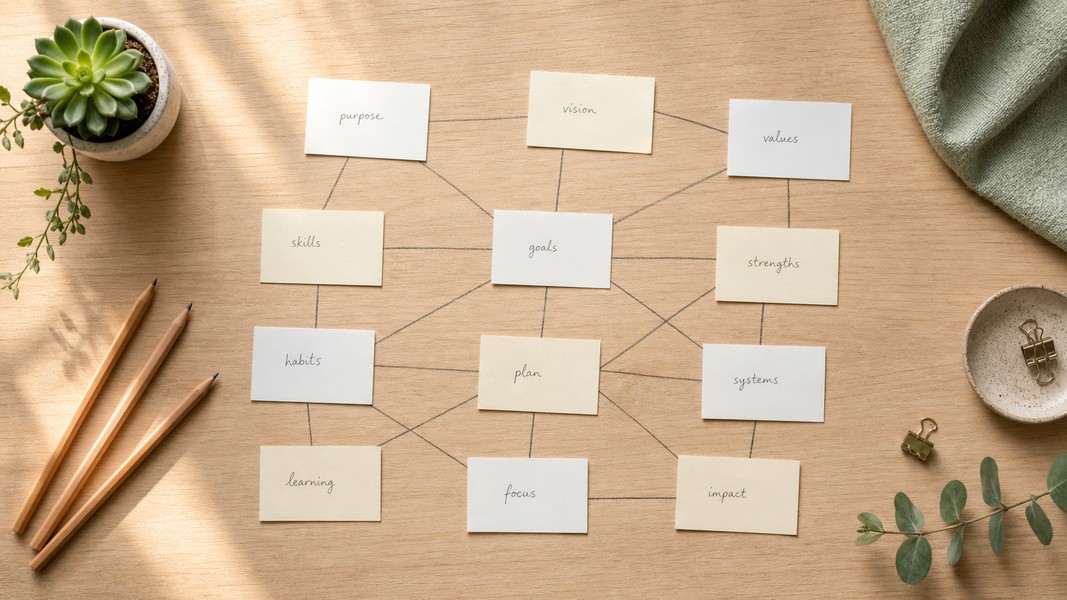
Zettelkasten: How to Build a Knowledge System
July 24, 2026
Learn how the Zettelkasten method works, why linked notes beat linear notebooks, and how to build your own knowledge system from scratch.


April 3, 2026
Auditory learning is a style in which you absorb and retain information best through hearing and verbal processing. If you find yourself replaying a professor's words in your head long after class, if discussions help you understand concepts that reading alone doesn't, or if you quietly talk yourself through problems, you're likely an auditory learner.
Understanding how you learn is only half the equation. The other half is building a study system that actually plays to that strength. This guide covers what auditory learning is, how to recognize it in yourself, and which strategies consistently deliver results for auditory learners across any subject.
Auditory learning sits within the VARK model, a framework that classifies learners by their preferred sensory modality: Visual, Aural (Auditory), Reading/Writing, and Kinesthetic. The "aural" category describes people who process information most effectively when it comes through sound, speech, and discussion.
Auditory learners are attuned to tone, rhythm, and phrasing. They often remember the way something was said, not just what was said. They tend to think out loud, enjoy hearing verbal explanations, and may struggle to absorb dense written material without speaking it aloud first.
This connects to how memory works. When you process information across multiple channels, verbal and visual, your brain forms more retrieval pathways, which is why speaking and hearing content together encodes it more durably than reading alone. For auditory learners, that verbal channel is their primary encoding route.
This doesn't mean auditory learners can't read or write. It means their memory and comprehension work best when those activities are paired with some form of auditory processing: reading aloud, discussing ideas, or hearing content explained rather than just seeing it on a page.
The clearest sign is that lectures click in a way that textbooks often don't. You follow along easily when someone explains something verbally, but you may need to read a paragraph three times before it registers.
Other common patterns include talking quietly while working or moving your lips when reading. This isn't a bad habit; it's your brain reinforcing the input through sound. You may also find that studying in silence feels unnatural, while background music or ambient sound helps you focus and keeps your mind from drifting.
Auditory learners are often sensitive to tone and inflection in speech. You notice when something "sounds off" in an explanation before you can articulate why. You remember phone conversations vividly, can often recall the exact phrasing someone used, and may prefer verbal directions over written instructions.
Academically, auditory learners tend to be strong in subjects built around discussion and debate: humanities, social sciences, and languages. They often ask instructors to repeat things not because they weren't paying attention, but because re-hearing something solidifies understanding better than re-reading notes.
On the other side, auditory learners can struggle with dense textbooks, purely visual subjects like geometry, and study environments that cut off all verbal processing. Long silent reading sessions can feel draining in a way that an equally long lecture does not.
The most effective techniques for auditory learners share one principle: they keep sound and speech in the loop, even during activities that normally happen in silence.
Record and replay your own explanations. After a lecture or study session, record a brief verbal summary of what you just covered. Explain the key concepts as if you're teaching someone else. This forces you to organize what you know, and replaying it later is far more effective than re-reading your notes. Research on verbal learning consistently shows that explaining material aloud strengthens recall compared to passive review.
Read aloud during study sessions. When working through a textbook or reviewing notes, read sections out loud. Speaking the words activates different memory pathways than silent reading, reinforcing retention through both the act of saying and hearing. This is especially useful for content that requires exact recall, like formulas, definitions, or legal rules.
Use rhythmic memory aids. For memorization-heavy content, turning information into a rhyme or chant makes it stick. The rhythm creates an additional retrieval cue your brain can use when needed. Medical students have long used this approach for anatomy; it works equally well for chemistry nomenclature, historical dates, or vocabulary in a second language.
Join or form a study group. Group discussion is where auditory learners tend to consolidate understanding fastest. Explaining your interpretation of a concept to others, defending your reasoning, and hearing different perspectives all engage verbal processing in ways solo study can't replicate. If you don't have a study group, explaining material to a friend or family member who doesn't know the subject works just as well.
Pair active recall with verbal response. Instead of silently flipping flashcards, say the answer out loud before checking. The verbalization is the cognitive work, not just the checking. This approach combines the proven benefits of active recall testing with the auditory reinforcement your brain responds to.
Use text-to-speech for written material. When you have a dense reading assignment, try listening to it rather than reading it silently. Most devices have built-in text-to-speech tools, and having the text read to you while following along engages your auditory processing directly.
Understanding the differences between learning styles helps you choose study methods deliberately and adapt when your preferred approach isn't an option.
Auditory learners process through sound and speech; they need to hear, say, or discuss material. Visual learners build understanding through images, diagrams, and spatial organization. Kinesthetic learners connect best through hands-on experience, movement, and physical manipulation of concepts.
Here's how they compare in practice:
| Style | Strongest in | Weakest in | Core study methods |
|---|---|---|---|
| Auditory | Discussion, debate, languages, lectures | Dense textbooks, geometry, silent reading | Verbal summaries, study groups, recordings |
| Visual | Diagrams, data, mapping relationships | Audio-only content, fast verbal delivery | Mind maps, color-coding, charts, video |
| Kinesthetic | Labs, physical demos, real-world tasks | Long lectures, abstract theory | Experiments, movement, hands-on practice |
One important note: research has challenged the idea that matching instruction exclusively to a learner's preferred style improves outcomes. A widely cited review by Pashler et al. found little evidence that teaching in a single preferred modality outperforms mixed approaches. What the research does support is that multimodal learning, combining auditory, visual, and hands-on elements, produces stronger retention for most learners.
For auditory learners, this means you shouldn't ignore visual tools like spaced repetition flashcards or mind maps. Use them, but also layer in verbal processing: talk through the flashcard answers, narrate the connections in a mind map out loud. The goal isn't to stay inside one modality; it's to make sure verbal processing is always part of the mix.
Technology has made auditory-first studying significantly more practical. Text-to-speech tools let you listen to written material rather than read it. Podcast-style audio summaries let you review content during a commute or workout. And AI-powered voice tools now create a direct pipeline from speaking to structured study materials.
For auditory learners, the most powerful shift is being able to capture verbal thinking and convert it into something reviewable. With Voice Memos, you can record yourself explaining a concept after class, and the app automatically generates a full transcript, structured notes, and a set of flashcards or quiz questions from that recording. A five-minute voice note becomes a complete study resource.
The same workflow applies to lectures. Record the class, process it in Voice Memos, and you end up with organized content you can engage with in whatever format fits the moment: listen back to the audio, read through the AI-generated transcript, or test yourself with generated questions for active recall practice. That flexibility is particularly useful for auditory learners who want to review on the go without being tied to a desk.
Sciences and STEM. Science can feel visually heavy, but auditory learners succeed when they narrate their way through problems. Walk through a physics derivation or chemistry mechanism out loud before writing anything. For formulas and processes, create verbal chants or say each step aloud while working. Discussing lab procedures with a classmate before starting also helps auditory learners build a mental model before engaging with the visual details.
Humanities and social sciences. These subjects are a natural fit. Class participation, seminar discussion, and essay arguments all favor verbal reasoning. Talk through your interpretation of a text or historical event before writing; many auditory learners find it faster to record a spoken outline and transcribe it than to write a rough draft directly.
Languages. Language learning is the domain where auditory processing is most directly an advantage. Read aloud in the target language, listen to native speakers, and practice speaking regularly. For vocabulary, hearing words in context through audio programs builds memory faster than silent flashcard review for most auditory learners.
Mathematics. Math seems visual, but verbalization helps significantly. Explain each step of a solution out loud as you work through it. If you can describe why each step follows from the last, you genuinely understand it rather than just pattern-matching. For formulas, rhythmic repetition helps: saying them in a consistent rhythm creates a retrieval pattern your brain can access under test pressure.
Auditory learning is a genuine and common way people process information. The strategies that work best, recording and replaying, reading aloud, verbal rehearsal, group discussion, aren't workarounds for a limitation. They are rigorous study methods, calibrated to how your memory actually encodes and retrieves information.
The key is to stop treating verbal processing as an add-on and start building it into every study session. Plan for it deliberately: record your explanations, schedule discussion time, and use tools that convert your voice into reviewable study material. When your study system aligns with how your brain encodes information, the same effort produces better results.
Discover more insights and tips to enhance your productivity
Learn how the Zettelkasten method works, why linked notes beat linear notebooks, and how to build your own knowledge system from scratch.
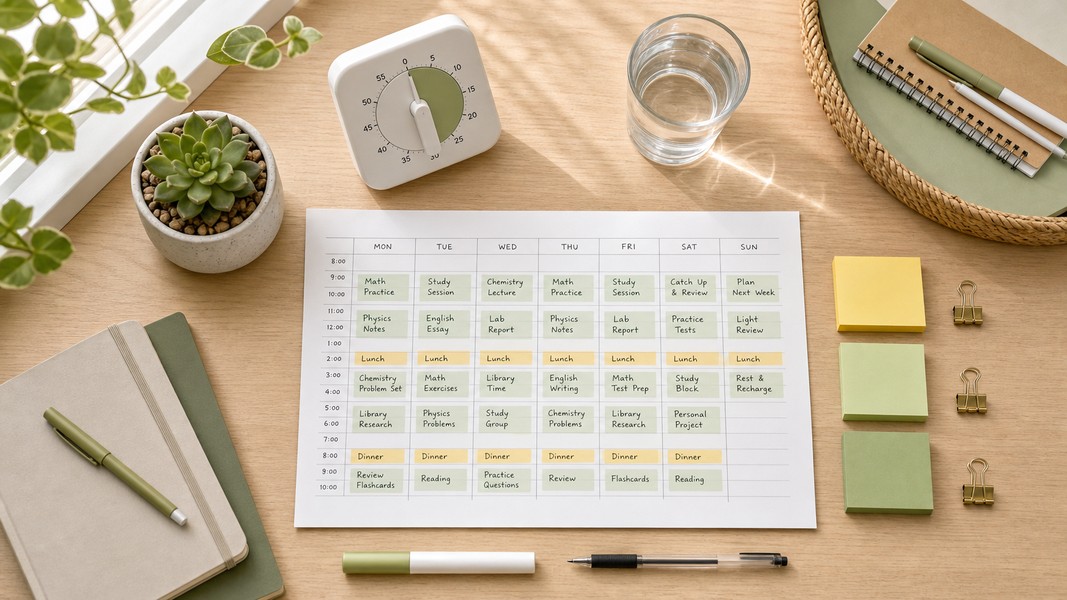
Struggling to manage your time as a student? These 7 evidence-backed tactics fix the real reasons students fall behind and waste hours.

Fathom AI is great for free Zoom notes, but it has real limits. Here are the best fathom ai alternatives for meetings, students, and multi-format capture.