
Zettelkasten: How to Build a Knowledge System
July 24, 2026
Learn how the Zettelkasten method works, why linked notes beat linear notebooks, and how to build your own knowledge system from scratch.


February 28, 2026
The best AI quiz generator for most students is Quizgecko for PDF-heavy courses or Knowt if you want unlimited free flashcards alongside your quizzes. For students who learn from voice recordings and YouTube lectures, Voice Memos handles inputs that most tools ignore entirely. Here is how all seven compare.
| Tool | Best For | Free Tier | Voice | YouTube | Standout Feature | |
|---|---|---|---|---|---|---|
| Quizgecko | STEM PDF-to-quiz | Yes | Yes | No | Yes | Spaced repetition export |
| Mindgrasp | Multimedia lectures | Trial | Yes | Yes | Yes | AI tutor explanations |
| Quizizz AI | Gamified revision | Yes | No | No | Yes | Real-time progress tracking |
| Voice Memos | Multi-modal inputs | Yes | Yes | Yes | Yes | Voice and camera support |
| Studygenie | Exam-matching questions | Yes | Yes | No | No | Weak area tracking |
| Knowt | Budget-conscious students | Yes | Yes | No | No | Unlimited free flashcards |
| QuestionWell | Text-based reading quizzes | Yes | Yes | No | No | Standards-aligned questions |
Before picking a tool, it helps to understand what you're betting on. A landmark study by Karpicke and Roediger found that students who used practice testing recalled 80% of material on delayed tests, compared to 36% for students who re-studied the same content. That gap is not small. Active recall, the act of retrieving information from memory, beats passive review every time. When you struggle to pull an answer from memory, your brain strengthens the neural pathway for that information. Re-reading creates an illusion of familiarity without building that pathway. AI quiz generators make active recall practical at scale. Instead of spending an hour writing questions from a 40-page chapter, you get a full quiz set in under a minute. The time you save goes toward actually testing yourself, which is where the learning happens. Combining active recall with spaced repetition flashcards amplifies the effect further: one meta-analysis found that spaced practice with testing produces up to three times the retention of massed study sessions.
Seven criteria shaped this comparison:
Quizgecko is built around one core workflow: upload content, get a quiz. You paste text, upload a PDF, or drop in a URL (including YouTube), and it generates multiple choice, true/false, short answer, and fill-in-the-blank questions. The standout feature is its spaced repetition export. After generating a quiz, you can export the questions as flashcards formatted for spaced repetition review, or export to CSV for Anki import. For STEM students who need to memorize formulas, anatomical structures, or chemical reactions, that pipeline is genuinely useful. The free tier allows a limited number of quizzes per month. The paid plan at $9.99/month unlocks unlimited quizzes, more question formats, and full export options. For students who generate a lot of quizzes from dense readings, the paid tier pays for itself quickly. The main limitation is that Quizgecko has no native voice input. If your primary study material is lecture recordings, you need a different tool.
Mindgrasp handles more input types than most tools on this list: PDFs, YouTube links, voice recordings, and plain text all feed into the same quiz generation pipeline. It then generates multiple choice and short answer questions, plus AI tutor-style explanations that walk you through why an answer is correct. That tutor feature matters for medical and STEM students. When a question asks about the mechanism of action of a drug, getting the answer wrong and then receiving a clear explanation of the underlying pharmacology is more useful than just seeing the correct option. Mindgrasp treats quiz generation as a learning process rather than just an assessment. Pricing starts at $9.99/month with a free trial period. The $6.99/month annual rate makes it more accessible for students on tight budgets. Reviews consistently rate it highly for multi-input flexibility and explanation quality, though some users note accuracy issues when processing highly technical or complex source material.
Quizizz has been a classroom staple for years, and its AI layer makes it practical for self-study. You can generate quizzes from text or YouTube URLs and then work through them with gamification features: timers, leaderboards, and instant feedback that turns a study session into something more engaging than staring at a textbook. The tool is strong for subjects with discrete facts: biology, history, geography. You can test knowledge of specific items and track which ones you consistently miss. The free tier is generous for students studying solo, and the progress tracking shows which topics need more attention over time. The weakness is that Quizizz doesn't process PDFs or voice recordings directly. If your study materials live in uploaded documents rather than text you can paste, you'll need to extract content manually before using it. For students who work primarily with lecture slides or typed notes, that's a manageable workaround.
Voice Memos stands out because it handles inputs that most quiz generators ignore entirely. You can feed it a voice recording from a lecture, upload a PDF, paste a YouTube URL, or photograph handwritten notes with your camera. All of those become source material for AI-generated quizzes with multiple choice, true/false, and short answer formats. That multi-modal flexibility makes it particularly useful for students whose materials don't come in a single clean format. A medical student might have a recorded clinic session, a textbook chapter PDF, and a YouTube explanation of the same concept. Voice Memos processes all three in the same session, and the resulting quiz covers the content from every angle. The spaced repetition scheduling built into the platform means quizzes don't just assess you once. The system surfaces questions again at optimal intervals based on your performance, which is the mechanism behind the retention gains research associates with spaced practice. The free tier covers core features. For students exploring among the broader category of AI study tools, Voice Memos is worth testing specifically for its voice and camera input capabilities, which remain uncommon in this tool category.
Studygenie focuses on question quality over input variety. The AI is tuned to generate questions that match the difficulty and format of actual exams, rather than pulling sentences from source material and turning them into trivia. The textbook table-of-contents selector lets you choose specific chapters to quiz rather than processing an entire document. The weak area tracking identifies which concepts you're consistently missing and prioritizes those in subsequent quizzes. For students preparing for standardized exams like the USMLE, bar exams, or professional licensing tests, that targeting is valuable. The free tier allows unlimited manually-created question sets. AI-generated quizzes require the $14.99/month paid plan. The higher price reflects the emphasis on quality: Studygenie is not trying to be the fastest or cheapest quiz generator. It's trying to produce questions that prepare you for what an actual exam looks like. The limitation is input scope. Studygenie works with PDFs and text. Voice and YouTube are not supported.
Knowt positions itself as a free alternative to Quizlet and delivers on that promise. The free tier allows unlimited AI-generated flashcards and quizzes from PDF uploads and text, with no cap on the number of sets you create. The quiz formats include multiple choice and true/false. You can import from Quizlet if you're migrating an existing library. The interface is straightforward, and the learning curve is minimal. What Knowt lacks is support for voice recordings and YouTube URLs. It's a document-and-text tool. For students who primarily study from typed notes, lecture slides, or uploaded readings, that's sufficient. For students who want to process audio or video content, a different tool is necessary. The $10.99/month annual plan unlocks more AI features and removes any remaining limits, but the free tier handles the core quiz generation workflow without restriction.
QuestionWell generates questions from text and PDFs with a focus on alignment with learning standards. This makes it particularly useful for courses built around assigned readings: upload the chapter, get a question set that covers the key concepts, and test yourself before a discussion or exam. The free tier handles PDF and text input with no major restrictions. The paid plan at $10/month adds more question types and bulk generation. The tool doesn't support voice or YouTube, and the export options are basic compared to Quizgecko. For students in humanities, social sciences, or any course that assigns dense reading, QuestionWell generates usable questions quickly without requiring payment for basic functionality.
Input flexibility is the most important factor for most students. A tool that only accepts text forces you to manually extract content from PDFs, recordings, and video lectures before using it. That friction reduces how often you'll actually use the tool. Think about where your study materials actually come from:
AI quiz generators make active recall practical for everyday studying. The best choice depends on your materials. Students working from dense PDFs and textbooks get strong results from Quizgecko or Studygenie. Students with lecture recordings or multi-format materials benefit most from Mindgrasp or Voice Memos, both of which handle audio input. Students on a tight budget will find that Knowt's free tier covers the core workflow without restriction. Whatever tool you pick, the underlying mechanism is the same: forcing yourself to retrieve information is more effective than reviewing it. The AI handles the question creation. The work of actually testing yourself still falls on you.
Discover more insights and tips to enhance your productivity
Learn how the Zettelkasten method works, why linked notes beat linear notebooks, and how to build your own knowledge system from scratch.
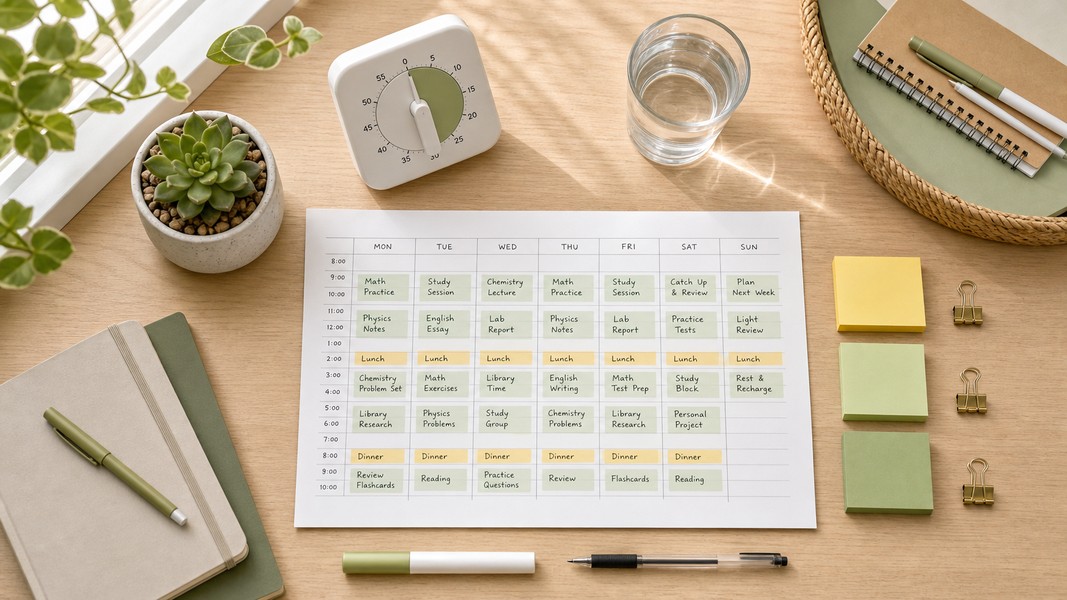
Struggling to manage your time as a student? These 7 evidence-backed tactics fix the real reasons students fall behind and waste hours.

Fathom AI is great for free Zoom notes, but it has real limits. Here are the best fathom ai alternatives for meetings, students, and multi-format capture.