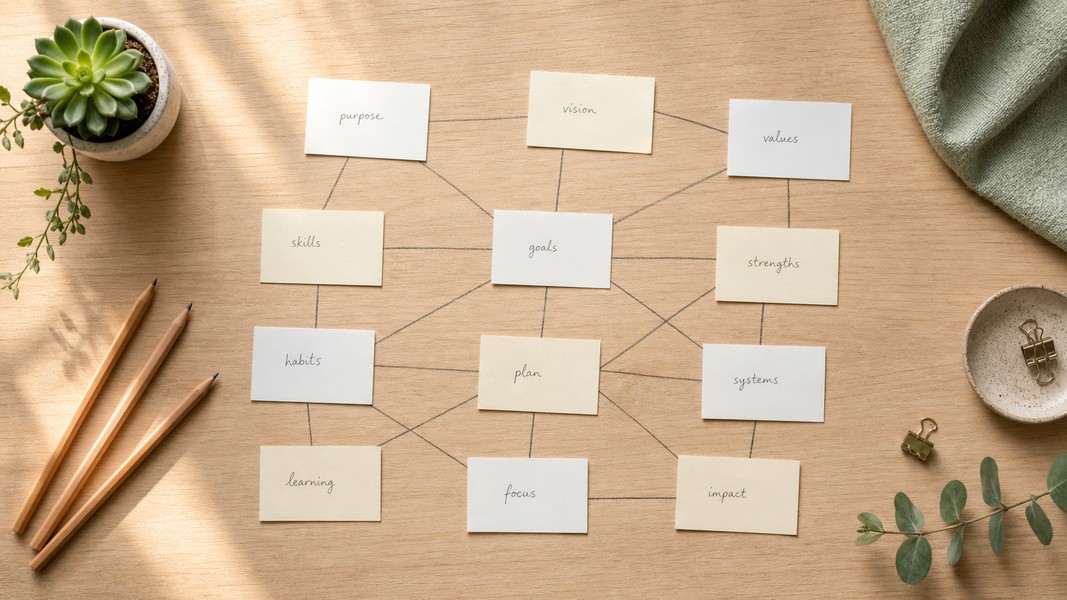
Zettelkasten: How to Build a Knowledge System
July 24, 2026
Learn how the Zettelkasten method works, why linked notes beat linear notebooks, and how to build your own knowledge system from scratch.

April 26, 2026
A concept map is a diagram that visually represents concepts and the relationships between them, using labeled arrows to connect ideas into meaningful statements. Developed by educational psychologist Joseph Novak at Cornell University in 1972, the method was built on constructivist learning theory: the idea that students learn best by connecting new information to what they already know.
Unlike freeform brainstorming tools, a concept map is structured. Every connection between two concepts must be labeled with a linking phrase that turns the pair into a readable statement, called a proposition. That precision is what makes concept maps powerful for learning, not just for organizing.
A concept map starts with a focus question: the central problem or idea the map is meant to answer. From there, you identify key concepts, arrange them from most general to most specific, and connect them using arrows labeled with phrases like "causes," "requires," or "leads to."
The result is a network of propositions. For example: "Photosynthesis requires sunlight" or "Heart failure leads to fluid retention." These aren't visual clusters with vague proximity; they're statements that capture precise relationships.
This structure distinguishes concept maps from mind mapping, which uses free-form branches from a central idea without requiring explicit relationship labels. Mind maps are better for brainstorming; concept maps are better for understanding how things actually connect.
Every concept map has four core components working together.
Nodes are the concepts themselves, usually written inside ovals or rectangles. They represent any object, event, or idea relevant to your topic, ranging from broad categories to specific terms.
Linking phrases appear on the arrows that connect nodes. They're what turn a concept map into something genuinely useful. Instead of just knowing that "mitochondria" and "ATP" are related, you understand that "mitochondria produce ATP." The phrase carries the meaning.
Cross-links are arrows that connect concepts from different parts of the map. They reveal unexpected relationships across different branches and are often where the most valuable insights emerge. A concept map without cross-links is just an outline arranged differently.
The focus question sits at the top or center and anchors the entire map. It keeps the concepts relevant and prevents scope creep. Without one, it's easy to add too many nodes and lose the thread of what you're actually trying to understand.
The four main formats serve different purposes depending on the subject and your goal.
Hierarchical maps organize concepts from most general at the top to most specific at the bottom. This is the most common format for academic subjects like biology or history, where you start with a broad category and break it into subcategories.
Spider or radial maps place the central concept in the middle with related ideas radiating outward in branches. This works well for brainstorming or exploring a topic where many subtopics are roughly equal in importance, with no clear top-down ordering.
Flowchart maps show processes, sequences, or cause-and-effect chains in a directional layout. If you're mapping a biological pathway, a historical sequence of events, or a clinical decision tree in nursing, a flowchart format fits best.
Systems maps capture feedback loops and dynamic relationships. They're used in fields like ecology, economics, and organizational design, where outcomes loop back and influence earlier parts of the system.
Most students use hierarchical maps for coursework, but combining formats within a single map is common when the subject demands it.
Building a concept map from a lecture or chapter takes about 20-30 minutes. Here's the process step by step.
Step 1: Write your focus question. Start with the problem you're trying to understand. "What causes heart failure?" or "How does photosynthesis work?" A clear question shapes everything that follows and keeps the map focused.
Step 2: List 8 to 15 key concepts. Pull the most important terms or ideas from your material. Don't filter yet. If you're working from lecture notes or a textbook chapter, identify the vocabulary, main arguments, and core processes.
Step 3: Rank by importance. Put the broadest or most general concept at the top. Everything else arranges below it in descending order of generality. Some concepts will feel equal in importance, and that's fine.
Step 4: Connect with linking phrases. Draw arrows between related concepts and write a word or short phrase on each arrow. The phrase should complete the sentence formed by following the arrow from one node to the next.
Step 5: Add cross-links. Look for relationships between concepts in different branches. Cross-links often represent the deepest insights, the moments when you realize two separate ideas are actually the same phenomenon in different contexts.
Step 6: Revise. A first-draft concept map is rarely the best version. Rearrange nodes, rewrite linking phrases that are vague, and remove redundant connections. The goal is a map where every proposition makes a true, specific statement.
Starting with sticky notes before moving to a digital tool like Lucidchart or Miro lets you rearrange concepts freely before committing to a layout.
Here's what concept maps look like applied to real academic subjects.
Biology: Photosynthesis. The central node is "Photosynthesis." Branches extend to "requires" light energy and chlorophyll, "takes in" CO2 and water, and "produces" glucose and oxygen. A cross-link connects light energy to chlorophyll with the phrase "activates." This map makes it immediately clear what goes into the process, what drives it, and what comes out.
History: Causes of World War I. The focus question is "What caused WWI?" Main nodes branch from "causes": nationalism, imperialism, the alliance system, and militarism. A subordinate node under nationalism connects to the assassination of Archduke Franz Ferdinand in 1914 with the phrase "triggered." Cross-links show how the alliance system transformed a regional crisis into a world war. This kind of map makes causal chains far easier to explain and remember than a linear list of dates ever could.
Nursing: Heart Failure Care Plan. Central node: "Heart Failure." Branches cover assessments (lung sounds, oxygen saturation, daily weight), nursing diagnoses (fluid retention, activity intolerance), interventions (medication adherence, dietary sodium restriction, patient education), and outcomes (improved self-management). Cross-links connect specific interventions to the diagnoses they address. Nursing educators use concept maps precisely because patient care requires integrating multiple types of information simultaneously, and linear notes struggle to show those interdependencies.
STEM: The Cell. The map branches from "Cell" into prokaryotic and eukaryotic types, then into organelles and their functions. A cross-link connects "mitochondria" to "ATP production" with "generates." This structure makes it easy to see which organelles appear across cell types while serving the same function.
The cognitive reason concept maps work is active processing. Building a map forces you to decide which concepts matter and how they relate, rather than re-reading highlighted text. That decision-making is what creates durable memory.
Research supports this advantage. Concept mapping promotes deeper comprehension than passive review methods, particularly for subjects with dense, interconnected content like biology, history, and nursing. In medical education, students who build concept maps of clinical scenarios develop stronger clinical reasoning skills, because the maps force them to link patient assessments to diagnoses and specific interventions to specific outcomes.
The cross-links are often the most important part. They're where students notice they've been treating related ideas as separate when they're actually the same thing. Catching that kind of confusion before an exam is what makes concept mapping valuable beyond just organizing notes.
Concept maps also pair naturally with active recall sessions. After building a map, cover it and try to reconstruct it from memory, then compare your version against the original. This combines the visual organization of concept mapping with the retrieval practice that drives long-term retention.
Creating concept maps from scratch takes time, and that can be a barrier when you're working through dense material quickly. AI tools have made the initial drafting significantly faster.
Voice Memos lets you upload a PDF chapter, paste a YouTube lecture URL, or record a class session directly in the app. Once the content is processed, the AI generates a structured mind map of the key concepts and relationships. You can use that as a starting point for a more detailed concept map, filling in linking phrases and adding cross-links manually as you refine your understanding.
The combination works well because the AI handles the first draft, identifying concepts you might have overlooked, while the manual revision step provides the active processing that makes material stick. Voice Memos also includes an interactive quiz mode and spaced repetition flashcards, so after building your concept map you can immediately test yourself on the relationships you've mapped.
For the visual layout itself, tools like Lucidchart and Miro are purpose-built for structured diagrams and work well once you know which concepts to include.
A concept map turns complex material into a structured web of relationships you can see, revise, and remember. It works best when you have a clear focus question, keep your concept count to 8-15 nodes, and write accurate linking phrases on every connection. The cross-links you add after the first draft often reveal the deepest insights. Whether you're studying photosynthesis, building a nursing care plan, or untangling the causes of a historical event, a well-built concept map gets you from raw information to genuine understanding faster than linear notes.
Discover more insights and tips to enhance your productivity
Learn how the Zettelkasten method works, why linked notes beat linear notebooks, and how to build your own knowledge system from scratch.
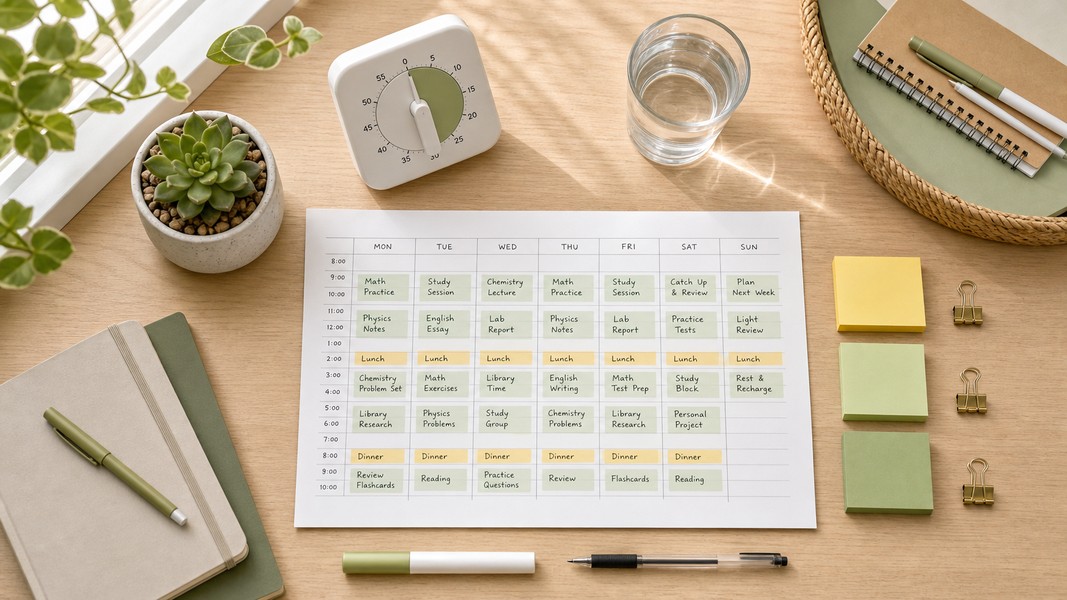
Struggling to manage your time as a student? These 7 evidence-backed tactics fix the real reasons students fall behind and waste hours.

Fathom AI is great for free Zoom notes, but it has real limits. Here are the best fathom ai alternatives for meetings, students, and multi-format capture.