
Zettelkasten: How to Build a Knowledge System
July 24, 2026
Learn how the Zettelkasten method works, why linked notes beat linear notebooks, and how to build your own knowledge system from scratch.


April 28, 2026
A solid CPA exam study plan covers 400 to 600 total hours spread across four sections over 12 to 18 months. That sounds like a lot, and it is. But most candidates who fail don't run out of time. They run out of structure.
This guide walks you through every stage of building your cpa exam study plan: how much time each section actually takes, which order to tackle them in, how to build a realistic weekly schedule, and which study methods hold up under the pressure of dense, technical content.
According to Becker's estimates, total study time across all four sections ranges from 400 to 600 hours. Here's how that breaks down per section:
Your Discipline section is a choice: BAR, ISC, or TCP. TCP has the highest pass rate at 77.65% because candidates can build directly on REG knowledge rather than starting fresh territory.
Working professionals with moderate obligations should plan for 8 to 12 hours per week. At that pace, completing 400 to 600 hours takes 50 to 75 weeks, roughly 12 to 18 months. Full-time students can push to 20 to 25 hours weekly and finish in 5 to 7 months.
The Uniform CPA Exam consists of three required Core sections and one Discipline section of your choosing. Every section runs four hours and includes multiple-choice questions (MCQs) and task-based simulations (TBSs).
FAR covers financial reporting for for-profit, nonprofit, and government entities. It's often the longest section to study because of the breadth of accounting standards. You'll face 50 MCQs and 7 TBSs.
AUD focuses on the auditing process, professional ethics, and attest engagements: 78 MCQs and 7 TBSs. The content overlaps with REG on professional conduct, which is worth keeping in mind when sequencing.
REG combines federal tax compliance, business law, and professional responsibilities: 72 MCQs and 8 TBSs. It's the shortest Core section by recommended study hours but covers more subject domains than most candidates expect.
Your Discipline section goes deeper into one specialty. BAR involves consolidations, business valuation, and strategic analysis. ISC focuses on IT governance and controls. TCP shifts from REG's compliance orientation toward tax planning strategy.
The order you take these sections matters. A good sequence reduces total study time by letting you carry knowledge forward rather than starting cold each time.
A commonly recommended approach: Start with FAR or REG, take AUD within a few months of REG, and save your Discipline section for last. Starting with FAR builds the accounting foundation that underlies other sections. Starting with REG gives you the tax and professional conduct grounding that AUD overlaps with directly.
Taking AUD close to REG pays off because both sections test professional ethics and regulatory frameworks. Studying them consecutively reinforces that shared content rather than letting it fade.
For your Discipline section: if you choose TCP, completing it immediately after REG captures the most overlap. BAR benefits from accumulated FAR knowledge. ISC is fairly standalone and works well as a closer.
Review the AICPA Exam Blueprints before committing to a sequence. These official documents outline topic weightings and skill levels per section. They're updated one to two times annually, so checking before you start ensures your plan reflects current exam content.
Your weekly target depends on your situation. Most working professionals can realistically commit 8 to 10 hours per week. Those with fewer outside obligations can push to 12 to 15. The goal isn't maximum hours per week; it's sustainable consistency over 12 to 18 months.
A realistic weekly structure for 12 to 15 hours looks something like this: two to three hours on weekday evenings split between lecture review and practice MCQs, four hours on Saturday morning covering simulations and weak topic review, and two to three hours on Sunday for spaced repetition and flashcard review. That leaves room for occasional flexibility without falling behind the plan.
A 6-month accelerated plan requires 20 to 25 hours per week and works best for full-time students or candidates taking time away from work. It's achievable but demands very consistent execution with almost no margin for disruption.
An 18-month plan at 8 to 12 hours per week suits most working professionals. It allows deeper absorption of FAR's complex standards, reduces burnout risk, and lets you repeat weak areas without compressing the schedule dangerously. Most candidates follow something close to this pace.
Focus on one section at a time. Switching between sections forces you to context-switch constantly, which fragments retention. Dedicate 8 to 12 weeks to each section depending on its recommended hours and your weekly availability.
During weeks one through eight, spend roughly 90% of your time on new material and 10% on review. In the final two weeks before each exam, flip that ratio: 10% new material and 90% review and full-section mock exams. This structure comes from UWorld Roger CPA and prevents the common mistake of learning right up to exam day with no consolidation period.
Re-reading lecture slides and notes feels productive but doesn't transfer well to the exam. The CPA tests application and analysis, not recall of isolated facts. You need methods that train your brain to retrieve and use information under timed, high-stakes conditions.
Spaced repetition is one of the most research-backed methods for the kind of high-volume memorization CPA prep demands. It works by spacing review intervals based on how well you know each concept. Material you've mastered fades into longer review cycles. Weak material stays in rotation until it sticks.
For CPA prep, this means reviewing flashcards on a spaced schedule (1 day, 3 days, 1 week, 2 weeks, 1 month) rather than cramming a stack the night before each exam. AI-powered AI flashcard tools automate this scheduling and adjust based on your performance, so the system adapts as your knowledge develops.
For accounting content, think in structure: Assets, Liabilities, Equity, Revenue, Expenses. For tax: classification, rate, deduction eligibility. Building these mental frameworks lets you reason through unfamiliar exam questions rather than searching for a memorized answer that may not surface under pressure.
Run individual MCQ sets of 20 to 40 questions during your learning phase. Progress to full-section simulations in weeks nine through twelve, and take full four-hour mock exams in the two weeks before each actual exam. This builds both content mastery and time management, which is a real variable on a four-hour test.
Most candidates use a structured review course. Leading providers include Becker, UWorld Roger CPA Review, and Surgent, each offering video lectures, practice question banks, adaptive flashcard libraries, and progress tracking.
Beyond a review course, a few tools can make dense CPA material more manageable. For professionals studying in fragmented windows of time, converting lecture recordings into organized notes and flashcards removes a major bottleneck. Voice Memos lets you record study sessions and automatically generates summaries, so you can review a two-hour lecture pass in 15 minutes. Its PDF upload feature processes accounting standards documents directly into quiz questions and spaced repetition decks, cutting the time between reading and active practice.
Audio review is particularly underused in CPA prep. Reviewing recorded summaries during commutes, workouts, or other transitional periods can add several hours of productive review per week without extending your desk time. Voice Memos supports this with transcription in 40+ languages and automatic action detection, which surfaces key concepts and review items from any recorded content.
For candidates working through dense materials like FASB standards or IRC sections, converting those PDFs into interactive flashcard decks makes the content actively testable rather than passively readable.
Long-form exam prep breaks down in predictable ways. Here's how to address the most common failure points before they happen.
If you fall behind your hours target: Identify whether the hours were unrealistic or whether life disrupted an achievable schedule. Recalibrate the timeline for that section; extend by two to four weeks if needed, but don't abandon consistency by cutting weekly hours below your sustainable minimum. Eight steady hours per week beats 20 erratic hours with three-week gaps.
When a practice exam reveals a weak area: Don't skip it. Spend one to two focused weeks doing targeted practice on that specific topic type. Review course providers typically offer support resources for concepts that stay stubborn across multiple review cycles.
To maintain momentum across sections: Schedule study like a fixed appointment, not a flexible preference. Track your weekly hours against your plan and make small adjustments weekly. Completing each section is worth pausing to acknowledge; the timeline is long enough that consistency needs to feel like progress.
A successful plan looks like this in practice:
Start with your recommended hour estimate per section (120-150 for FAR, 110-140 for AUD, 80-110 for REG, 60-150 for your chosen Discipline). Divide by your weekly hours to get the number of weeks per section. Sequence Core sections first, with AUD following REG, and your Discipline section last. Spend the first 80% of each section's study block on new material and the final 20% on consolidation and simulation practice. Use spaced repetition for all high-volume memorization, and review the AICPA Exam Blueprints before you start and after any major exam content updates.
Passing the CPA exam comes down to three things done consistently: enough hours distributed across a realistic timeline, active learning methods that prepare you for application rather than recall, and a schedule you can maintain for 12 to 18 months without burning out. Structure matters more than intensity. Starting with a concrete cpa study plan, adjusting it regularly against your actual progress, and keeping your methods active rather than passive is what separates candidates who pass on the first attempt from those who keep rescheduling.
Discover more insights and tips to enhance your productivity
Learn how the Zettelkasten method works, why linked notes beat linear notebooks, and how to build your own knowledge system from scratch.
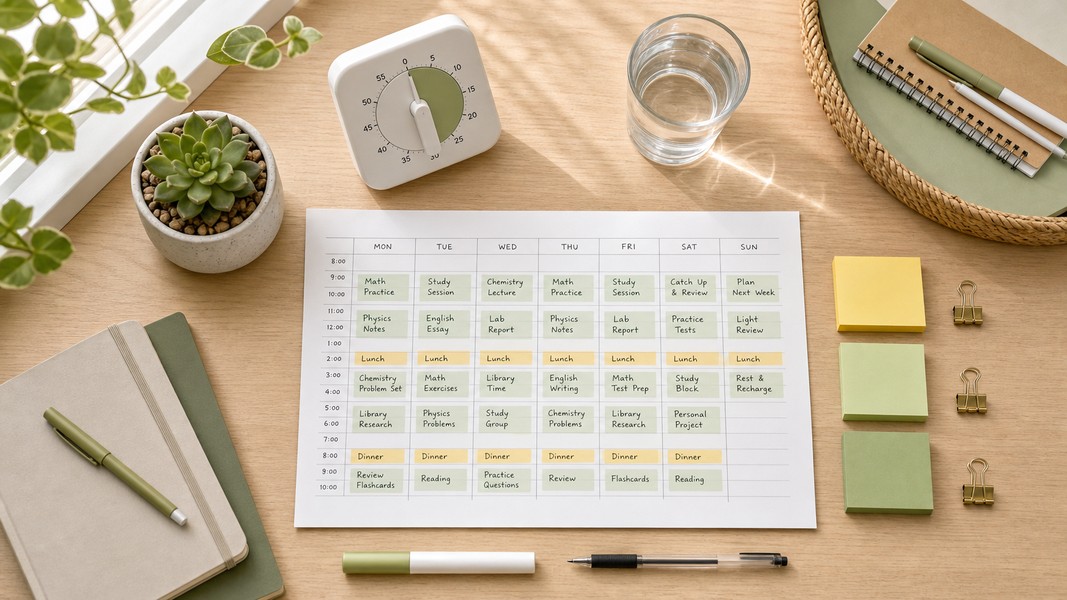
Struggling to manage your time as a student? These 7 evidence-backed tactics fix the real reasons students fall behind and waste hours.

Fathom AI is great for free Zoom notes, but it has real limits. Here are the best fathom ai alternatives for meetings, students, and multi-format capture.