
Zettelkasten: How to Build a Knowledge System
July 24, 2026
Learn how the Zettelkasten method works, why linked notes beat linear notebooks, and how to build your own knowledge system from scratch.


April 5, 2026
A strong LSAT study plan runs 3 to 6 months, with 120 to 400 total study hours depending on your target score and starting point. The exam tests three core skill areas: logical reasoning, analytical reasoning (logic games), and reading comprehension. A well-structured plan divides your time across these sections systematically, starting with concept mastery and progressing to timed full-length practice tests.
If you're building your lsat study plan now, this guide covers both a 3-month track for focused prep and a 6-month track for deeper score improvement.
The LSAT consists of four scored 35-minute sections: two Logical Reasoning sections (24-26 questions each), one Analytical Reasoning section (22-24 questions), and one Reading Comprehension section (26-28 questions). There's also one unscored variable section and an unscored Argumentative Writing sample.
Scores range from 120 to 180. According to LSAC, the median score sits around 150 to 152, with roughly 45% of test-takers falling between 145 and 155. Top law programs typically expect 166 and above; solid regional schools admit students at 155 to 162.
Most successful test-takers invest between 120 and 400 hours of preparation. Reaching a score around 150 requires getting roughly two-thirds of questions correct. Scoring 160 or higher requires consistent accuracy across all three section types.
Plan for 1 to 2 hours per day, four to five days a week. This pacing prevents burnout and gives you time to absorb reasoning concepts between sessions. Research shows that 200 to 400 hours correlates with meaningful score improvement from average to competitive levels. If you're targeting a top-20 school, build toward the higher end of that range.
A 3-month lsat study plan runs in three phases: foundation, skill-building, and test-week readiness.
Weeks 1-4: Foundation
Spend the first month learning core concepts for each section without time pressure. For Logic Games, practice identifying game types (sequencing, grouping, matching) and building diagrams from scratch. For Logical Reasoning, learn the common argument structures: flaw, assumption, strengthen, weaken, inference. For Reading Comprehension, focus on identifying paragraph roles and passage structure before looking at questions.
Dedicate 10 to 15 hours per week during this phase. Take one untimed diagnostic test in week 1 to establish a baseline, then set it aside until week 5.
Weeks 5-8: Skill-Building
Shift to timed section practice, working under real 35-minute conditions. After each section, do blind review: go back through every question and record your reasoning before checking the answer key. This process, not just reviewing wrong answers, is where consistent improvement happens.
Introduce one full practice test per week starting in week 6. Review each test thoroughly over the two days following it.
Weeks 9-12: Practice Tests and Refinement
Run two full timed practice tests per week. Between tests, focus on error patterns rather than reviewing every question. Identify your weakest question types and target those specifically.
In the final week, stop taking new tests. Review your error log, reinforce your strongest strategies, and rest.
The 6-month study plan for lsat prep extends each phase and adds a deeper mastery period before test-intensive prep.
Months 1-2: Concept Mastery
Take a full diagnostic in week 1 to set your baseline. Spend the first two months working through each section type without time pressure, using a prep book or structured course to build conceptual foundations. Focus on understanding why correct answers are correct, not just what they are.
Months 3-4: Skill Development
Shift to timed sections and weekly practice tests. Introduce blind review consistently. Most test-takers see a meaningful score gain in this phase when their review process is disciplined. Use spaced repetition to reinforce question-type recognition, returning to earlier concepts regularly rather than treating them as finished.
AI flashcard makers can help here: convert your notes on logical argument types, game rules, and common flaws into decks you review daily. Spaced repetition keeps frameworks fresh without requiring you to re-read lengthy prep notes.
Months 5-6: Full Test Mode
Run 2 to 3 full practice tests per week. Track your score by section over time, not just by total. If Logical Reasoning is holding down your overall score despite strong performance elsewhere, shift your drilling focus accordingly.
Target incremental milestones: a 5-point gain by month 3, a 10-point gain by month 5. These benchmarks help you calibrate whether your approach is working and where to adjust.
Logic Games intimidates most new test-takers, but it's also the section where score improvement is most predictable with the right approach.
Spend the first 2 to 3 minutes of each game reading all rules and building your diagram before looking at any questions. Identify the game type (sequencing, grouping, hybrid) and write out all inferences, especially "Not Laws" covering positions a variable can't occupy. Fast, accurate diagramming built from a complete rule set is the foundation for every question in the game.
Target 8 to 9 minutes per game, leaving slightly more time for complex hybrid setups. If a question takes more than 2 minutes to work through, skip it and return after finishing the other questions in that game.
Logging your diagrams and rule chains after each practice session helps you recognize structural patterns faster. Voice Memos lets you record verbal walk-throughs of your diagramming process, then transcribes them for review. Explaining the rules out loud reinforces your reasoning even when you get the question right.
Reading Comprehension rewards methodical readers, not fast ones. Read each passage in 3 to 4 minutes, noting the main point of each paragraph and the author's perspective. Avoid over-annotating: a brief structural label per paragraph is more useful than underlining large portions of text.
Allocate 5 to 8 minutes for the question set after each passage, targeting roughly 8 minutes and 45 seconds total per passage set. Global questions about main idea or primary purpose should be answered from your structural understanding of the passage. Local questions about specific details or sentence function typically require a quick return to the relevant section.
LSAC's format guide is worth reviewing before your first practice test to understand exactly how each section is structured and scored.
Two Logical Reasoning sections together account for roughly half your total score. Target about 1 minute and 20 seconds per question to finish within 35 minutes. Use the 8-minute mark as a pacing checkpoint: you should be on question 6 or 7 at that point. The official prep materials include timed sections you can use to calibrate your pacing before full practice tests.
Identify the argument structure first: conclusion, premises, and assumptions. Most question types, whether strengthen, weaken, flaw, or assumption, require a clear read on the argument before you evaluate answer choices. Practice pre-phrasing the correct answer type before reading the options.
Common pitfall: relying on gut instinct instead of working through the argument structure. The LSAT is designed to reward systematic reasoning and penalize intuitive answers. This is why the reasoning process matters more than simply accumulating correct answers in practice.
AI study tools work well for LSAT prep because much of the test comes down to pattern recognition developed through repetition.
Voice Memos supports the review process in a few specific ways. You can upload your prep notes or annotated practice sets and generate quiz questions from that content directly, turning passive review into active recall. The app's mind map feature helps visualize rule chains and constraint relationships across different Logic Game setups, which is useful for students who benefit from a structural overview before drilling individual games.
For spaced repetition, converting your notes on argument types, game templates, and common question patterns into flashcard decks keeps those frameworks in active memory throughout your prep. The combination of voice capture, AI-generated review questions, and spaced repetition addresses the key challenge of LSAT prep: not just learning concepts, but retaining them under timed conditions.
Once you're through the LSAT and into law school, the same AI-assisted approach applies. The case brief template workflow you'll use in 1L is easier to build if you've already developed efficient AI-driven review habits during LSAT prep.
Inconsistent scheduling is the most practical obstacle. Missing sessions compounds: it takes longer to rebuild momentum than to maintain it. Build in one or two scheduled rest days per week, but protect your study blocks.
Building overly complex Logic Game templates and over-annotating Reading Comprehension passages are twin traps. Both slow you down without improving accuracy. Simpler systems applied consistently outperform elaborate methods that fall apart under time pressure.
Finally, avoid measuring progress only by total score. Section-level tracking tells you where time investment is paying off and where your approach needs adjustment.
The 3-month lsat study plan suits candidates with a focused prep window and a baseline score within range of their target. The 6-month plan works for anyone making a larger score jump, returning to test prep after time away, or managing prep alongside a demanding course load.
In both tracks, blind review and consistent timed practice tests matter more than raw hours logged. Pair structured prep with AI tools that make your review sessions more efficient and your retention stronger, but don't substitute tool use for the careful reasoning work the test actually requires.
Discover more insights and tips to enhance your productivity
Learn how the Zettelkasten method works, why linked notes beat linear notebooks, and how to build your own knowledge system from scratch.
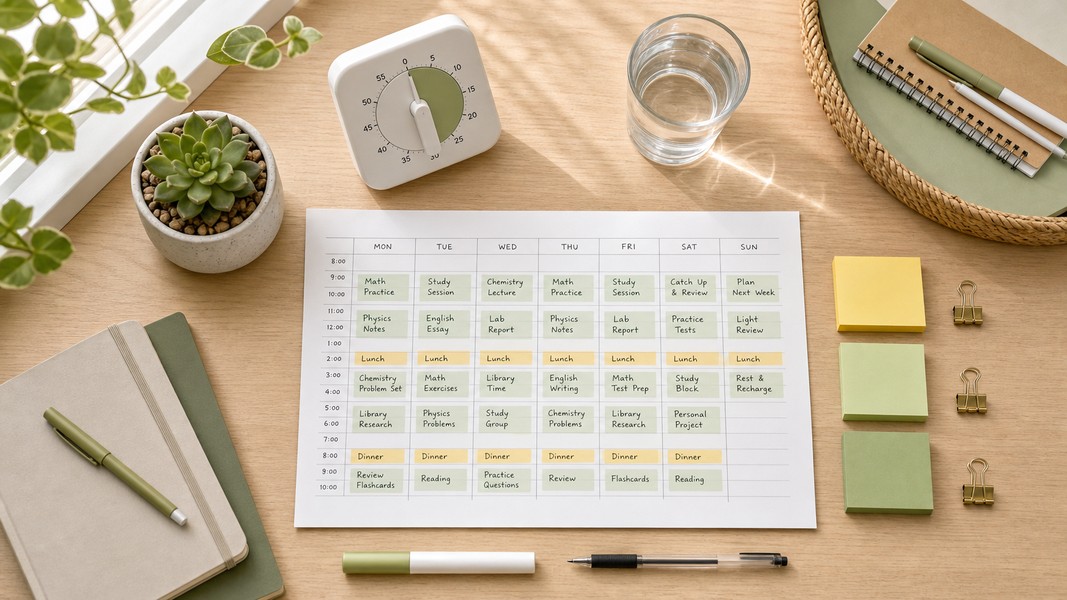
Struggling to manage your time as a student? These 7 evidence-backed tactics fix the real reasons students fall behind and waste hours.

Fathom AI is great for free Zoom notes, but it has real limits. Here are the best fathom ai alternatives for meetings, students, and multi-format capture.