
Zettelkasten: How to Build a Knowledge System
July 24, 2026
Learn how the Zettelkasten method works, why linked notes beat linear notebooks, and how to build your own knowledge system from scratch.


April 10, 2026
Passing NCLEX requires more than reviewing textbooks. The exam is computer-adaptive, adjusting question difficulty based on your answers in real time, and the 2023 introduction of Next Generation NCLEX (NGN) shifted the focus further toward clinical judgment over memorized facts. A structured nclex study plan that accounts for both the format and the content gives you the best chance at a first-attempt pass.
Most candidates prepare over 8-12 weeks after graduation. Starting soon after finishing nursing school keeps course content fresh and avoids the significant retention loss that comes from waiting months before studying. This guide walks you through a phased workflow: baseline assessment, systematic content review, and high-volume practice, adaptable for NCLEX-RN or NCLEX-PN.
The NCLEX tests minimum competency for safe nursing practice, not mastery of every clinical topic. It uses NCSBN standards to determine whether you can think critically and safely in clinical situations, not whether you can recite everything from your pharmacology textbook.
The exam delivers between 85 and 150 questions within a five-hour window. Because it's computer-adaptive, the exam ends when the algorithm has statistical confidence in your competency level. Question count alone tells you nothing about your performance: some candidates pass in 85 questions, others need 150.
The Next Generation NCLEX format, active since 2023, introduced new question types including case studies, bow-tie questions, matrix grids, and drop-down menus. These question types reward clinical reasoning: understanding why a nurse would take an action and what the consequences are, rather than pattern-matching to a memorized answer. Candidates who prepare only with traditional multiple-choice question banks consistently find these formats disorienting on exam day.
The 2026 test plan (effective April 1, 2026) carries over the same structure with minor updates: the "Safety and Infection Control" subcategory is now "Safety and Infection Prevention and Control," and there is added emphasis on health equity and unbiased care. The overall content weights and question format remain unchanged.
Before you open a review book, take a diagnostic assessment. Most major question banks, including UWorld, Kaplan, Archer, and NCLEX Bootcamp, offer diagnostic exams or performance analytics that reveal your weakest content areas from the start.
Your goal in Phase 1 is to understand two things: which NCLEX content categories you're weakest in, and how comfortable you are with the NGN question format. If bow-tie questions or case studies feel unfamiliar, you need to build that familiarity before you can start improving your performance on them.
Use the NCSBN test plan as your map. The NCLEX-RN tests eight client needs categories. Management of Care carries the highest weight at 17-23%, followed by Physiological Adaptation at 11-17% and Pharmacological and Parenteral Therapies at 10-16%. These three categories alone can account for nearly half of your exam questions, so weaknesses here carry disproportionate risk.
Spend the first week taking your diagnostic assessment and reviewing the test plan structure. In the second week, build your study schedule by assigning time proportional to content weight, not proportional to how comfortable you already feel. Most candidates instinctively spend more time on areas they know well. A diagnostic-driven schedule corrects that tendency before it costs you.
Content review is not passive reading. Reading a chapter does not prepare you for clinical judgment questions that ask you to prioritize, delegate, or identify a deteriorating patient. Your review needs to connect facts to clinical scenarios from the start.
Work through content in blocks aligned with the test plan categories. Start with your weakest areas while your energy and motivation are highest. Within each category, focus on the highest-weighted subcategories first. Management of care and pharmacology deserve more time than health promotion and maintenance, given their relative weight in the final exam.
For pharmacology, which sits in the 10-16% range and consistently trips up candidates, use spaced repetition flashcards to anchor drug classes, mechanisms, and nursing considerations. Pharmacology is one area where active recall clearly outperforms passive review: you need to retrieve information under pressure, not just recognize it when reading. Voice Memos can generate flashcard decks from voice recordings or uploaded PDFs, letting you convert your nursing school notes or textbook chapters into study materials without retyping everything from scratch.
Set a daily practice question target in this phase. Expert guidance and major prep platform recommendations converge on roughly 60 practice questions per day as an effective baseline. The critical habit is reviewing every rationale, not just checking your score. Understanding why a wrong answer is wrong teaches more than getting a question right by chance. Candidates who skip rationale review often plateau in their scores and can't identify why.
Include NGN question types in your daily practice from week 3. Treating case studies and bow-tie questions as a separate "advanced" topic to tackle later is a common mistake. By building them into your regular practice early, you make them routine rather than stressful when they appear on exam day.
By week 9, your content review should be complete and your question-answering rhythm should feel natural. Phase 3 shifts focus to high-volume timed practice, full-length simulations, and targeted performance review based on your analytics.
Run timed 75 or 85-question blocks at least twice per week. Timed sessions build the mental endurance needed for a five-hour adaptive exam and reveal how your decision-making changes under time pressure. Most candidates find their accuracy drops in the final third of a long session. Identifying that pattern in practice, rather than on exam day, gives you time to correct it through rest strategies and pacing adjustments.
Use your question bank analytics to drive your review. If you're scoring below average in reduction of risk potential or clinical judgment scenarios, pull targeted question sets from that category rather than defaulting to random mixed practice. Voice Memos' quiz mode can supplement platform-based review: generate short quiz sets from your own notes on a specific content area, which reinforces weak spots without requiring you to open a separate platform.
Quality of review matters more than question volume. Three hundred well-reviewed questions per week, where you fully understand each rationale, beats 600 questions where you move on without processing what went wrong. NCLEX failures trace more often to inadequate rationale review and weak clinical judgment development than to gaps in content knowledge.
In your final week before the exam, reduce question volume, review your most-missed categories from your analytics, and prioritize sleep. Fatigue directly impairs clinical reasoning, which is exactly what NCLEX measures.
The following 10-week framework works for most candidates with 8-12 weeks of preparation time:
Candidates with 12-14 weeks should extend the content review phase and add a dedicated week for NGN format practice in the middle. Candidates with 4-6 weeks should compress weeks 1-2 into a single diagnostic week and increase daily question targets to compensate.
The NCLEX-PN covers the same eight client needs categories but with a scope adjusted to practical and vocational nursing responsibilities. The RN exam focuses heavily on leadership, delegation across a healthcare team, and multi-patient management. The PN exam centers on direct patient care, safety implementation, and clinical interventions within the scope of a practical or vocational nurse.
For PN candidates, the phased approach is identical: diagnostic assessment first, content weight drives your schedule, and daily practice questions anchor your preparation. The key adjustment is in how you approach management of care questions. RN management questions frequently involve delegation decisions and oversight of unlicensed personnel. PN questions in the same category focus more on recognizing when to report findings to an RN or physician and implementing established care plans within defined boundaries.
Practicing with active recall techniques applies equally to both tracks. Testing yourself on the material, through flashcards, self-quizzing, or practice questions, consistently outperforms re-reading notes for retention and clinical reasoning development. The retrieval process itself strengthens your ability to apply information under exam conditions.
The most common preparation errors follow a predictable pattern: candidates study the way they studied in nursing school, which was optimized for course exams, not the NCLEX format.
Passive review is the biggest trap. Re-reading lecture notes and highlighting textbooks produces familiarity with content, not the ability to apply it under pressure. NCLEX questions rarely test recognition of a fact. They test what a nurse should do with that fact in a specific clinical situation. Every study hour spent on passive review is an hour that could have gone toward active practice.
Delaying the exam beyond 3-4 months is another frequent mistake. Nursing school content fades quickly once you stop using it daily. Candidates who wait six months or more before scheduling often spend a significant portion of their prep time relearning material they knew well at graduation. Schedule your exam soon after completing nursing school, not after an extended delay.
Studying comfort zones over weak areas is a structural problem in many self-directed plans. Your score improves most by raising your floor in weak categories, not by reinforcing categories where you're already strong. Let your diagnostic data drive your schedule, and revisit that data regularly as you progress through Phase 2.
Finally, underestimating NGN question types is a growing issue for candidates who rely on older study materials. Prep resources that predate 2023 don't include bow-tie questions, matrix grids, or case study formats. Verify that your question bank covers the full current NGN format before committing to it as your primary practice tool.
A strong NCLEX study plan starts with an honest baseline assessment, uses the official test plan to allocate your time based on content weight, and builds toward high-volume practice with rigorous rationale review. The phased approach here takes you from diagnostic clarity through content mastery and into exam-ready practice over 8-12 weeks. Clinical judgment is the skill the exam tests most directly: every study habit you build should reinforce applying knowledge in realistic scenarios, not just storing facts for recognition questions.
Discover more insights and tips to enhance your productivity
Learn how the Zettelkasten method works, why linked notes beat linear notebooks, and how to build your own knowledge system from scratch.
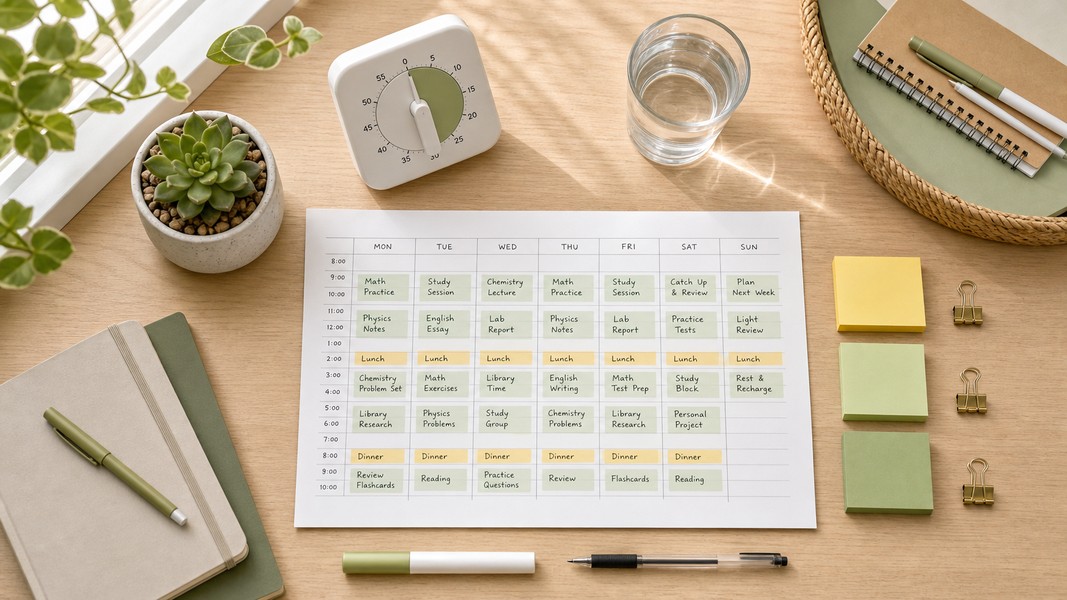
Struggling to manage your time as a student? These 7 evidence-backed tactics fix the real reasons students fall behind and waste hours.

Fathom AI is great for free Zoom notes, but it has real limits. Here are the best fathom ai alternatives for meetings, students, and multi-format capture.