Best Voice Notes Apps: Top Picks Tested
July 17, 2026
The best voice notes app does more than record. Compare top AI-powered picks for students and professionals, including transcription, summaries, and study tools.


April 18, 2026
Test taking strategies are the techniques you apply before, during, and after an exam to maximize your performance under pressure. Most students focus entirely on studying more content. Few ever practice the skills that determine how well they demonstrate that knowledge when it actually counts.
The result is predictable: well-prepared students blank on material they know, lose points to poor time management, or talk themselves into changing correct answers. This guide covers every stage of the exam process, from weeks before test day to how you review your results afterward, so you're prepared for the performance itself, not just the content.
Understanding what causes underperformance is the first step toward fixing it.
Test anxiety is a primary driver. When panic sets in during an exam, your working memory capacity drops sharply, making it harder to retrieve information you've stored. The APA identifies test anxiety as one of the most significant academic stressors students face, with many reporting complete "blanking" on material they knew well during review. The knowledge is there. The anxiety blocks access to it.
Cramming compounds the problem. Reviewing material for the first time the night before produces surface-level familiarity, not durable memory. Students who cram often feel confident going in and then struggle when exam questions require application or analysis. Distributed practice, spacing your study over days and weeks, produces the kind of retention that holds up under exam conditions.
Unfamiliarity with the exam format is underrated as a cause of lost points. If you've never practiced timed, format-specific questions (multiple choice, short answer, essay) before the actual exam, the format itself becomes part of the challenge. Every unfamiliar element consumes attention that should go toward demonstrating what you know.
How you structure your preparation matters as much as the hours you put in.
Distributed practice is the foundation. Space your review sessions over days and weeks rather than concentrating them into one or two long sessions before the exam. Short focused sessions of 30-45 minutes using active techniques produce deeper retention than extended cramming, because sleep and spacing allow memory consolidation to occur between sessions.
Self-testing is one of the most effective preparation techniques available. Taking practice questions, not just reviewing notes, forces active retrieval from memory, which strengthens the retrieval pathway for future use. Research published by learning scientists at the National Academies documents that self-testing can improve performance by up to 50% compared to passive re-reading of the same material.
Building active recall into your study sessions rather than rereading is one of the highest-leverage changes you can make. Close your notes and try to reconstruct key ideas from memory. Use flashcards, write summaries without looking at source material, or answer practice questions and check what you got wrong.
Practice tests under timed, realistic conditions serve a second purpose beyond content review: they desensitize you to the exam environment. Students who run full-length, timed practice exams every few weeks heading into a major test report lower anxiety on test day because the experience feels familiar rather than novel.
Voice Memos can generate quiz questions directly from your lecture recordings, uploaded PDFs, and study notes. Running these AI-generated quizzes under timed conditions gives you exam-style practice from your own material, without spending time manually writing practice questions or searching for external question sets.
Your study schedule for the weeks before an exam should prioritize active practice over passive review. If you're spending most of your study time rereading, you're reinforcing familiarity, not retrieval strength.
The night before an exam, what you avoid matters as much as what you do.
Avoid introducing new material. Reviewing content for the first time the night before an exam does not produce reliable retention. It adds anxiety without adding meaningful preparation. Light review of your existing notes, or a short quiz on material you've already studied, is reasonable. Encountering entirely new topics at the last minute is not.
Sleep is a non-negotiable factor. Research on sleep and cognition consistently shows that even one night of poor sleep impairs working memory, attention, and recall of previously learned material. Staying up late to squeeze in more review hours costs more than it gains.
Prepare your logistics the night before: confirm where you need to be, what time to arrive, what identification or materials are required. Reducing morning friction lowers pre-exam stress before you even enter the room.
A brief, light review followed by a consistent wind-down routine will leave you better positioned than a five-hour cramming session followed by four hours of sleep.
The first few minutes set the tone for everything that follows.
Read the full instructions before starting. Instruction-skipping is a consistent source of avoidable errors. Exam format can vary even within the same course, and assumptions based on previous tests sometimes cost points on the very first question.
Before writing anything, scan the full exam. Identify which sections carry the most weight, estimate the time available per section, and make a rough allocation. Time management decisions made before you start are more reliable than time checks made midway through when anxiety is higher.
Start with questions you feel confident about. Building momentum early brings your thinking into a clearer state and ensures you collect the points you know. Return to difficult questions after you've moved through the material you're more comfortable with.
When you get stuck, skip and move on. Sitting on a question you cannot answer is one of the most expensive uses of exam time. Mark it clearly, move to the next question, and return when you've finished the rest of the section. Later questions often trigger recall that helps with earlier ones.
Use scratch paper actively throughout. Writing out calculations, partial reasoning, or key terms offloads cognitive work from working memory, where anxiety applies the most pressure. Externalizing your thinking reduces the load and creates a trail you can check.
Set rough checkpoints for yourself: aim to have completed a certain section by a certain time, then check once per section. Constant clock-watching elevates anxiety without improving pacing. Planned check-in points keep you on track without disrupting your focus.
Multiple-choice exams have a distinct set of techniques worth practicing separately from general test-taking.
Read the question stem before looking at the answer choices. Forming your own answer before seeing the options reduces the influence of plausible-sounding but incorrect distractors. Then compare what you formed against the choices rather than evaluating each option in isolation.
Eliminate obviously incorrect answers first. Narrowing a four-option question from four choices to two doesn't just improve your odds if you guess: the act of elimination forces active engagement with each option and often reveals the correct answer through contrast.
Be cautious about changing your first answer. Research on first-instinct accuracy generally supports staying with your initial choice unless you have a clear, reasoned basis for changing it. Vague second-guessing tends to move students away from correct answers more often than toward them.
Watch for absolute language in answer choices. Options containing "always," "never," or "all" are frequently incorrect because they leave no room for exceptions. More nuanced options are often closer to accurate for complex subject matter.
For format-specific exams like the NCLEX, SAT, or licensing tests, Voice Memos can create practice quizzes in multiple-choice format from your own study materials, helping you build pattern recognition for how questions in that specific exam style are typically constructed.
Essay questions test a different skill set, and poor time use within this section is the most common source of lost points.
Spend 10-15% of your allotted time planning before you write. For a 45-minute essay, three to five minutes of outline work produces a more coherent, complete response than jumping straight to writing. An outline forces you to identify your key argument, supporting points, and conclusion before the clock becomes a source of anxiety.
State your thesis or main point clearly in the opening paragraph. Essay graders read quickly. A clear opening statement signals that you understand the question and have a position. Burying your main argument deep in the response costs credit regardless of how well the body is written.
Answer what the question actually asks. Students under pressure sometimes write at length about related material they know well rather than addressing the specific prompt. Read the question twice before outlining: once to understand it, once to confirm your outline matches.
For short-answer questions, lead with the key term or concept being tested, then elaborate. Graders working through large numbers of responses scan for direct answers, not buildup.
Budget time across questions proportionally to their point value. A question worth 20 points deserves twice the time as a 10-point question, not an equal split.
Anxiety during an exam is normal. What you do with it determines whether it stays manageable.
Controlled breathing is the most accessible in-exam technique for reducing acute anxiety. Slow exhales activate the parasympathetic nervous system, countering the fight-or-flight response that anxiety triggers. A few deliberate, slow breaths before you begin or when you feel stuck take under a minute and can noticeably lower your physiological stress level.
Cognitive reframing matters equally. Test anxiety often produces negative self-talk: "I'm going to fail," "I don't know anything," "Everyone else is finishing faster." These thoughts are rarely accurate and consume attention that could go toward the questions in front of you. Recognize them as anxiety output, not factual assessments, and redirect attention to the next answerable question.
Don't monitor other students. Other people finishing early is not information about your performance. Different strategy approaches, confidence levels, and question distributions produce different completion times. Focus entirely on your own pace.
If anxiety spikes at any point, give yourself permission to pause for twenty to thirty seconds, use a breathing technique, and return. This is not wasted time. Spending thirty seconds to recalibrate is almost always less costly than spending several minutes stuck in a spiral.
The best time to decide what you'll do when you feel stuck is before the exam, not during it. Having a plan, "I'll take three slow breaths, skip the question, and return," means you respond automatically rather than improvising under pressure.
How you process exam results determines whether the experience improves future performance.
Review mistakes systematically rather than emotionally. Each wrong answer is data about a specific gap: a concept you haven't solidified, a question format you misread, or a time management decision that cost accuracy. Identifying which category of error produced the mistake gives you a concrete fix for the next exam.
For knowledge gaps, return to your source material and generate new practice questions on the content you got wrong. Voice Memos can generate focused quizzes from your uploaded notes on any specific topic, which is more efficient than re-reviewing an entire set of material when only a few concepts need reinforcement.
For strategy errors, such as misread questions, poor time allocation, or changed correct answers, document what happened and adjust explicitly before the next exam. Strategy errors are behavioral and respond well to explicit correction rather than simply studying harder.
Track your performance trend across practice tests and real exams. A single result is a data point; a trend tells you whether your preparation approach is actually working. If scores plateau despite increasing your study hours, that is a signal to change strategy, not volume.
Treat mistakes as information, not verdicts. Students who analyze errors and adjust their approach improve faster than those who respond to poor results by studying more of the same way. The exam is not a final judgment. It is a round of feedback that informs what comes next.
Test-taking strategies work at every stage of the exam process, not just in the room on the day. Distributed practice and self-testing before the exam build the retrieval strength that holds up under pressure. Core in-exam habits, reading instructions first, starting with confident questions, skipping and returning on difficult ones, protect your time and manage cognitive load. Format-specific techniques for multiple choice and essays improve accuracy within each section. Post-exam review converts results into better preparation for the next attempt. The students who improve fastest aren't always the ones who study the most hours: they're the ones who practice strategically, manage their performance environment, and learn from every result they get.
Discover more insights and tips to enhance your productivity
The best voice notes app does more than record. Compare top AI-powered picks for students and professionals, including transcription, summaries, and study tools.
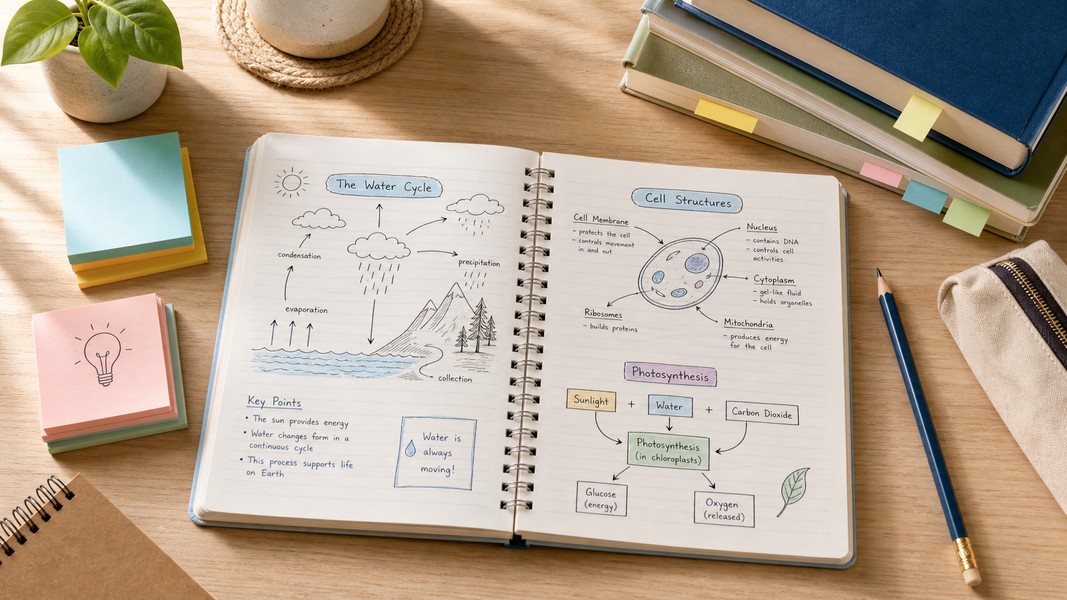
Dual coding theory shows that pairing text with visuals improves memory and recall. Learn how to use it with diagrams, mind maps, and structured notes.

Learn how the Pomodoro Technique works, how to use it for studying, why it boosts focus, and how to adapt it for ADHD and different subjects.