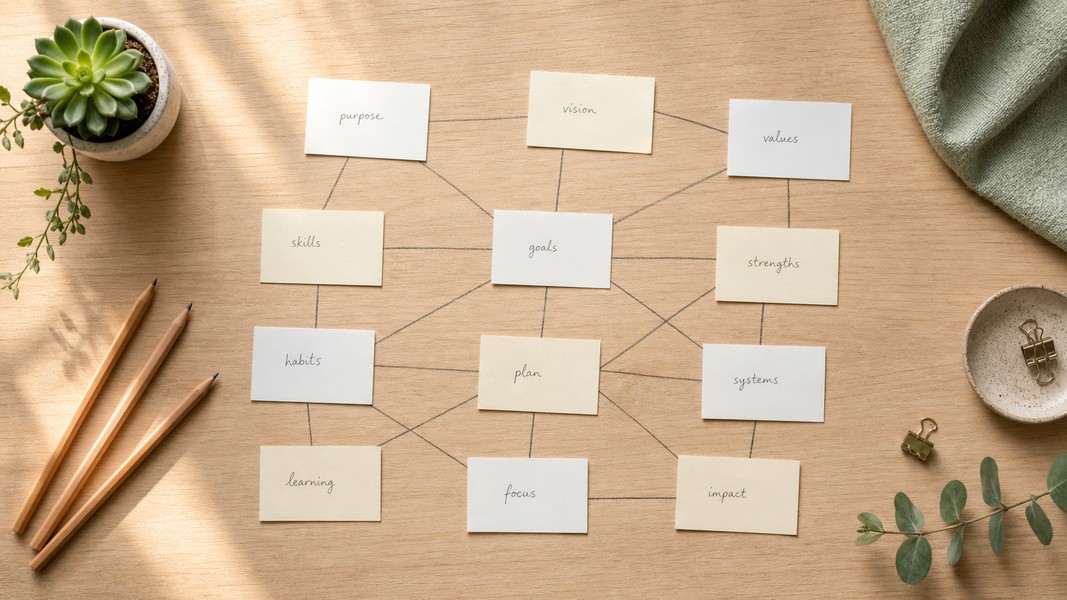
Zettelkasten: How to Build a Knowledge System
July 24, 2026
Learn how the Zettelkasten method works, why linked notes beat linear notebooks, and how to build your own knowledge system from scratch.


March 11, 2026
An AI PDF summarizer is a tool that uses natural language processing to automatically extract, analyze, and condense the most important information from PDF documents into concise summaries. Instead of reading a 20-page research paper from start to finish, you upload the file, and the AI returns the core arguments, key findings, and supporting evidence in seconds.
This matters because most reading tasks don't require word-for-word coverage. They require understanding what a document is saying well enough to decide what to do next. Whether you're screening papers for a literature review or trying to absorb a 300-page textbook before an exam, the ability to compress that first pass changes how much you can realistically cover.
Standard search and Ctrl+F locate specific keywords within a document. They find where a word appears but understand nothing about the meaning surrounding it. An AI PDF summarizer reads the document holistically, detects which ideas are central versus peripheral, and reconstructs the meaning in condensed form.
The difference matters in practice. If you're looking for a paper's conclusion, Ctrl+F for "conclusion" finds the heading. An AI summarizer extracts what the conclusion actually says, how it connects to the methodology, and what limitations the authors identified. You get the structure of the argument, not just the location of a word.
AI summarizers also work across PDF types: native digital documents, scanned physical pages, textbooks with tables and figures, reports with headers and subheadings. For scanned materials, they use optical character recognition to convert image-based text into processable content before the summarization begins.
Two distinct NLP approaches drive most AI PDF summarizers. Understanding the difference helps you know what you're getting.
Extractive summarization scores individual sentences in the document for relevance and selects the highest-scoring ones verbatim. It doesn't change the wording; it identifies which sentences already contain the most important information and presents those. This works well for factual documents where the core insight tends to live in a single sentence, like a policy statement or a research abstract.
Abstractive summarization takes it further. Using transformer-based models like GPT-4 or Claude, the AI builds an internal semantic representation of the entire document and then generates new text that captures the same meaning, often more concisely than any single sentence in the original. It can combine information from different sections into a unified summary, handle redundancy, and rephrase complex passages into simpler language.
Modern models use context windows exceeding 100,000 tokens, which means they can hold large documents in memory while generating summaries. Quality depends on three factors: context window size (longer documents need larger windows), semantic understanding (grasping tone, relationships, and argument structure), and structure detection (recognizing headers, lists, tables, and figures).
The average person reads at 200 to 300 words per minute. A standard 20-page academic paper runs around 10,000 words, which means 30 to 50 minutes of uninterrupted reading before you've seen the whole document once. Add note-taking and the time compounds quickly.
AI summarization compresses that initial pass to seconds. Research suggests that AI document review tools reduce manual review time by up to 70 percent by consistently identifying key points without the fatigue or cognitive drift that affects human readers over long documents. Average adult reading speed sits between 200 and 300 words per minute, putting a 10,000-word document at a 30 to 50 minute commitment before a single note is taken.
That said, the comparison isn't AI versus humans: it's AI for the right tasks versus AI for the wrong ones.
Manual reading outperforms AI for nuanced interpretation. Critical analysis of a primary source, detecting subtle framing or bias in an argument, close reading of literary or legal texts where word choice carries meaning: these require human judgment that AI summarization cannot reliably replicate. When the goal is understanding, not just screening, you still need to read.
Where AI wins clearly:
Literature reviews represent the clearest use case. When a research project requires assessing 50 to 100 papers for relevance, reading each one fully before deciding which ones matter isn't realistic. An AI PDF summarizer lets you scan the argument, methodology, and conclusions of dozens of papers in the time it would normally take to read three. You read the ones that make the cut; you skip the rest with confidence.
Textbook studying has a different logic. Most chapters contain a core concept plus repetition, examples, elaboration, and practice problems. The core concept is what you need to learn; the rest exists to help you internalize it. AI summarization extracts that core concept so you can focus your rereading and practice time on the parts that actually need it, rather than working through the entire chapter before knowing what to prioritize. In Voice Memos, uploading a textbook chapter produces a structured summary alongside the option to generate quiz questions directly from that content.
For professionals, the pattern applies across contracts, research briefs, investor reports, policy documents, and technical specifications. Any document where you need to understand the main point before deciding whether to invest full reading time benefits from an AI first pass.
International students studying in a second language often find AI summarization particularly useful. Getting a clean summary in plain language reduces the cognitive load of parsing dense academic prose in an unfamiliar linguistic register, making it easier to identify which sections require closer attention.
Output quality depends heavily on the specificity of your request. Sending a PDF and asking for "a summary" works, but being precise works better.
Ask for what you actually need. "Summarize the main argument, the three key supporting pieces of evidence, and the authors' stated limitations" produces a summary you can immediately use. "Extract the methodology and sample size" gives you exactly that for a research paper. The more targeted the request, the more directly usable the output.
PDF quality matters for scanned documents. Native digital PDFs, created directly in Word, LaTeX, or a PDF editor, give AI tools clean text to work with. Scanned physical documents introduce OCR errors, especially when the original has small fonts, margin annotations, or low-resolution scanning. If a scanned PDF is producing poor summaries, improving scan quality before uploading is often the most effective fix.
For documents longer than 100 pages, chunking by chapter or section consistently produces better results than uploading the entire file at once. Even with large context windows, very long documents can dilute the signal, particularly for abstractive models trying to synthesize across disparate sections.
Getting a summary is the beginning of the workflow, not the end. Passive review of a condensed document doesn't build long-term retention. What does build retention is using the summary as raw material for active study.
Voice Memos handles this pipeline directly. Upload a PDF, receive an AI-generated summary of the key content, then immediately convert those points into flashcards or quiz questions using built-in study modes. The extraction and study material creation happen in the same place, without copying and pasting between tools.
This matters because the summary identifies what's worth remembering. Active recall practice is how you actually remember it. Using the summary as the source for self-testing, rather than as the final step, closes the loop between reading and learning.
If you study across multiple sessions, pairing AI PDF summaries with spaced repetition strengthens retention further. The AI does the extraction; the spaced repetition system schedules your review sessions for optimal memory consolidation. You focus on actually engaging with the material instead of managing the logistics of what to review when.
The most effective students use AI PDF summarization not to read less but to read better. They use the summary to orient themselves before a closer read, to identify what to prioritize, and to generate the study materials they'll use over the following days. The AI handles the mechanical part of extraction; the learning still requires genuine engagement.
An AI PDF summarizer closes the gap between receiving a document and understanding what it contains. It compresses the first pass, surfaces the core ideas, and makes it possible to cover more material without sacrificing comprehension on the documents that actually matter. The key is using it strategically: for screening, for orientation, and as the starting point for study workflows that go deeper. The summary is a tool. What you do with it determines whether it helps you learn.
Discover more insights and tips to enhance your productivity
Learn how the Zettelkasten method works, why linked notes beat linear notebooks, and how to build your own knowledge system from scratch.

Struggling to manage your time as a student? These 7 evidence-backed tactics fix the real reasons students fall behind and waste hours.

Fathom AI is great for free Zoom notes, but it has real limits. Here are the best fathom ai alternatives for meetings, students, and multi-format capture.