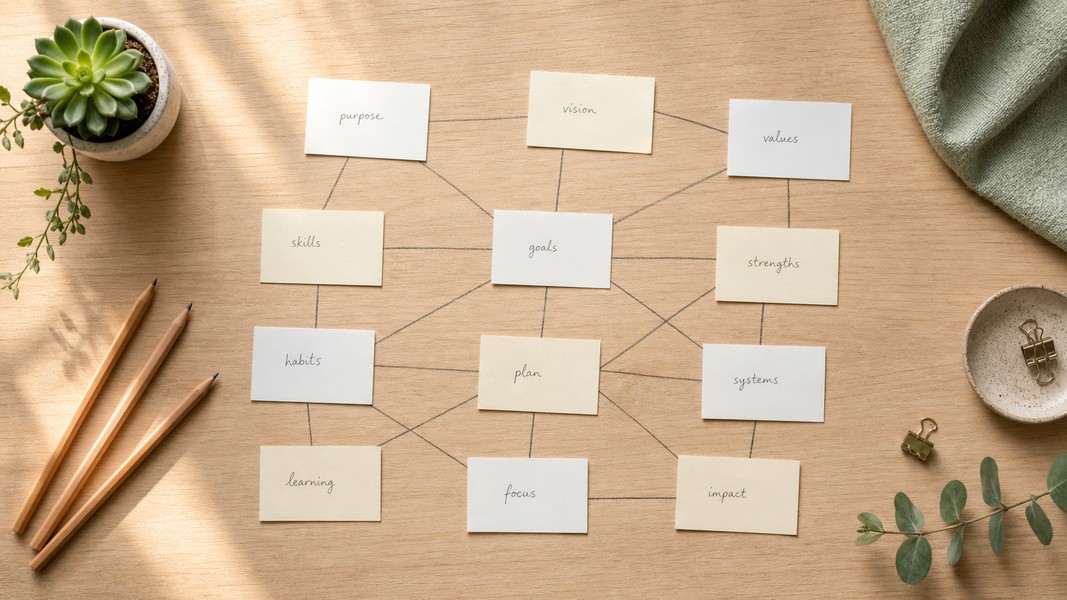
Zettelkasten: How to Build a Knowledge System
July 24, 2026
Learn how the Zettelkasten method works, why linked notes beat linear notebooks, and how to build your own knowledge system from scratch.


June 12, 2026
The best AI tools for productivity do one thing above all else: they remove the manual work that fills the gap between what happens in your day and what actually gets done. For busy professionals, that gap is enormous. Most of it is invisible until you track it.
Think about the last time you left a client meeting, a strategy session, or a discovery call. You probably carried three or four follow-up items in your head. Then your next call started, and those items started to blur. An hour later, you were reconstructing what you needed to do from half-remembered notes and vague memories. That reconstructive work is the productivity tax that AI tools now eliminate.
This guide covers how AI tools for productivity work, which categories matter most for knowledge-heavy roles, and how to start using them without overhauling your entire workflow.
Research consistently shows that knowledge workers spend the majority of their time on coordination rather than skilled work. One widely cited Atlassian analysis found employees spend roughly 60% of their time on meetings, email, and status updates rather than the actual work they were hired to do. Senior managers average around 23 hours per week in meetings, up from less than 10 hours in earlier decades, according to Harvard Business Review research on executive time use.
The meeting itself is only part of the problem. What follows is the real drain: writing up notes, converting discussion into tasks, updating project tools, sending follow-up emails, and remembering who said what. In fields with formal documentation requirements, like healthcare, clinicians can spend as much time on documentation as on patient care. That ratio maps closely to knowledge work more broadly, where the admin work after meetings can consume as much time as the meetings themselves.
Context switching compounds this. Every transition between meetings, documents, and tasks carries a cognitive cost of several minutes as the brain reloads context. For someone with back-to-back calls, a dense schedule never fully recovers. By the end of the day, the work that required deep focus either didn't happen or happened badly.
The issue isn't that professionals lack tools. Most already have email, a project manager, a CRM, and a notes app. The issue is that none of those tools automatically connect what happened in a meeting to what needs to happen next. That connection requires a human to sit down, remember, retype, and route information, repeatedly, every day.
AI productivity tools tackle that connection problem directly. Rather than requiring you to manually transcribe, organize, and route information, they capture what happens and structure it automatically.
The clearest evidence comes from healthcare. Systems like ambient AI scribes now handle clinical documentation in real time, reducing documentation time by 30-50% for physicians in several documented implementations. Kaiser Permanente rolled this out across 40 hospitals and 600+ medical offices specifically to let clinicians "spend more time focused on patients and less time on administrative tasks." The underlying capability, accurately capturing complex conversations and converting them into structured records, is identical to what AI productivity tools provide for business professionals.
For meeting-heavy roles, AI meeting recorders handle transcription, summarization, and action extraction in the background while you stay fully present in the conversation. Tools like Otter.ai can condense a one-hour meeting into a 30-second summary with key points and next steps, according to the company's own documentation. The value isn't the summary itself; it's that generating that summary no longer costs you any time.
Beyond meetings, AI tools now handle the organization problem that follows. The pattern of having ideas scattered across emails, chats, PDFs, and ad-hoc voice notes, then losing track of which ones mattered, is something a growing category of knowledge base tools addresses directly. By ingesting raw notes and documents, chunking them by topic, and making them searchable with source references, these tools convert a fragmented information environment into something you can actually query.
Voice Memos takes this further by working across input types simultaneously. You can record a voice note during a commute, upload a PDF from a vendor, and paste a YouTube URL from a webinar, and the AI processes all three formats into organized, searchable notes. The automatic detection of tasks, events, reminders, locations, and contacts happens across every input, not just audio, which means your action items surface whether they were spoken, written, or buried in a document.
Different work patterns call for different tool priorities. Here's where AI delivers the clearest return by situation.
Meeting-heavy professionals (sales reps, account managers, consultants, customer success) spend a large share of each day in conversations that generate follow-up obligations. For these roles, the highest-value AI capability is automatic capture and action extraction. You want to leave every call with a transcript, a summary, and a task list generated without any effort on your part. You also want those tasks routable to your CRM or project tool without manual copy-paste.
Research and interview-heavy professionals (analysts, journalists, UX researchers, strategy consultants) accumulate large volumes of qualitative data that need to be synthesized. AI transcription turns hours of recorded interviews into searchable text, and AI summarization surfaces the patterns without requiring a full re-read. The ability to query across multiple sources ("what did three different clients say about this issue?") is particularly useful for synthesis-heavy work.
Multi-project executives and founders struggle most with retrieval and context reconstruction. When you're across five projects simultaneously, remembering the reasoning behind a decision made three weeks ago is genuinely difficult. AI knowledge base tools that index your notes, emails, and documents and let you query them conversationally solve a real problem that no amount of folders and tags ever fully addressed.
For all three profiles, AI meeting notes have become the entry point to the broader category because meetings generate the most structured, predictable value from automation.
One consistently underrated aspect of AI productivity tools is that voice input is fundamentally faster than typing. Average conversational speaking speed is 120-160 words per minute. Average typing speed for most knowledge workers is 40-50 words per minute. That means voice capture is 2-3 times faster for raw idea capture, even before accounting for AI's role in structuring what gets captured.
The practical implication is that professionals who switch to voice-first workflows capture significantly more than they did when limited to typing. A workflow described by productivity writer Kyle Bradshaw illustrates this: after switching to AI audio tools, he noted capturing "more data now" than before, no longer needing to take notes in real time during meetings because the AI handled transcription, organization, and summarization. His attention stayed on the conversation rather than on the act of documentation.
Voice notes captured on the go, during a walk or a commute, carry the same organizational weight as formal typed notes when AI handles the structure. That changes what's worth capturing. Fleeting observations, half-formed ideas, and quick reactions that previously got lost because they weren't worth the friction of opening a notes app now become part of a searchable, organized record.
For professionals who work across contexts, voice-first capture combined with AI transcription and organization is a meaningful shift, not just a convenience upgrade.
Here's how this plays out in practice for a typical consulting or account management role.
Before AI tools, the workflow looked like this: join a client call, take fragmentary notes, end the call, spend 20-30 minutes reconstructing what was discussed, manually write a summary, copy action items into a task system, and draft a follow-up email. Repeat for each meeting in the day. That's one to two hours of admin for every three to four hours of actual conversation time.
With AI tools, the workflow compresses. You start a recording (or use a meeting bot), stay fully engaged in the conversation, and end the call with a transcript, a summary, and extracted action items waiting for your review. Review takes five minutes rather than thirty. The follow-up email drafts from the same material. CRM updates happen from the same structured output.
The time recovered isn't marginal. Across five client-facing calls in a day, a 25-minute reduction per call adds up to two hours of recovered capacity. Applied to a full work week, the math starts to change how much is actually possible in a day.
Voice Memos fits this workflow as an all-in-one option. Record the call or voice notes directly in the app, add the meeting PDF or deck as a PDF upload, and the AI identifies tasks, events, contacts, and reminders across all of it. The top AI note takers all address some version of this problem, but multimodal input, handling voice, PDF, camera scan, and video simultaneously, is rare outside of tools built specifically around it.
The fastest way to see results is to start with your highest-frequency, highest-cost pain point and apply one AI tool there rather than trying to overhaul everything at once.
For most professionals, that starting point is meeting documentation. Pick an AI meeting recorder or a voice-first note tool and use it consistently for two weeks. Don't change anything else. Track how much time you recover on documentation and follow-up for those meetings.
Once the capture habit is established, extend it to other input types. Start uploading the PDFs and documents you receive before meetings so your notes and the source material live in the same place. Add voice capture for ideas that come up outside of formal meetings.
The third step is building a light review habit. A five-minute daily pass through AI-extracted tasks and action items, before the day gets moving, prevents items from falling through the gaps. The tools generate the structure; the brief review ensures it actually connects to your work.
Most professionals who adopt this approach find the largest gains in the first two weeks, when the contrast between manual and AI-assisted documentation is most visible. The compounding benefit comes later, when months of structured notes, decisions, and contexts become searchable and retrievable rather than lost in a stack of documents nobody has time to read.
AI productivity tools for busy professionals are most valuable not as novelties but as a structural fix for the manual work that accumulates around knowledge work. The gap between what happens in conversations and what gets done is real, measurable, and now addressable.
The clearest ROI comes from three places: eliminating post-meeting documentation time, automating action item extraction and routing, and building a knowledge base that makes past decisions and contexts retrievable. Voice-first capture adds a speed advantage that compounds over time as more of your working day becomes part of a structured, searchable record.
The best approach is narrow and consistent at first. Pick the highest-friction point in your workflow, apply an AI tool there, and verify the time savings before expanding. That's how the shift from manual to AI-assisted knowledge work actually sticks.
Discover more insights and tips to enhance your productivity
Learn how the Zettelkasten method works, why linked notes beat linear notebooks, and how to build your own knowledge system from scratch.
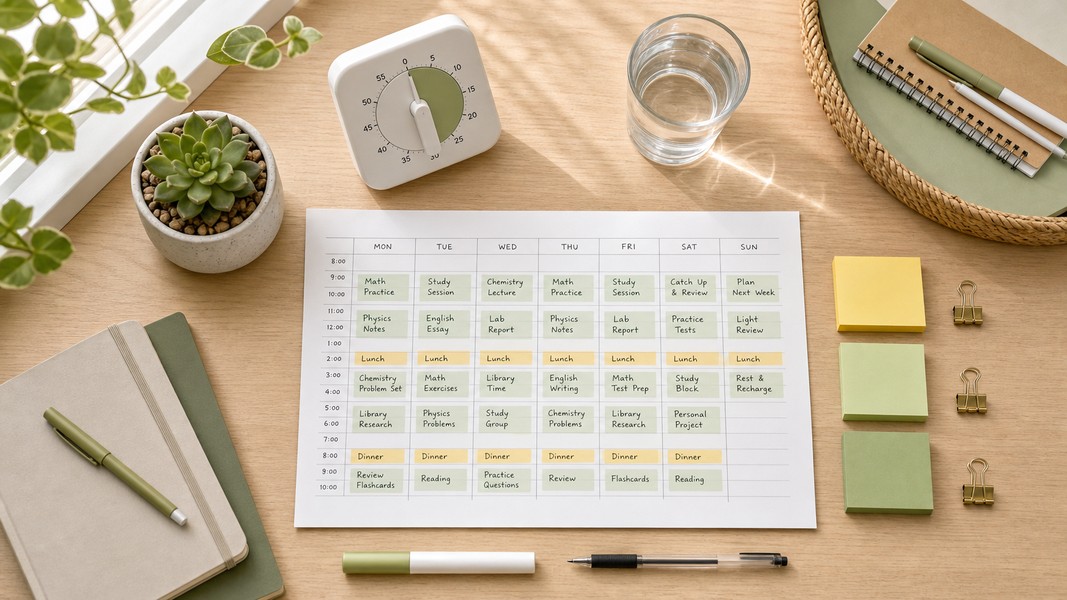
Struggling to manage your time as a student? These 7 evidence-backed tactics fix the real reasons students fall behind and waste hours.

Fathom AI is great for free Zoom notes, but it has real limits. Here are the best fathom ai alternatives for meetings, students, and multi-format capture.