Zettelkasten: How to Build a Knowledge System
July 24, 2026
Learn how the Zettelkasten method works, why linked notes beat linear notebooks, and how to build your own knowledge system from scratch.

July 9, 2026
A second brain is a personal knowledge management system that stores and organizes information outside your head so your mind can focus on thinking rather than remembering. The concept was popularized by Tiago Forte, whose BASB framework has transformed how millions of students and professionals approach note-taking and knowledge organization.
The problem is straightforward: you encounter far more information every day than your brain can hold. Lectures, meetings, articles, podcasts, conversations: they pass through you and disappear. A second brain captures that flow and turns it into something retrievable and useful.
These 7 techniques are designed to build a system that works long-term, not just when motivation is high.
A second brain isn't a dump of every note you've ever taken. It's an active system for capturing, organizing, distilling, and expressing knowledge in ways that compound over time. The goal is to make information retrievable when you need it, not to collect everything you've ever encountered.
Forte's PARA method gives this system a practical organizational backbone:
This structure works because it maps to how you actually use information, not just how you received it. A note on persuasion psychology belongs in Resources if you're studying the topic, or in a Project if you're using it to write a proposal this week.
Most people's notes exist in two states: freshly captured or completely abandoned. They write things down during lectures or meetings, then never return to them. Without a review habit or a retrieval system, notes become a digital storage graveyard that accumulates without ever delivering value.
The underlying failure isn't the act of capture. It's everything that comes after. A Gartner study found that nearly half of digital employees struggle to find the information they need to do their jobs effectively. The bottleneck isn't input; it's the missing loop between capture, processing, and recall.
A second brain fixes this by treating note-taking as a full workflow rather than a single step. Capture is just the front door.
The biggest barrier to a functioning second brain isn't the organization system; it's friction at the capture stage. If recording an idea requires opening a notebook, finding a pen, or switching apps, you'll skip it. Most ideas arrive at inconvenient moments: while walking, commuting, or in the middle of a conversation.
Voice recording removes that friction almost entirely. Speaking an idea takes a few seconds, costs no attention, and works in any context. The capture habit sticks because the activation cost is nearly zero.
Tools like Voice Memos take this further: voice recordings are automatically transcribed, organized by topic, and searchable as text, so your spoken captures become usable notes without any manual processing. For students in back-to-back lectures or professionals between meetings, this means the capture habit can fit into days that never had a spare moment before.
Use voice-first capture for lecture ideas, meeting takeaways, spontaneous reflections during your commute, and any insight that arrives when your hands aren't free. The goal is to make capture so frictionless that you never consciously choose to skip it.
Raw captures are inputs, not outputs. A voice note or a draft thought is raw material. Processing converts raw material into something your future self can actually use without rereading the whole original.
Set aside 10 to 15 minutes at the end of each day or work session to review what you captured and distill the essential insight. Ask: what's worth keeping? What does this connect to? What's the core point?
A daily processing habit prevents the backlog effect that makes note systems feel overwhelming. When you skip processing for a week, returning to dozens of unprocessed notes feels like a chore. When you process daily, the inbox stays manageable.
Distillation doesn't mean summarizing every note in full. Some captures need only a one-sentence highlight. Others deserve a short paragraph. The goal is to extract signal from noise before the context of why it mattered starts to fade.
Processing also forces an active choice: keep, discard, or file. That decision itself reinforces memory and clarifies what actually matters to you.
Capturing and organizing knowledge matter less if you can't recall it when you need it. This is where most personal knowledge management systems break down. They're optimized for input and storage, not for retrieval under pressure.
Spaced repetition addresses this by scheduling review intervals that grow longer as information becomes more familiar. The technique is backed by research on the forgetting curve, which shows that memory decays predictably over time but can be reinforced through well-timed review.
For students preparing for exams, spaced repetition turns a second brain from passive storage into a memory training system. You're not rereading notes; you're testing your ability to recall them. For professionals, it helps maintain retention of frameworks, client context, and domain knowledge without constant rereview.
You don't need to apply spaced repetition to everything you capture. Focus it on material that genuinely requires long-term recall: exam content, key frameworks, important details about ongoing projects, vocabulary in a language you're learning. For everything else, searchability is enough.
To get more from your review sessions, explore how active recall works as a complementary retrieval strategy alongside spaced repetition.
Notes stored in isolation are less valuable than notes that connect to other ideas. The real leverage in a second brain comes from synthesis: discovering relationships between things you learned at different times, in different contexts, for different purposes.
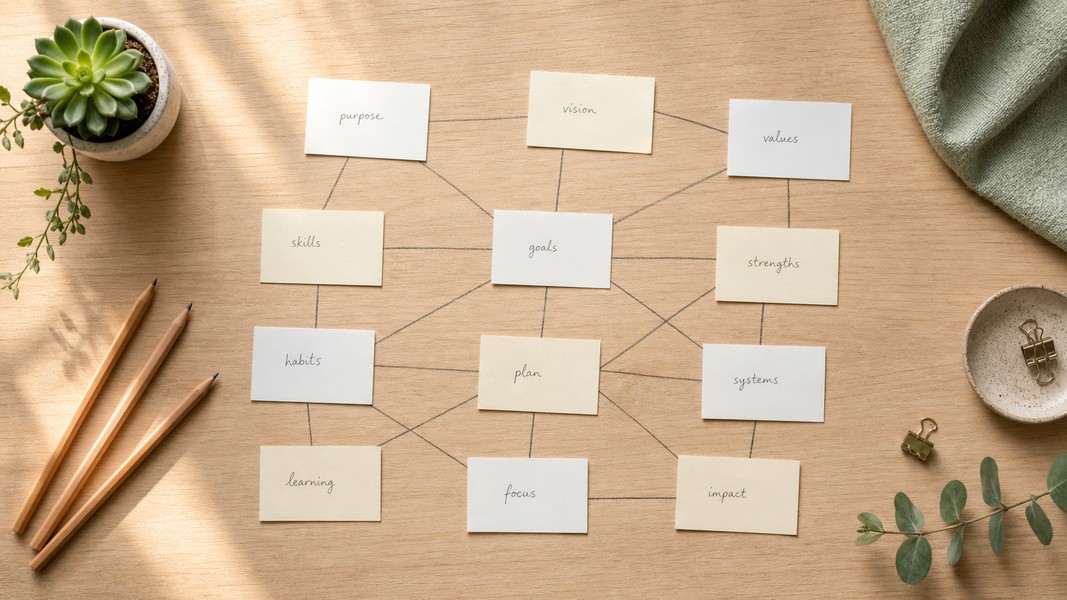
Mind mapping helps surface these relationships visually. After processing a batch of notes on a topic, create a simple mind map that links key concepts. A framework you captured in a business book might connect directly to a behavioral psychology note from six months ago. Seeing that connection accelerates understanding and often generates insights you wouldn't find by reviewing notes linearly.
Mind mapping is most effective as an after-capture step rather than a during-capture step. Trying to map ideas while you're still taking in new information splits your attention. Capture raw; organize and connect afterward, when you can see the material more objectively.
You don't need specialized software for this. A basic branching diagram on paper works as well as any digital tool. The goal is to see structure, not to produce a document.
Not all notes deserve equal attention on every visit. Progressive summarization is a technique for making notes more useful over time without rewriting them from scratch or spending hours on maintenance.
The first pass: read your original note and highlight the sentences that seem most important. The second pass: revisit those highlights and bold the most essential phrases, the ones that capture the single most important idea. An optional third layer: add a short synthesis in your own words at the top of the note.
Forte describes this as progressive summarization: each layer makes the note more compressed and accessible without losing the detail underneath. When you return to a note days or months later, you can grasp the core point in seconds rather than rereading the full source.
This matters most when you're under time pressure: a meeting in 20 minutes, an essay due tomorrow, a presentation you haven't reviewed recently. Progressive summarization means your most-used notes are always in a form that's faster to use than re-reading from scratch.
Long notes covering multiple topics are difficult to reuse. When a single note contains five different ideas, finding and applying any one of them requires navigating the others. Atomic notes solve this by limiting each note to one idea, making every piece of knowledge modular and recombinant.
This approach draws from the Zettelkasten method developed by sociologist Niklas Luhmann. His system of interconnected single-idea cards grew into a personal knowledge network of over 90,000 notes, directly fueling decades of prolific research and writing. The principle is that small, self-contained notes can be recombined in ways that large composite notes cannot.
You don't need to restructure your entire system around atomic notes to benefit from the idea. Start with your most important knowledge: key frameworks you return to regularly, recurring insights, decisions you want to document and revisit. Over time, a collection of well-formed atomic notes becomes a network that actively generates new thinking rather than just storing past learning.
The test for an atomic note: can you understand it fully without reading anything else? If yes, it's atomic. If not, it probably contains multiple ideas that belong in separate notes.
A second brain without review is just a filing cabinet. The review habit is what transforms stored knowledge into an active resource you actually trust and use. Without it, your notes drift out of sight, your system falls out of date, and eventually you stop consulting it at all.
A straightforward cadence works better than a complex one. Weekly: scan your active projects, process anything you haven't distilled yet, and update tasks. Monthly: browse your resources and archives for connections to current work, and look for anything that's become more relevant since you filed it. Quarterly: archive completed projects, remove captures that no longer apply, and review whether your PARA structure still reflects your actual priorities.
The review habit is what separates people who have a knowledge system from people who just have folders. Scheduling it, rather than planning to do it "when there's time," is what makes it reliable.
Many people find that the weekly review is the single most important session in their second brain routine. It closes the loop on the past week and sets clear context for the week ahead.
A second brain needs two types of tools: a capture layer and an organize-and-retrieve layer. The capture layer needs to be fast and frictionless; the organize layer needs to be reliable and searchable.
For capture, frictionless means multi-modal. Voice Memos supports five input types: voice recording, text, PDF upload, camera scan for handwritten notes, and YouTube URL processing. Each input is automatically transcribed and organized by AI, so you're not choosing between capturing an idea and doing it correctly. For students and professionals who switch between voice, text, and visual inputs throughout the day, this replaces a fragmented capture workflow with a single consistent entry point.
For organization, tools like Notion and Obsidian offer robust support for PARA-style structures, linked databases, and backlinked notes. Both work well as the retrieve-and-organize layer, particularly for users who want manual control over folder structure and tag taxonomies.
The best system is the simplest one you'll consistently use. Start with capture. Add organization once the capture habit is established. Don't optimize the retrieval layer until you have something worth retrieving.
For more on pairing capture with effective organization, explore these note-taking methods that work well alongside a second brain approach.
The most common failure mode with a second brain is starting too big. People design elaborate systems, spend a weekend migrating old notes, and burn out before the first habit forms.
Start with voice-first capture for one week. Record your ideas without worrying about organization. Then add daily processing. Then add a weekly review. Each layer compounds the value of the previous one.
The second brain concept isn't about having perfect notes. It's about building a system that makes your knowledge more accessible than it would be stored only in your head. Even implementing two or three of these seven techniques produces a meaningful difference in how effectively you can learn, recall, and use what you already know.
Discover more insights and tips to enhance your productivity
Learn how the Zettelkasten method works, why linked notes beat linear notebooks, and how to build your own knowledge system from scratch.
Struggling to manage your time as a student? These 7 evidence-backed tactics fix the real reasons students fall behind and waste hours.

Fathom AI is great for free Zoom notes, but it has real limits. Here are the best fathom ai alternatives for meetings, students, and multi-format capture.