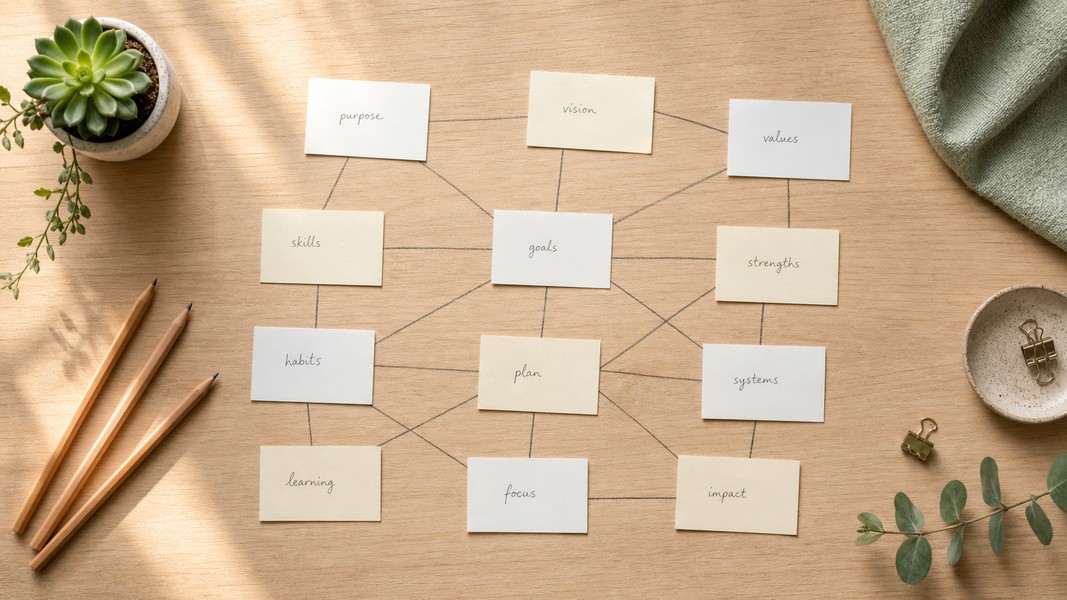
Zettelkasten: How to Build a Knowledge System
July 24, 2026
Learn how the Zettelkasten method works, why linked notes beat linear notebooks, and how to build your own knowledge system from scratch.

July 1, 2026
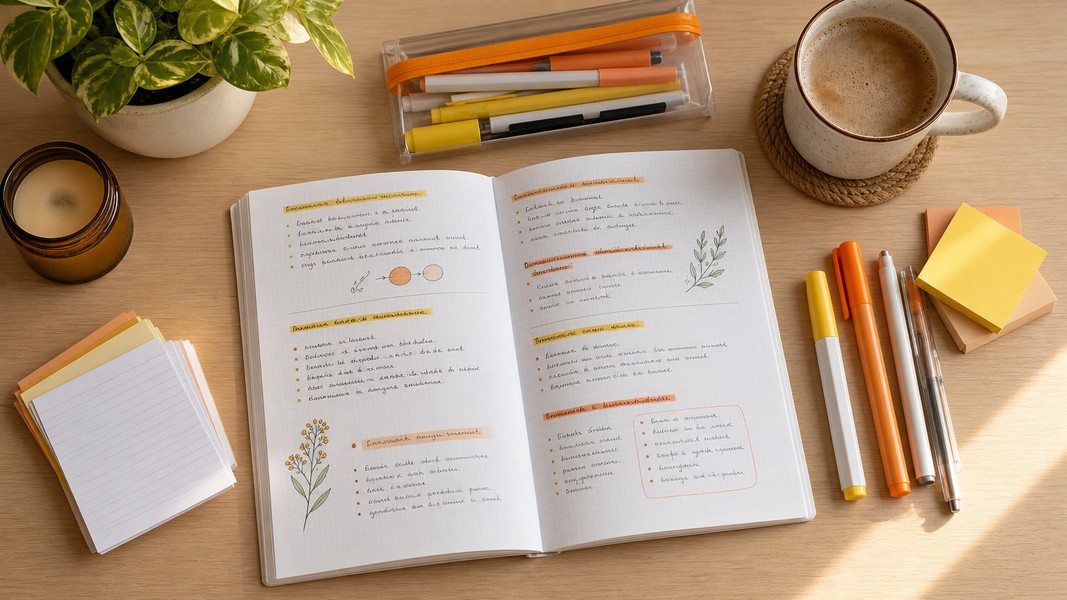
Study techniques and methods are structured strategies that use cognitive science principles to improve how you encode, store, and retrieve information. Unlike passive habits such as rereading or highlighting, the most effective techniques force your brain to actively work with material, building stronger and more durable memory traces.
This guide covers eight evidence-based study techniques with step-by-step implementation, plus a framework for choosing the right method based on your material, timeline, and goals.
Study techniques are deliberate, repeatable learning strategies based on how memory actually works. They target three stages of the learning process: encoding (taking information in), storage (holding it over time), and retrieval (pulling it back when you need it).
The technique you choose matters as much as how long you study. Research from The Learning Scientists and other cognitive psychologists consistently shows that active methods, such as retrieval practice and elaboration, produce significantly better long-term retention than passive ones. Rereading feels productive because the material feels familiar, but familiarity is not the same as being able to recall it on a test.
The brain does not store information like a hard drive. It reconstructs memories from networks of associations each time you retrieve something. Techniques that force reconstruction, like self-quizzing or teaching concepts in your own words, strengthen those networks in ways that rereading simply does not.
Active recall, also called retrieval practice or the testing effect, is the technique of deliberately trying to remember information from memory without looking at your notes. Each retrieval attempt reactivates neural networks tied to that memory and strengthens them, making future recall faster and more reliable.
The research behind active recall is particularly compelling. Studies comparing retrieval practice to restudying consistently find that students who quiz themselves remember significantly more, both one week and five weeks after learning, than students who spent the same time reviewing notes.
The practical takeaway: switching from rereading to self-testing can improve long-term retention without spending more time studying.
There are four main ways to practice active recall. Flashcards with a question on one side and an answer on the other are the most portable format. Practice tests and past exam papers simulate the conditions you will actually face. Self-quizzing from notes means turning headings into questions and answering them before looking. Blank-page recall means taking a fresh sheet after a session and writing everything you can remember, then comparing to your notes to find gaps.
The biggest mistake students make with active recall is peeking too quickly. Looking at the answer before genuinely attempting recall turns the exercise into passive review. The struggle to retrieve, even when it feels uncomfortable, is what drives the learning benefit.
For an in-depth breakdown of how to build retrieval practice into your study sessions, see our guide to active recall.
Spaced repetition is the practice of reviewing material at gradually increasing intervals over time instead of massing all your study into one session. The concept is grounded in the forgetting curve, first described by 19th-century psychologist Hermann Ebbinghaus: memory fades quickly at first, then more slowly over time. Each review resets that curve and pushes the next forgetting point further into the future.
The spacing effect shows that distributing the same amount of study time across multiple sessions produces far better long-term retention than a single extended session. Cramming the night before an exam can work for the next morning, but the material disappears quickly afterward.
Spaced repetition turns this insight into a practical system. After reviewing material, you schedule the next review based on how well you knew it. Material you found easy gets pushed further out. Material you struggled with comes back sooner. Over weeks, this produces an individualized schedule where you see each item just before you are likely to forget it.
A simple manual version: after covering new material, review it the same day, then two days later, then at the end of the week, then after two weeks. This schedule does not require software to work. A calendar and a list of topics is enough.
Common mistakes include treating spaced repetition as mere rereading spread out over time. The spacing benefit is amplified when each review session also uses active recall. Just looking over your notes on a schedule is better than cramming, but looking over notes then closing them and quizzing yourself is better still.
Voice Memos generates spaced repetition flashcard decks automatically from your notes, lectures, or uploaded PDFs. The app schedules reviews based on your performance, so you spend more time on weak material and less time on what you already know solidly.
For a deeper look at the science behind interval learning, our guide on spaced repetition covers scheduling systems and the research in detail.
The Feynman Technique is a four-step learning method that uses explanation as a diagnostic tool. When you try to explain a concept simply and find you cannot, you have just identified exactly what you do not understand. The gap in your explanation is a map of the gap in your knowledge.
The steps are straightforward. First, choose a specific concept, not a subject ("osmosis," not "biology"). Second, explain it on paper using plain language, as if you were teaching someone who knows nothing about the topic. Third, notice where your explanation becomes vague, relies on undefined jargon, or trails off into uncertainty. Fourth, go back to your source material to fill those gaps, then rewrite the explanation more clearly.
The method works because self-explanation forces deep encoding. Research on elaboration shows that generating your own explanations in plain language improves understanding and transfer more than passive reading. Teaching forces thinking. When you explain a concept out loud or on paper, you discover what you actually know versus what only looks familiar.
For sciences, this means explaining not just what happens but why each step occurs. For math, it means narrating the reasoning behind each solution step, not just executing the procedure. For humanities, it means summarizing a theory or historical argument in two paragraphs without leaning on the original text's phrasing.
The most common failure mode is staying inside your head. Mentally walkthrough an explanation rather than writing or saying it aloud, and you will miss the gaps. Externalizing the explanation is what makes the diagnostic work.
A mind map places a central topic in the middle of a page and builds outward with branching subtopics, keywords, and connections. The technique, popularized by Tony Buzan, uses visual structure to organize complex material in a way that mirrors how concepts relate to each other rather than how they appear sequentially in a textbook.
Mind maps draw on dual coding theory, which holds that combining verbal and visual representations creates more retrieval cues than text alone. When you add spatial layout, color, and imagery to keywords, you give the brain multiple overlapping "hooks" to pull a memory back. Research on concept maps and visual organizers reports improvements in retention and comprehension compared to plain linear notes.
The practical steps are simple. Write the central topic in the center of a blank page. Draw branches outward for main subtopics, using a single keyword per branch rather than full sentences. Add smaller branches from each for supporting details, examples, or questions. Use different colors for different branches. Draw cross-connections where concepts relate to each other across branches.
The most effective mind maps prioritize structure over completeness. A map cluttered with long phrases and dense sentences loses its visual clarity. The goal is to represent relationships, not reproduce your notes. A well-built map lets you see, at a glance, how the parts of a topic connect.
Voice Memos includes a mind map study mode that generates visual concept maps automatically from your notes, recordings, or uploaded documents. Rather than building a map from scratch, you can start with an AI-generated structure and then annotate or expand it based on what you need to review.
Mind mapping works especially well for subjects with interconnected concepts: biology pathways, economic models, historical cause-and-effect chains, or the structure of a novel. It is less suited to memorizing isolated facts, where flashcards and retrieval practice are stronger tools.
The Cornell method, developed by Walter Pauk at Cornell University in the 1950s and described in his widely used book on college study skills, divides each page into three sections. The right two-thirds is the notes column where you capture ideas during a lecture or reading. The left third is the cue column, kept blank during the session and filled in afterward with questions or keywords. The bottom strip is a summary section where you write the core takeaway of the page in two to three sentences.
The structure converts passive note-taking into an active review tool. During a lecture, you record the main ideas in the notes column using short phrases and abbreviations. Within 24 hours afterward, you turn to the cue column and write a question or keyword for each key point. Then you cover the notes column and try to answer each cue from memory before uncovering to check.
The review process is where the method earns its reputation. The cue column essentially turns your notes into a set of practice questions, which combines Cornell with active recall in a single workflow. The summary at the bottom forces you to compress the page into its essential argument, which deepens encoding through elaboration.
For textbook reading, the method adapts cleanly. Read a section, then write the core ideas in the notes column. Convert chapter headings into cue questions. Write the summary after finishing the section, not while reading it.
The common failure is leaving the cue column blank. Many students set up the Cornell structure but never fill in the left column, which removes the self-testing benefit entirely. The summary is also frequently skipped or turned into a repetition of the notes rather than a synthesis.
The Pomodoro Technique was developed by Francesco Cirillo and structures work into alternating focused intervals and short breaks. The classic format is 25 minutes of focused work followed by a 5-minute break, with a longer break of 15 to 30 minutes after every four cycles.
The method works by making sustained attention feel achievable. An open-ended study session can feel overwhelming, which leads to procrastination or distracted half-effort. Knowing you only need to focus for 25 minutes before a guaranteed break lowers the psychological cost of starting. Breaks, when used for genuine rest rather than checking notifications, allow the brain to recover and maintain performance across a longer session.
The approach does not require rigid adherence to 25-minute blocks. Many students find that 40- or 50-minute intervals with 10-minute breaks suit subjects that require longer ramp-up time. What matters is the pattern: bounded focus, real rest, repeat.
Practical implementation follows three rules:
The most common mistake is using breaks for social media or other mentally engaging activities. A break that keeps your attention in the same cognitive space as the work does not restore the focused capacity you need for the next interval.
Interleaving is the practice of mixing different topics, subjects, or problem types within a single study session rather than completing all practice on one type before moving to the next. Instead of doing 20 quadratic equation problems in a row, you alternate between quadratic equations, linear equations, and word problems.
This approach, identified in cognitive psychology as a "desirable difficulty," feels harder during practice and produces worse performance within a session. Students who interleave often feel less confident than those who practice one type repeatedly. But the long-term outcome flips: interleaved practice produces better retention, better transfer, and better performance on tests.
The mechanism is discrimination learning. When you interleave problem types, each problem requires you to first identify what kind of problem it is and which strategy applies. This identification step, which blocked practice skips entirely, is exactly the challenge you face on exams. Interleaving trains the selection process, not just the execution.
Interleaving is most effective for subjects where exam questions require choosing between strategies: mathematics, physics, organic chemistry, essay types in history or literature. It is less appropriate for genuinely new material where you have not yet built the basic understanding needed to distinguish between types.
Start interleaving after you have worked through a topic enough to understand it. Mixing problems from three or four subtopics of a unit, rather than drilling one at a time, will feel inefficient but will pay off on the exam.
Elaborative interrogation is a technique that builds understanding by asking "why" and "how" questions about the material you are studying, then generating an explanation in your own words. Instead of accepting a fact at face value, you ask why it is true and how it connects to what you already know.
The technique works because self-generated explanations connect new information to existing knowledge structures. Facts that link to prior knowledge are easier to remember and easier to apply in new contexts. Facts memorized in isolation tend to stay there and fail to transfer.
Implementation is simple. Read a fact or concept. Ask: why is this true? Write an explanation using only what you know, without restating the source material. Then check your explanation against the text and correct where you were wrong or vague.
The discipline is producing genuine causal explanations rather than paraphrases. "The mitochondria produces ATP because it contains enzymes that drive oxidative phosphorylation, which transfers electrons and generates a proton gradient" is elaborative interrogation. "The mitochondria produces energy because that is its function" is not.
For different subjects: in sciences, ask why a process occurs at each step. In history, ask what caused an event and why people responded the way they did. In math, ask why a formula works, not just how to use it. In literature, ask why an author made a specific structural or thematic choice.
The most common failure is generating shallow explanations that feel complete but are not. Writing "because the textbook says so" or restating the fact in slightly different words does not engage the elaboration mechanism that makes this technique work.
The most effective exam preparation combines multiple techniques in a structured sequence rather than relying on any single method. Here is a workflow that uses the techniques from this guide across a typical week:
During lectures: use Cornell notes to capture main ideas in the notes column. Avoid transcribing verbatim; focus on structure and key points.
Within 24 hours of class: fill in the cue column with questions and write a brief summary at the bottom of each page. This converts your notes into a review tool while the material is still fresh.
When reading textbooks or working with PDFs: apply elaborative interrogation to concepts you are learning for the first time. Ask why each process, theory, or argument works the way it does.
Across the week: convert key facts and definitions into flashcards and review them with spaced repetition. Voice Memos can generate flashcard decks automatically from your recordings or uploaded materials, with scheduling built in.
For problem-based subjects: use interleaving when doing problem sets. Mix several subtopic types in each session rather than drilling one type until it feels mastered.
In the final 10 to 14 days before an exam: shift toward active recall under exam conditions. Take practice tests, time yourself, and use blank-page recall on each major topic. Prioritize areas where retrieval is still slow or uncertain.
The night before an exam, light retrieval review is more effective than introducing new material. Brief sessions of flashcard review and self-quizzing consolidate what you have already learned; cramming new content at that stage rarely sticks.
The pattern that consistently fails is relying heavily on rereading and highlighting throughout the semester, then cramming with practice tests in the final days. The techniques in this guide work best when distributed across the entire study period, not compressed into the end.
Matching technique to material and context produces better results than picking a single favorite and applying it to everything.
For factual material, active recall and spaced repetition are the strongest choices. Vocabulary, definitions, dates, formulas, and names all respond well to flashcard-based retrieval. Cornell notes can organize facts before review begins.
For conceptual material, start with the Feynman Technique and elaborative interrogation. Understanding why a concept works matters more than memorizing a definition. Once the concept is understood, spaced repetition can maintain it.
For procedural material such as math problem types, physics calculations, or programming patterns, interleaving and practice testing are the primary tools. Understanding alone does not build the retrieval fluency needed to execute under time pressure.
For initial learning, the priority is encoding: clear notes, immediate clarification of gaps, brief self-explanation of what you just covered. This is not the stage for intensive retrieval practice.
For review and exam prep, the balance shifts toward retrieval. Minimize rereading and maximize practice testing, blank-page recall, and spaced flashcard sessions.
Ignore the idea that you have a fixed "learning style" that determines which methods work for you. The research does not support matching study methods to visual, auditory, or kinesthetic preferences. What matters is matching technique to material type, stage of learning, and the demands of the assessment you are preparing for.
The gap between students who struggle and those who perform consistently well is rarely effort. It is usually method. Rereading and highlighting feel like studying but do not build the retrieval strength that exams require.
The eight techniques in this guide, active recall, spaced repetition, the Feynman Technique, mind mapping, Cornell notes, Pomodoro, interleaving, and elaborative interrogation, are not equally useful for every situation. Use active recall and spaced repetition as your core review tools. Use Feynman and elaborative interrogation when you need to understand rather than memorize. Use interleaving when you need to discriminate between problem types. Use Cornell notes and Pomodoro to build structure into your sessions.
Start with one or two techniques rather than trying to implement all of them at once. The best study method is one you will actually use consistently, adjusted based on what is working.
Discover more insights and tips to enhance your productivity
Learn how the Zettelkasten method works, why linked notes beat linear notebooks, and how to build your own knowledge system from scratch.
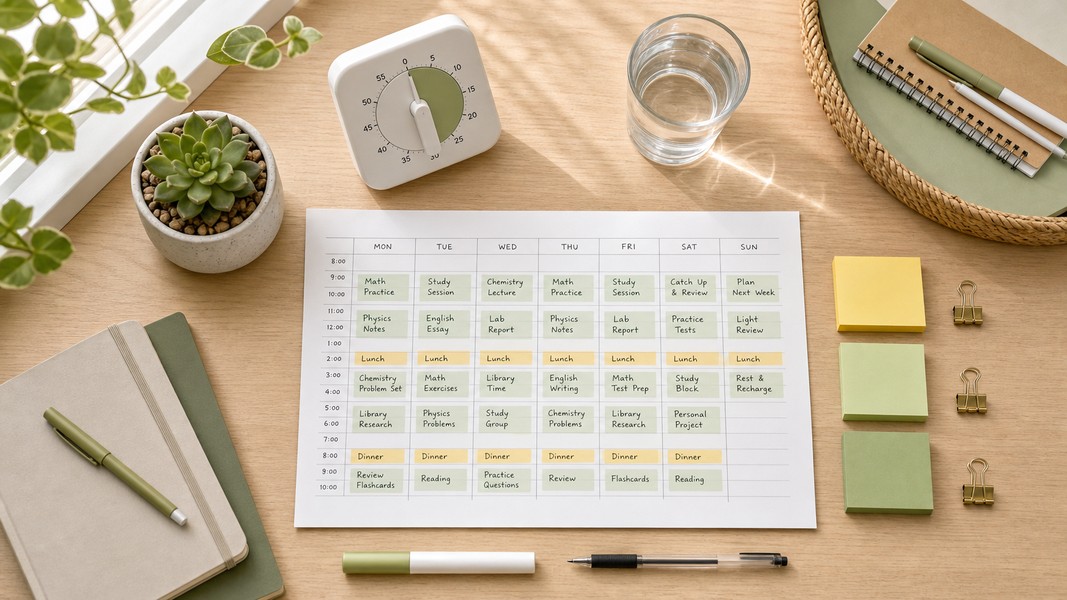
Struggling to manage your time as a student? These 7 evidence-backed tactics fix the real reasons students fall behind and waste hours.

Fathom AI is great for free Zoom notes, but it has real limits. Here are the best fathom ai alternatives for meetings, students, and multi-format capture.