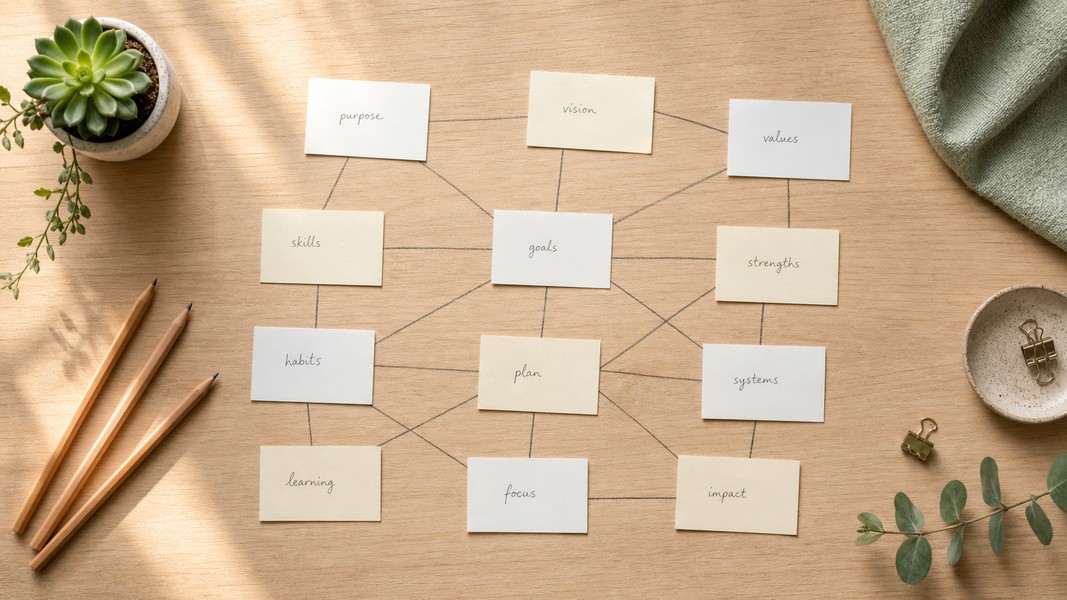
Zettelkasten: How to Build a Knowledge System
July 24, 2026
Learn how the Zettelkasten method works, why linked notes beat linear notebooks, and how to build your own knowledge system from scratch.


April 2, 2026
A study guide is a structured document that organizes key concepts, definitions, and review questions from your course materials into a single, focused resource. When you know how to make a study guide well, you shift from passive re-reading to active learning, and that shift matters. According to retrieval practice research, actively generating information improves long-term retention significantly more than re-reading the same material.
The process of building a study guide is itself a study session. Summarizing in your own words, organizing by concept, and writing practice questions all require you to retrieve and process information rather than just recognize it on the page. This guide walks you through how to make a study guide from your class notes, PDFs, and lecture recordings, including where AI tools can speed up the most time-consuming parts.
Before you start building one, it helps to know what separates a useful study guide from a document you will never open again.
An effective study guide organizes concepts by topic rather than by date, so related information sits together naturally. It includes definitions and terminology with context, not just isolated terms. It incorporates practice questions that force retrieval. It uses concise summaries rather than copied paragraphs. And for visual subjects like biology or chemistry, it includes diagrams or structured relationships between concepts.
The testing element is where most students fall short. A study guide filled only with notes is still passive review. The ones that improve exam scores include questions, flashcards, or short quizzes built directly from the content. Without a self-testing layer, you end up with a better-organized version of your notes rather than a tool that actually trains your recall.
This is the most common starting point. Follow these steps to turn a semester of scattered notes into a focused review document.
Step 1: Gather all your notes in one place. Pull together handwritten notes, typed notes, slides, and any supplementary reading for the subject. The goal is a single input source before you start organizing.
Step 2: Map out the main topics or units. Use your syllabus or course outline as the framework. These become the main sections of your study guide. Work by theme or unit, not by date or lecture order.
Step 3: Extract key concepts, definitions, and relationships. For each section, identify the core ideas and their definitions, any cause-and-effect or comparative relationships, formulas or rules for STEM subjects, and anything the instructor repeated or emphasized across multiple sessions.
Step 4: Rewrite in your own words. Restating content without looking at your notes is a retrieval exercise. Do not copy verbatim. Compress and rephrase. If you struggle to restate something clearly, that is useful feedback: you need to spend more time on that section before the exam.
Step 5: Add practice questions at the end of each section. Short-answer prompts, fill-in-the-blank items, or problem sets for math all work. The questions do not need to be complex. The point is to force recall without immediately looking at the answer.
For a faster version of this workflow, Voice Memos lets you upload handwritten notes, typed documents, or PDFs and automatically extracts key concepts, generates quiz questions, and builds flashcard decks, compressing hours of manual organization into minutes.
Dense textbooks are harder to work from because most of the content is not what will appear on the exam. A targeted approach helps.
Before you read, scan the chapter outline and any listed learning objectives. These signal what the textbook itself considers essential. As you work through each section, extract only content that maps directly to those objectives rather than trying to capture everything.
For STEM subjects, prioritize formulas, diagrams, and worked examples. Copy key formulas with a brief note on when to apply each. For humanities and social sciences, focus on arguments, key terms, and evidence. A concise summary per theory or author is more useful than copied paragraphs.
AI tools are particularly effective here. With Voice Memos, you upload a PDF and the app processes the text, identifies core ideas, and generates an interactive quiz or flashcard set from the material automatically. This approach connects to active recall as a study method: creating a quiz from each chapter forces retrieval, which is more effective than re-reading the chapter twice.
Education research consistently points to the same conclusion: short, active review bursts outperform long passive re-reads, and structured guides make it easier to run those focused sessions.
Lecture recordings are underused. Most students watch them once passively, if at all. Turning a recording into a study guide forces active engagement and creates a resource you will actually return to before the exam.
If you are working manually, take rough notes during the live lecture and use the recording afterward to fill gaps. When you review, pause and restate key points in your own words rather than transcribing verbatim. For math and quantitative subjects, capture the problem-solving steps for each example: the problem type, the approach, the sequence of steps, and a note on where students most often make errors.
With Voice Memos, you can paste a YouTube lecture URL or upload a recorded audio file, and the app transcribes and structures the content automatically. Speaker detection handles multi-person discussions, so seminar recordings and group sessions come out cleanly organized. From there, you can generate quizzes, flashcards, or structured notes directly from the transcript, without manually rewatching anything.
This removes the transcription bottleneck entirely and lets you spend your time on understanding rather than capturing.
A completed study guide is the starting point, not the end point. The students who see the biggest gains from their study guides are the ones who convert the content into active review formats.
Flashcards work well for definitions, formulas, vocabulary, and anything with a discrete answer. Practice quizzes work better for conceptual understanding, applied reasoning, and multi-step problems. Both formats outperform re-reading for long-term retention, because they force your brain to reconstruct the answer rather than recognize it.
Spaced repetition strengthens this further. Rather than reviewing all flashcards at once before the exam, scheduling review sessions at increasing intervals moves information into long-term memory more reliably. Voice Memos has built-in spaced repetition scheduling for flashcard decks, so the spacing is handled automatically without you having to plan it out.
Mind maps are a third option, useful for subjects where the relationships between concepts matter more than individual definitions. History, biology, philosophy, and systems-heavy STEM topics all benefit from visual maps. A mind map version of your study guide shows how topics connect, not just what each one means in isolation. You can also use the Cornell notes method as a structural template for written content alongside mind maps for visual connections.
Keep each section tight. If you cannot summarize a concept in three to four sentences, you have not understood it clearly yet. That is a signal to study that section more before the exam, not a reason to write longer notes.
Build your study guide early. Creating one one to two weeks before an exam gives you time to use it for spaced review sessions. Building it the night before means you are in creation mode during the window when you should be reviewing.
Weight your coverage toward high-yield content. Use past exams, practice problems, and your instructor's emphasis to identify what is most likely to appear. A study guide that covers everything equally is less useful than one that goes deep on the material most likely to be tested.
For math specifically, include at least two worked examples per concept type. Math is tested through problems, not definitions, and your study guide should reflect that. Step-by-step walkthroughs are more useful for review than a list of formulas you have memorized.
Finally, review your study guide out loud at least once. Saying content aloud engages different processing pathways than reading silently and tends to surface gaps in your understanding more quickly than silent review.
Making a study guide is one of the most effective things you can do before an exam, not because having the document is useful, but because building it forces active engagement with the material. Summarizing, organizing, and adding practice questions all produce stronger long-term retention than passive review.
The most effective study guides pull from multiple sources: class notes, textbook readings, and lecture recordings. They include self-testing elements. And they are built early enough to support spaced review sessions before the exam. Whichever method or tools you use, the goal is the same: an organized, testable version of everything you need to know.
Discover more insights and tips to enhance your productivity
Learn how the Zettelkasten method works, why linked notes beat linear notebooks, and how to build your own knowledge system from scratch.
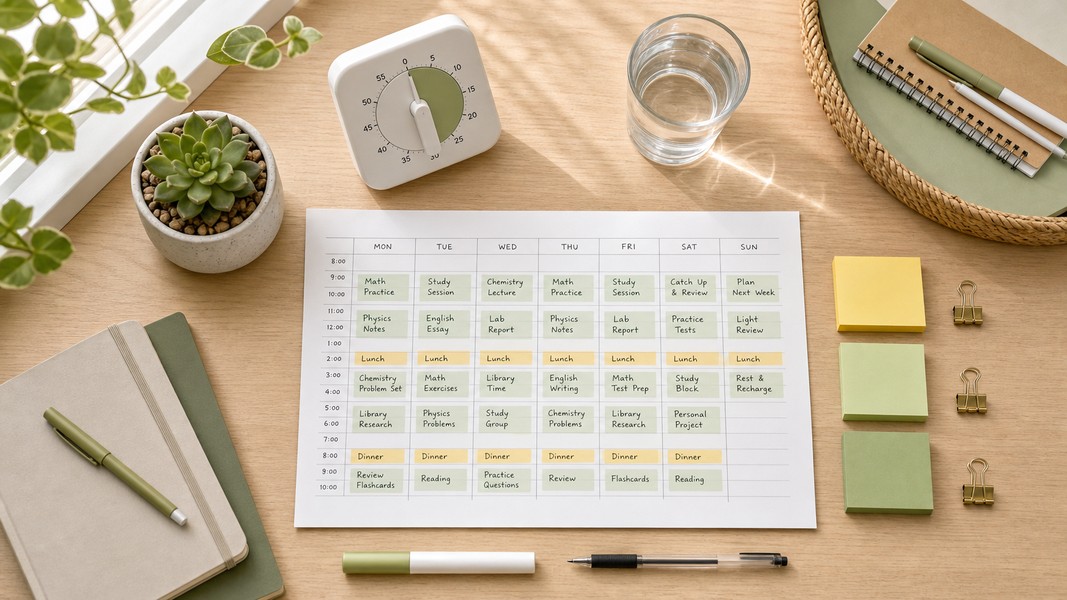
Struggling to manage your time as a student? These 7 evidence-backed tactics fix the real reasons students fall behind and waste hours.

Fathom AI is great for free Zoom notes, but it has real limits. Here are the best fathom ai alternatives for meetings, students, and multi-format capture.