
Zettelkasten: How to Build a Knowledge System
July 24, 2026
Learn how the Zettelkasten method works, why linked notes beat linear notebooks, and how to build your own knowledge system from scratch.


March 6, 2026
A solid MCAT study plan is the single biggest predictor of whether you hit your target score or spend another year retaking the exam. The average matriculant scores a 511.5, while the average applicant scores around 506, a gap that forces roughly 25-50% of test-takers aiming for competitive schools back to the drawing board. This guide gives you a concrete, phase-by-phase system to close that gap, from your first diagnostic to your final full-length simulation.
The most common reason students underperform is not lack of effort; it is a flawed system. Many jump into content review without taking a diagnostic test first, meaning they spend weeks studying material they already know while ignoring their real weak spots.
A third pitfall is skipping structured error analysis after practice questions. Without reviewing why you got something wrong, you repeat the same mistakes on test day. As MedEdits has observed with retakers, repeating the same strategy after a disappointing score almost always produces the same result.
The research is clear: effective prep requires a minimum of three months, targeting roughly 240 total hours, or about 20 hours per week over 12 weeks. Shorter timelines consistently underperform because the MCAT tests deep integration of concepts, not surface-level recall.
Structure your 12-week plan across three distinct phases.
Phase one, weeks one through four, is your foundation. You take a full-length diagnostic on day one to establish a baseline score, then focus on broad content review across all four sections at 15-20 hours per week. The goal here is not mastery; it is mapping the terrain.
Phase two, weeks five through eight, shifts to targeted content review paired with light practice. You are drilling the specific weaknesses your diagnostic revealed, running section-level practice sets, and aiming for 70% accuracy on subject drills. Weekly hours climb to 20-25.
Phase three, weeks nine through twelve, is full-length territory. You are taking one scored full-length per week, doing deep review of every question, and simulating actual test-day conditions. Hours rise to 25-30 per week. Consistent improvement of five to ten points across this phase signals your plan is working.
A 20-hour week works for most students starting around a baseline score of 500. The key is distributing time proportionally: roughly 30% to Chemistry and Physics, 30% to Biology and Biochemistry, and 40% to CARS and Psychology/Sociology combined, since the verbal and social science sections reward daily practice more than any cramming session can fix.
A practical weekly structure looks like this. Monday through Wednesday, you rotate through content blocks of two to three hours per subject. Thursday and Friday shift to four hours of practice questions followed by two hours of review. Saturday is your full-length simulation day, running the full 7.5-hour test under realistic conditions. Sunday is reserved for two hours on weak areas, followed by genuine rest.
Keep individual sessions to 90-120 minutes with short breaks in between. Early in your prep, run practice passages untimed: accuracy before speed is the correct sequencing.
Spaced repetition is one of the most well-supported memory techniques in cognitive science, boosting long-term recall two to three times compared to passive re-reading. Active recall, the act of retrieving information rather than reviewing it, yields roughly 50% better retention for science content specifically. The challenge has always been implementing these techniques at scale across thousands of MCAT concepts.
This is where AI tools create a genuine edge. Instead of manually building flashcard decks from your notes, you can use a tool like Voice Memos to record yourself working through lecture content or reading aloud from your notes, and the app automatically transcribes and converts that material into flashcards and quizzes. Uploading your Bio notes and generating hundreds of targeted questions in minutes compresses what used to take hours of manual card creation.
The advantage over static Anki decks is personalization. Rather than working through a pre-built deck someone else designed, your study materials are built from your own notes, in your own words, targeting the exact content you are actually reviewing.
The scoring scale runs from 118 to 132 per section, with a mean of 500 across all four. Hitting the 75th percentile (roughly 508-513 total) requires balanced scores in the 127-128 range across each section. A single section below 124 can eliminate your application at many schools regardless of your total score.
CARS rewards consistent daily reading more than any content review. Spend four hours per week on inference-based passage drills. Read dense non-fiction (philosophy, history, literary criticism) outside your prep materials to build the reading speed and argument-mapping skills the section demands.
Spend five hours per week here, split between equation practice and passage-based application. Do not memorize equations in isolation; practice retrieving and applying them under timed conditions. The MCAT tests experimental reasoning, not just plug-and-chug mechanics.
Pathway mastery is the core skill here. You need to trace mechanisms (metabolic pathways, signaling cascades, cellular processes), not just recognize their names. Five hours per week, with heavy emphasis on active recall. Voice Memos is particularly useful in this section: record yourself explaining a pathway out loud, let the app transcribe it, and turn that explanation into a self-quiz to reinforce the material.
Four hours per week on term memorization and passage mapping. This section has the highest density of vocabulary-dependent questions. Use AI quiz tools to generate rapid-fire definition drills from your Psych/Soc notes, since the volume of terms makes manual flashcard creation inefficient.
Ten to twelve full-length practice tests over your prep period is the recommended volume, with at least one per week during weeks nine through twelve. Daily question sets of 50-100 questions should run throughout all three phases, starting untimed and progressing to timed by week five.
The review session after a practice set matters more than the set itself. For every question you got wrong, log it by category: was it a content gap, a reasoning error, a misread passage, or a timing issue? Each error type has a different fix, and lumping them together produces unfocused review.
During full-length simulations in phase three, replicate actual test-day conditions. That means starting at the same time of day as your real test, taking only the scheduled breaks, eating what you plan to eat on test day. Students who run structured, reviewed full-lengths in this way consistently see ten to twenty point jumps compared to unstructured prep.
Resist the temptation to skip a full-length because you do not feel ready. The diagnostic value of a full-length under realistic conditions is irreplaceable, and no amount of content review substitutes for it.
The metrics worth tracking weekly are: your full-length composite score, your percentage correct by section, and your error category breakdown. These three numbers tell you whether your plan is working or needs a pivot.
A healthy trajectory is two or more points of composite improvement per week during phase three. If you are stagnant after four consecutive weeks, something in the plan needs to change: not more of the same. Common adjustments include doubling CARS practice time, switching from content review to active recall methods, or shifting from passage-level drills to full-section timed sets.
One underused tracking method is logging your study sessions in a voice note immediately after finishing. Dictating what you covered, what clicked, and what still feels fuzzy takes two minutes and gives you a searchable record of your own understanding over time. Tools like Voice Memos can transcribe these reflections automatically, turning informal self-assessments into a structured review log you can revisit each Sunday when you adjust your weekly plan.
The path from a 500 to a 511 is achievable, but only if your tracking is honest enough to surface what is actually not working. Matriculant averages confirm that students starting with low-to-mid 500s do reach competitive scores, but almost always after redesigning their study system, not simply studying harder within a broken one.
Set a weekly review appointment with yourself: thirty minutes on Sunday evening, looking at your numbers, logging your error patterns, and adjusting the following week's schedule accordingly. Pre-med is a long game, and the students who make it to acceptance day are the ones who treat their study plan as a living document rather than a fixed schedule they mechanically follow.
Discover more insights and tips to enhance your productivity
Learn how the Zettelkasten method works, why linked notes beat linear notebooks, and how to build your own knowledge system from scratch.
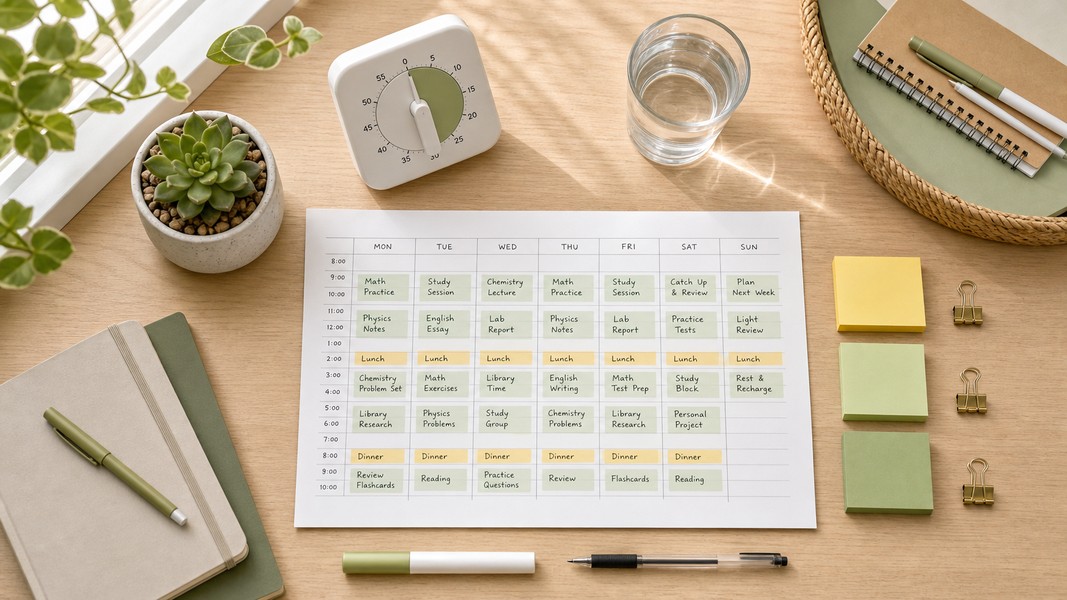
Struggling to manage your time as a student? These 7 evidence-backed tactics fix the real reasons students fall behind and waste hours.

Fathom AI is great for free Zoom notes, but it has real limits. Here are the best fathom ai alternatives for meetings, students, and multi-format capture.