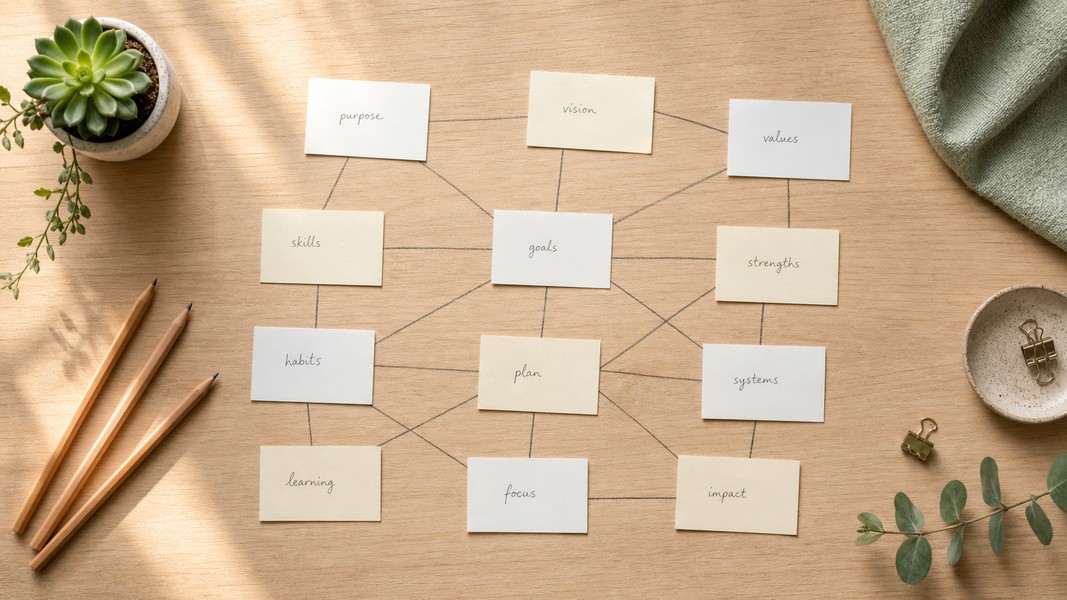
Zettelkasten: How to Build a Knowledge System
July 24, 2026
Learn how the Zettelkasten method works, why linked notes beat linear notebooks, and how to build your own knowledge system from scratch.

June 24, 2026
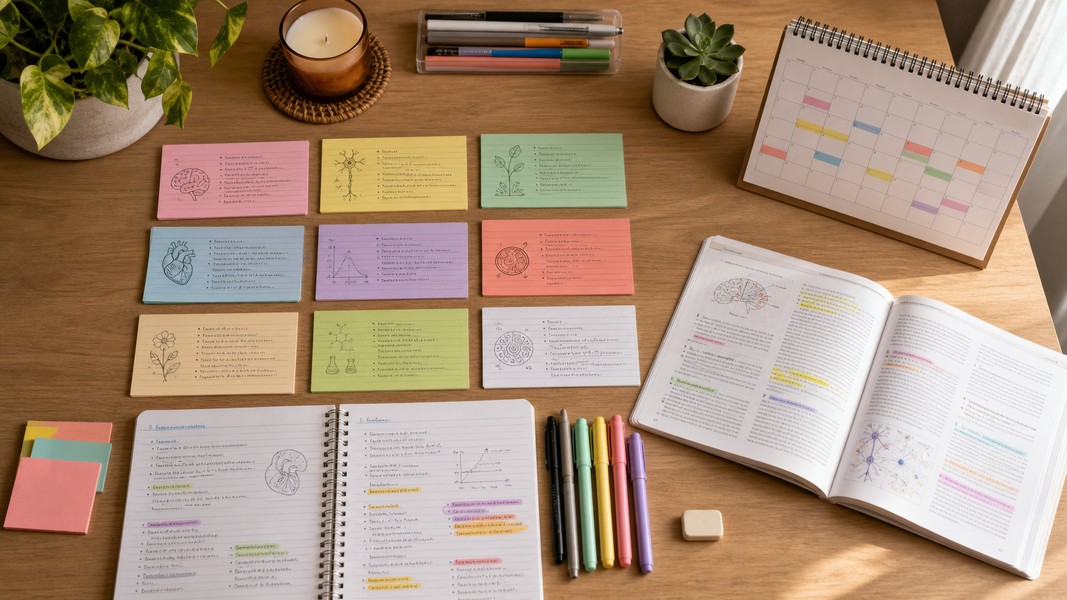
Memorization techniques separate students who retain what they study from those who forget it before the exam. The right techniques work with how your brain encodes and retrieves information. The wrong ones feel productive but leave almost nothing behind.
This guide covers 7 proven memorization techniques, from spaced repetition to sleep consolidation. Each is backed by cognitive science research, and each works better once you understand the mechanism behind it.
Re-reading your notes feels like studying. Highlighting key passages feels like learning. But research consistently shows these passive methods produce poor long-term retention.
The core problem is the difference between recognition and recall. Recognition means you can identify something when you see it again. Recall means you can produce it from memory without cues. Most passive study habits train recognition, not recall, and exams test recall.
Effective memorization requires active encoding - retrieving, organizing, and connecting information rather than just re-exposing yourself to it. Every technique on this list forces active engagement with the material.
Spaced repetition is the practice of reviewing information at increasing intervals over time. You study something new, then review it again after one day, then after a few days, then after a week. Each review happens just before the memory fades.
The mechanism behind this is the forgetting curve, first described by psychologist Hermann Ebbinghaus in the 1880s. His research, which remains foundational in memory science, showed that memory decays rapidly after initial learning, but each review resets that decay and extends how long the information stays accessible. Over multiple cycles, the material becomes durable long-term memory.
Spaced repetition consistently outperforms cramming for long-term retention. A single all-night study session may help you pass tomorrow's quiz, but the information disappears quickly. Spaced review encodes it deeply. A commonly used review schedule is 1 day, 7 days, 16 days, and 35 days after first learning.
The practical implication is that how you spread out your studying matters as much as how many hours you study. Five study sessions spread over a week produce better long-term retention than five hours in a single night.
For a deeper breakdown of how to build spaced review into your study system, see the spaced repetition guide.
Voice Memos automates much of this process. When you upload a lecture recording, PDF, or textbook chapter, the app generates spaced-repetition flashcard decks from the content, so you're not creating cards by hand.
Active recall means testing yourself on material rather than restudying it. Close your notes and try to write down everything you remember. Answer practice questions from memory. Explain concepts aloud without looking at your notes.
The testing effect, documented extensively by researchers Henry Roediger and Andrew Butler at Washington University, shows that retrieval itself is a learning event. Each time you successfully retrieve information, the memory pathway becomes stronger. Restudying mostly activates recognition; retrieval activates the deeper recall pathway.
One study found that a single practice test improved exam performance by 17% compared to restudying alone. That gap grows when retrieval practice is combined with spaced repetition.
You can apply active recall without any technology. Cover your notes and try to recall key points. Write a blank-page summary after each lecture. Use flashcards and check only after you've committed to an answer. The discomfort of trying to remember something you're not sure of is exactly when the encoding happens.
For the science behind this approach, the active recall method guide covers the research and practical implementation in detail.
The method of loci, often called the memory palace technique, is one of the oldest memorization techniques known. It dates back to ancient Greek and Roman rhetoric, where orators used it to memorize long speeches without notes.
The method works by placing pieces of information at specific locations along a familiar mental route: your childhood home, your daily commute, your school hallway. To retrieve the information, you mentally walk through the route and encounter each item where you placed it.
Here's how to build a basic memory palace. Choose a familiar location, like your apartment. Identify 10 distinct spots in a fixed order: front door, coat rack, kitchen counter, refrigerator, dining table, and so on. Assign one piece of information to each spot and create a vivid, slightly absurd image linking the information to that location. When you need to retrieve the information, mentally walk through the space.
The technique exploits the brain's strong spatial and visual memory systems. Abstract facts are difficult to hold; vivid images placed in specific locations are much easier to retrieve. It works especially well for ordered information: the steps in a biological process, a list of historical events, the order of elements on the periodic table.
Medical and law students often use memory palaces for dense factual material. Anatomy sequences, legal rules, and procedural steps all lend themselves well to this format. The more sensory and specific you make each mental image, the more reliably you'll retrieve it.
Chunking is the practice of grouping individual pieces of information into larger meaningful units. Your working memory can hold roughly 7 items at once (plus or minus 2, as psychologist George Miller famously described in his foundational research), but those items can each contain multiple pieces of information if they're properly grouped.
When you memorize a phone number, you naturally chunk it: not 10 isolated digits, but three groups. The same principle applies to academic content.
To chunk effectively, look for patterns, categories, and relationships in your material. Medical terminology chunks well by root words and prefixes: a student who understands that "brady" means slow and "cardia" refers to the heart can decode bradycardia without memorizing it as an isolated fact. History content chunks by era, regime, or theme. Formulas chunk by what each variable represents and when the formula applies.
Chunking reduces cognitive load and makes information more accessible during retrieval. Instead of recalling 30 isolated facts, you're recalling 5 categories that each contain 6 related items.
Mnemonics are memory aids that encode information through patterns, sounds, rhymes, or visual associations. They work because arbitrary information is hard to remember, but information attached to a pattern or story is much easier to retrieve.
Acronyms are the most common form: ROYGBIV for the colors of the rainbow, HOMES for the Great Lakes. Rhymes work for information that needs to stay in a specific order. Visual associations link a new word or concept to a vivid image that shares its sound or meaning.
Mnemonics are most useful when the material is arbitrary and doesn't naturally connect to prior knowledge. Vocabulary in a new language, anatomical structures, historical dates, and taxonomic classifications are all strong candidates.
The key is to make the mnemonic your own. A memory aid you invented will stick better than one you read somewhere, because creating it required active engagement with the material.
The Feynman Technique is a four-step method for understanding and retaining complex material: choose a concept, explain it in plain language as if teaching a beginner, identify where your explanation breaks down, and return to the source to fill in the gaps.
The technique works because of the generation effect: information you actively produce is remembered better than information you passively receive. When you explain a concept in your own words, you're forced to identify the gaps between what you think you understand and what you actually understand. Those gaps reveal exactly where more study is needed.
Voice Memos is particularly useful here. Record yourself explaining a concept aloud, then play it back to spot unclear reasoning or missing steps. The app transcribes your explanation so you can review it in text form and identify the exact points where your reasoning breaks down.
The Feynman Technique is best suited for conceptual material: anything where understanding matters as much as memorization. Science concepts, mathematical reasoning, historical causation, and legal principles all respond well to this method.
Sleep isn't passive downtime between study sessions. It's when your brain consolidates the day's learning into long-term memory. Both slow-wave sleep and REM sleep play roles in processing and stabilizing recently learned information, as detailed in NIH sleep research.
Pulling an all-nighter before an exam trades long-term retention for short-term availability, and even that trade often fails. Sleep deprivation impairs recall during the exam itself.
Research on memory consolidation shows that studying material shortly before sleep gives the brain less time to interfere with the new memory before consolidation begins. This doesn't mean cramming the night before works well overall, but it does mean that reviewing difficult material before bed is better than reviewing it first thing in the morning when you have a full day of other input ahead.
For students building long-term mastery, protecting sleep duration is as important as choosing the right study methods. Aim for consistent sleep timing, protect the hours after heavy study sessions, and avoid treating sleep as the variable that gets cut when time runs low.
No single memorization technique works equally well for all content. The most effective study systems combine methods based on what type of material you're working with.
For factual memorization, spaced repetition and active recall form the core, with mnemonics added for arbitrary sequences that won't stick through recall alone. For conceptual understanding, the Feynman Technique drives comprehension while spaced review and active recall build retrieval strength over time. For ordered or procedural content, the method of loci and chunking help organize the material before retrieval practice solidifies it.
A practical weekly approach looks like this: study new material and immediately do a short active recall session from memory. The next day, review using your flashcards or a spaced repetition system. Midweek, apply the Feynman Technique to the concepts that felt shaky during recall. By the end of the week, do a mixed self-quiz that covers everything from the week. Protect your sleep throughout.
The goal is to use each technique where it has the most leverage, not to apply all seven to every piece of content.
Most memorization techniques show their value over weeks and months, not hours. Spaced repetition builds long-term retention across a semester. Active recall builds fluency through repeated retrieval. Sleep consolidation works every night if you let it.
None of these methods deliver dramatic results in a single session. The payoff is cumulative: each retrieval makes the next retrieval easier, each spaced review extends how long the memory lasts, and each well-slept night stabilizes the learning from the day before.
The students who retain the most aren't always the ones who study the longest. They're the ones who use retrieval-based methods consistently, give their brains time to consolidate, and avoid the passive habits that feel productive but don't build durable memory.
Discover more insights and tips to enhance your productivity
Learn how the Zettelkasten method works, why linked notes beat linear notebooks, and how to build your own knowledge system from scratch.
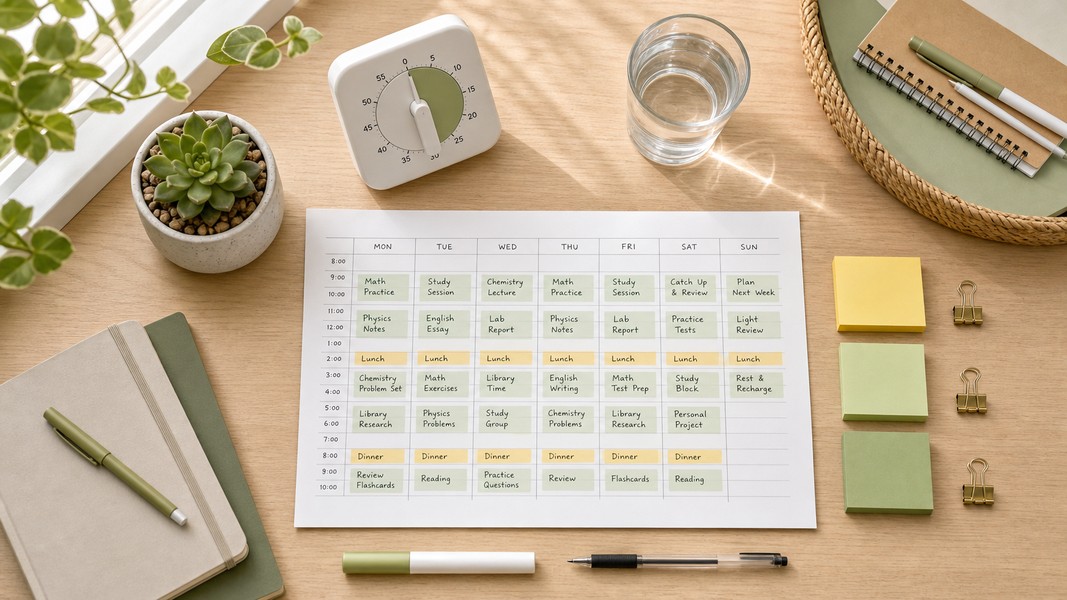
Struggling to manage your time as a student? These 7 evidence-backed tactics fix the real reasons students fall behind and waste hours.

Fathom AI is great for free Zoom notes, but it has real limits. Here are the best fathom ai alternatives for meetings, students, and multi-format capture.