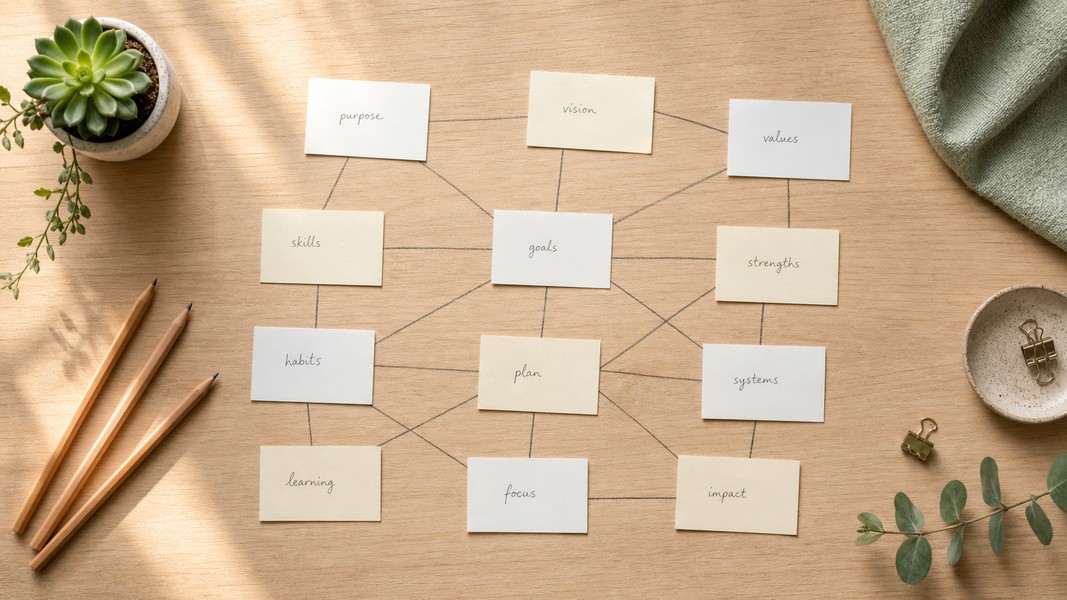
Zettelkasten: How to Build a Knowledge System
July 24, 2026
Learn how the Zettelkasten method works, why linked notes beat linear notebooks, and how to build your own knowledge system from scratch.


March 31, 2026
If you're comparing Otter.ai and Fathom, you already know the core problem: meetings move fast and capturing every detail manually isn't realistic. You need an ai note taker that keeps up without requiring a second job's worth of cleanup afterward. Both tools record, transcribe, and summarize. But they solve the same problem from opposite ends of the meeting timeline.
Otter.ai builds structured notes in real time while the call is still happening. Fathom waits until the call ends, then processes the full recording into a clean transcript and a recap you can skim in seconds. That timing difference shapes how each tool fits into a real workflow.
This post compares both tools across transcription quality, platform integrations, AI features, and the specific scenarios where each one earns its place.
| Category | Otter.ai | Fathom |
|---|---|---|
| Best For | Live notes, in-person use, mobile | Post-call recaps, sales workflows, Zoom-heavy teams |
| Transcription | ~95% accuracy, real-time | ~90-95%, post-processing |
| Free Plan | Limited monthly recording time | Unlimited recordings, limited AI summaries |
| Meeting Integrations | Zoom, Google Meet, Teams | Zoom, Google Meet, Teams |
| Mobile App | iOS and Android | Not available |
| Study Tools | None | None |
If real-time notes matter to you, Otter.ai is the clearer choice. If you want a generous free tier and don't mind waiting for results, Fathom holds up well. Neither tool supports students who need more than transcription from their recordings.
Otter.ai is built around one core idea: capture and organize information while the conversation is still happening. When you join a meeting, Otter.ai joins automatically on Zoom, Google Meet, or Microsoft Teams. It transcribes speech in real time, flags action items as they come up, and builds a structured summary before the call even ends.
By the time the meeting wraps, you often have a usable set of notes already in place. For professionals running back-to-back calls, that means walking out with tasks already logged rather than spending 20 minutes on cleanup. The mobile app extends this to in-person meetings and lectures, which makes it a realistic option for students recording directly from a phone.
Transcription accuracy sits around 95% in standard conditions, with solid handling of multi-speaker conversations where voices overlap. The tool can also use custom templates to structure live output for specific meeting types, like standups, reviews, or client calls.
Where Otter.ai loses ground is on its free plan, which caps monthly recording time. Users who record regularly will hit that limit quickly. There are accuracy complaints in noisy environments or with heavy accents, and the tool occasionally flags unrelated comments as action items, adding a small cleanup step after the fact. Some users have also raised concerns about aggressive email marketing and data privacy practices, which is worth factoring into a long-term decision.
Fathom takes the opposite approach: it stays out of the way during the call and delivers polished results once the call ends. After the meeting, Fathom processes the recording and returns a full transcript, a concise 30-second summary, and a list of action items. The post-processing model produces cleaner, more structured output because the tool isn't racing against live audio.
The free plan is Fathom's biggest differentiator. It offers unlimited recordings and transcriptions without a monthly cap, which makes evaluation practical before committing to a paid tier. AI summaries are limited on the free plan, but the core transcription access is unrestricted.
Fathom connects with Zoom, Google Meet, and Microsoft Teams, with the most stable experience on desktop browsers. On higher-tier plans, CRM sync becomes available, connecting call data directly to platforms like HubSpot and Salesforce. That makes Fathom a natural fit for sales teams whose workflows depend on call notes flowing into a pipeline automatically.
The gaps matter. Fathom has no mobile app, no way to import audio files recorded outside the platform, and no support for in-person use cases where a video call isn't running. The visible meeting bot also appears in the participant list, which some people find disruptive. And because everything processes after the call, you can't act on action items until post-meeting.
Both tools deliver solid transcription in standard office conditions. Otter.ai's real-time engine sits around 95% accuracy and handles multi-speaker environments well, including situations with overlapping voices. Fathom's post-processing approach produces output in the 90-95% range, and the extra processing time allows for some refinement, but user reports indicate more degradation with strong accents and background noise.
For most English-speaking environments, the difference is marginal. If your meetings regularly include participants from diverse locations or with non-native accents, Otter.ai's edge in real-time handling is worth noting.
This is largely a tie. Both tools auto-join Zoom, Google Meet, and Microsoft Teams without requiring manual setup per meeting. Otter.ai participates live, which means it can surface action items before the call ends. Fathom processes post-call, so the results arrive once the recording has been fully transcribed.
For professionals using desktop browser setups, both tools work reliably. Otter.ai has a clear advantage for mobile-initiated meetings given its dedicated iOS and Android apps. Fathom's integration is most stable on desktop and does not support mobile or in-person scenarios.
Otter.ai generates summaries that evolve in real time as the meeting progresses. It detects and verifies action items before the call ends, and customizable templates let you pre-structure output for different meeting formats. On paid plans, the tool can consolidate tasks across multiple meetings.
Fathom delivers summaries after the call, built around a concise recap format designed for quick review. On higher tiers, you can query transcripts directly using natural language, which helps when you need to find a specific moment in a long recording. The post-processing approach produces more polished output overall, but the delay means you can't act on anything while still in the room.
Neither Otter.ai nor Fathom was built for students. Both tools stop at transcription. There are no flashcards, no quizzes, no spaced repetition systems, and no visual tools like mind maps. Their pipelines are designed for professional meetings, not for converting lecture recordings into usable study material.
For students who use these tools to capture lectures, the workflow ends the moment you get a text transcript. Converting that into exam-ready material requires a separate tool entirely, which adds friction that compounds across a semester.
Otter.ai fits best when speed and mobility define your workflow. If you run back-to-back meetings and want organized notes before you close your laptop, the real-time approach removes a real pain point. It's also the stronger choice for anyone recording in person, on a phone, or in environments where a desktop isn't always available.
It's a practical fit for small business owners, team leads, and students who prioritize speed over post-processing polish. Students in particular benefit from the mobile app for lecture capture, even if study-specific features aren't available. Those who use Otter.ai as one piece of a larger study workflow, pairing it with external tools for flashcards or review, can make it work.
The free plan limitations mean power users will hit the ceiling faster than casual users, but for moderate weekly use it remains viable.
Fathom's free tier makes it the lower-risk starting point for teams that want to record without committing to a paid plan immediately. Unlimited recordings mean you can test it across a full quarter of meetings before deciding whether the AI features are worth unlocking.
Sales teams using Zoom get the most value from Fathom, particularly at higher tiers where CRM sync removes manual data entry between calls and pipeline updates. The post-processing delay is a minor trade-off for the depth and polish of what it delivers.
If your entire workflow happens on desktop video calls and you don't need mobile support, Fathom removes more friction than Otter.ai at the same cost tier. The post-call polish is genuinely better for teams that care about clean, shareable summaries over speed.
For professionals whose note-taking needs are limited to video calls, the Otter.ai vs Fathom comparison covers most of the relevant ground. But for students, researchers, or anyone whose recordings come from more than just scheduled meetings, both tools fall short in the same place: they stop at transcription.
Voice Memos handles a broader range of input. Beyond audio, it processes PDFs, images, handwritten notes photographed with a phone, and YouTube URLs in the same interface. The AI doesn't just transcribe: it automatically extracts tasks, events, reminders, and contacts from any content type. For students specifically, it generates flashcards with spaced repetition scheduling, interactive quizzes, and mind maps directly from captured content.
If you're looking at our AI meeting notes guide alongside this comparison, Voice Memos covers both meeting documentation and study material generation without switching tools. Transcription works across 40+ languages with automatic translation, which matters for international students studying in a second language. It also includes a dyslexic-friendly formatting mode, a feature neither Otter.ai nor Fathom offers.
For students who want to explore how these capabilities stack up against a broader set of tools, the roundup of AI study tools covers the full landscape.
Otter.ai and Fathom solve the same problem from different angles. Otter.ai wins on real-time speed, mobile support, and live organization. Fathom wins on a generous free tier, post-call polish, and integrations that serve sales teams well. Both do the core transcription job reliably, and choosing between them mostly comes down to when you need your notes and where you're recording from.
The shared limitation is study support. If your recordings are ever meant to help you learn rather than just document, you'll need a tool that moves beyond transcription into actual study material generation.
Discover more insights and tips to enhance your productivity
Learn how the Zettelkasten method works, why linked notes beat linear notebooks, and how to build your own knowledge system from scratch.

Struggling to manage your time as a student? These 7 evidence-backed tactics fix the real reasons students fall behind and waste hours.

Fathom AI is great for free Zoom notes, but it has real limits. Here are the best fathom ai alternatives for meetings, students, and multi-format capture.