
One-on-One Meeting Template: Agenda, Questions & Guide
July 18, 2026
A complete one on one meeting template with agendas, discussion questions, and follow-up formats to help managers run more effective 1:1s.


April 19, 2026
The SQ3R method is a five-step active reading strategy: Survey, Question, Read, Recite, Review. Developed by educational psychologist Francis P. Robinson in 1946, it turns passive reading into a structured process that builds comprehension at every stage. Instead of reading a chapter and hoping it sticks, SQ3R gives you a clear system for extracting, processing, and retaining what you read.
If you've ever finished a chapter and immediately forgotten what it said, SQ3R is worth learning. It was built specifically for the kind of dense academic texts where passive reading consistently fails: textbooks, research papers, and primary sources that don't yield their meaning easily on a single read.
SQ3R stands for Survey, Question, Read, Recite, Review. Robinson designed it based on information processing theory: comprehension improves when readers engage actively before, during, and after reading, not just while going through the text line by line.
Each step builds on the one before. Surveying gives you a mental framework. Questions give your reading a purpose. Active reading fills in the answers. Reciting tests what you retained. Review locks it in over time. Together, they transform a single reading session into a complete learning cycle.
The method has been widely taught in educational psychology since its introduction, and research backs its effectiveness over passive re-reading for complex material.
Before you read a single sentence, skim the chapter. Look at the title, headings, subheadings, bold terms, diagrams, charts, and the chapter summary if one exists. Your goal is not to read but to build a mental outline. What is this chapter about? What are the major sections? What vocabulary appears repeatedly?
This preview activates prior knowledge and creates a scaffold your brain uses to organize new information as you read.
Turn each heading into a question. If a heading reads "The Water Cycle," your question becomes "How does the water cycle work?" Write these questions in a notebook or the margins of your text before you start reading.
This step changes the purpose of reading from passive absorption to active search. You're no longer reading to get through the chapter; you're reading to find specific answers. That shift in intent produces meaningfully better retention.
Read one section at a time, focused on answering the question you wrote for that section. Pause after each section, don't read to the end of the chapter before stopping.
Highlight sparingly: one or two key points per page, maximum. The temptation to highlight everything defeats the purpose. Excessive highlighting is just passive re-reading with a marker.
Close the book or look away from the screen. In your own words, explain what you just read as if you're teaching a friend. Don't read your highlights back to yourself; retrieve the information without looking.
This step is the most cognitively demanding and the most valuable. It forces retrieval, which exposes gaps in your understanding immediately. If you can't explain something clearly, you haven't learned it yet. Go back, re-read the section, and try again.
Recording your verbal summary and having it transcribed automatically can make this step more useful: you get a written record of your understanding to review later, without the interruption of typing. Voice Memos does this automatically, turning your spoken recitation into a searchable transcript you can reference during review.
After finishing the chapter, review your notes and try to answer each of your original questions without looking at the text. Then review again the following day, and once more a week later.
Spaced review is what separates SQ3R from a one-time reading session. Without it, the effort you put into the first four steps decays quickly. With spaced review built in, retention compounds.
Here's how SQ3R looks when applied to a biology chapter on photosynthesis.
Survey: Skim the headings ("Light Reactions," "Calvin Cycle"), look at the chloroplast diagrams, note bold terms like chlorophyll and ATP. You now know the chapter covers two main stages of photosynthesis.
Question: Convert headings to questions: "How do light reactions work?" "What happens in the Calvin Cycle?" "Why does photosynthesis matter for life on Earth?"
Read: Work through each section to answer those questions. Light reactions split water, release oxygen, and produce ATP. The Calvin Cycle uses that ATP to convert carbon dioxide into sugars. Note key terms and mechanisms as you go.
Recite: Close the book. Explain: "Photosynthesis has two stages. Light-dependent reactions capture sunlight through chlorophyll, producing ATP and releasing oxygen as a byproduct. The Calvin Cycle uses that ATP to fix carbon dioxide into glucose." If you blank on the electron transport step, mark it as a gap and re-read that section before moving on.
Review: Tomorrow, cover your notes and try to answer your original questions from memory. One week later, repeat. Each review round requires less effort than the last, because the material is consolidating in long-term memory.
Research on SQ3R consistently shows it outperforms passive re-reading for comprehension and long-term recall. A study published in Teaching of Psychology found that students who used SQ3R scored higher on exams than those who simply re-read the material. Active methods like SQ3R can produce retention rates 50-80% higher than passive re-reading, which produces retention rates of roughly 10-15%.
The mechanism is straightforward: passive re-reading gives the illusion of familiarity without producing genuine learning. SQ3R forces retrieval, which is the same mechanism that makes flashcards and active recall so effective. You are practicing the act of remembering, not just re-exposing yourself to information.
SQ3R works best for dense academic reading where retention matters: textbook chapters, research articles, academic books. It's well suited to subjects like biology, history, psychology, and sociology, where you're absorbing new frameworks and concepts from text-heavy material.
Use it for your first pass through complex material, especially before an exam that requires you to apply or explain concepts, not just recognize them.
Where SQ3R is overkill: short articles you need to scan quickly, material you already know well, or subjects that are primarily mathematical or problem-solving based. For math and STEM coursework where problems drive learning more than reading, other methods often work better.
It also requires discipline. If you're short on time and need to cover a lot of ground quickly, SQ3R's deliberate pacing can feel slow. In those cases, a faster active recall loop may serve you better.
One common mistake is treating SQ3R as an all-or-nothing method. Even applying just the Survey and Question steps before reading produces measurably better comprehension than diving in cold. If you're pressed for time, the first two steps alone are worth the two minutes they require. The full five-step cycle is the goal for dense, high-stakes material; a partial version still beats passive reading for almost everything else.
These three methods address overlapping problems but at different stages of learning.
SQ3R is a reading framework. It tells you what to do before, during, and after you read a text. It works best when your primary source is a written document.
The Cornell notes method is a note organization framework. It's most useful during lectures or when synthesizing material you've already encountered. Cornell gives you a structure for your notes; SQ3R gives you a process for reading. The two work well together: use SQ3R to read the textbook, then use Cornell notes to organize key takeaways for review.
Active recall is a retrieval strategy. It focuses entirely on the testing effect: repeatedly retrieving information from memory strengthens it. Active recall is embedded in SQ3R's Recite and Review steps. If you want to go deeper, you can extend those steps with flashcards or self-quizzing after completing the SQ3R cycle.
None of these methods competes directly. They operate at different points in the learning process and can be combined into a single workflow.
SQ3R was designed in 1946, but its Recite and Review steps map directly onto what modern AI study tools do well.
During the Recite step, recording your verbal summary and having it transcribed gives you a written artifact of your own understanding. You can use that transcript as a foundation for review: compare it to your original notes, identify gaps, or feed it to an AI to generate quiz questions from your summary.
Voice Memos handles this entire pipeline. Record your verbal recitations, get an automatic transcript, then use the app's quiz mode or flashcard generation to build review materials from your own summaries. Your study materials are built from your understanding of the content, not just copied text from the chapter, which strengthens retention further.
During the Review step, spaced repetition flashcards generated from your SQ3R notes mean that review sessions are targeted and efficient. You spend time on what you haven't mastered, not on material you already know.
SQ3R works because it replaces passive reading with a structured learning cycle. Surveying builds a mental framework. Questions give reading purpose. Sectioned reading keeps focus. Reciting forces retrieval and exposes gaps. Spaced review cements long-term retention.
It's not the fastest way to get through a chapter. It is one of the most reliable ways to actually understand and retain what you read, which is the part that matters when exams arrive.
Discover more insights and tips to enhance your productivity
A complete one on one meeting template with agendas, discussion questions, and follow-up formats to help managers run more effective 1:1s.

The best voice notes app does more than record. Compare top AI-powered picks for students and professionals, including transcription, summaries, and study tools.
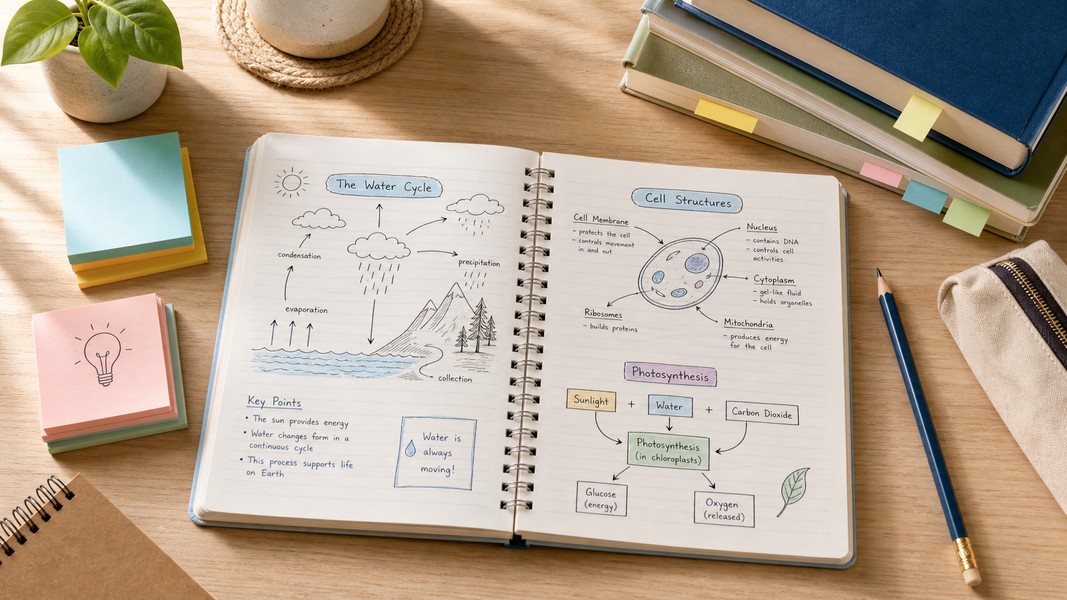
Dual coding theory shows that pairing text with visuals improves memory and recall. Learn how to use it with diagrams, mind maps, and structured notes.