
AI Productivity Tools for Busy Professionals
June 12, 2026
Discover the best AI tools for productivity. From automatic meeting capture to action item extraction, see how AI saves knowledge workers hours every week.


June 10, 2026
Seven IELTS listening tips that consistently separate band 6 candidates from band 7-8 scorers: shadowing, transcription review, vocabulary flashcards, predictive listening, spaced repetition, targeted Section 4 practice, and timed exam simulation. Applied systematically, these techniques transform passive IELTS listening practice into measurable score gains.
Most IELTS candidates plateau around 6.0-6.5 not because their English is weak, but because their practice approach is passive. They play recordings and hope their scores improve. This post shows you what to do instead.
The IELTS listening test presents four distinct challenges that trip up even confident English users.
First, the audio plays only once. There is no replay, no pause, no second chance. One lapse in concentration can cascade into three or four missed answers.
Second, the test uses a wide range of accents: British, Australian, New Zealand, North American, and others. If your IELTS listening practice has leaned on one accent, the exam will feel disorienting.
Third, the recordings are full of deliberate traps: self-corrections ("It's platform 4, sorry, platform 14"), distractors where an answer is stated then reversed, and closely similar numbers or dates. According to official IELTS guidance, these features are intentional, designed to test attention and selective listening rather than just vocabulary knowledge.
Fourth, the cognitive load is high. You must read the next question, listen to ongoing speech, and write your answer simultaneously. In a second language, this is genuinely difficult even at C1 level.
On the IELTS listening test, Band 6 requires roughly 23-26 correct answers out of 40. Band 7 requires around 30 correct. Moving from 6 to 7 means getting 4-7 more answers right, which sounds modest but requires systematic improvement across multiple skill areas.
Band 6 candidates typically understand the main idea but miss specific details. They struggle with Sections 3 and 4, where speech is more academic and dense. Band 7-8 candidates handle the full range of accents and question types without losing their place, and they make very few spelling or word form errors.
Over 3 million IELTS tests are taken globally each year, according to Cambridge English. For non-native speakers targeting study abroad or immigration, the gap between 6.5 and 7.0 often determines admission. Structured practice is a competitive advantage, not just exam prep.
Shadowing means listening to a recording and speaking along with it in near-real time, matching the speaker's rhythm, stress, and pace as closely as you can.
The technique builds phonological decoding: your brain's ability to map sound to meaning automatically. When you shadow regularly, you become more sensitive to reduced forms ("gonna", "wanna"), weak function words, and the way sounds blur together in natural speech. This directly improves your ability to catch details during fast IELTS recordings.
The method: choose a 30-60 second IELTS audio clip. Listen once for gist, then check the transcript for any unknown words. Play at 0.75x speed and read along, matching intonation and pauses. Then hide the transcript and shadow at normal speed. Repeat three to five times, focusing on a different element each pass: rhythm first, then vowel quality, then consonant clusters.
The goal is not perfect pronunciation but trained perception. The more you replicate natural speech patterns, the faster your brain recognizes them under exam conditions.
Transcription-based review turns passive listening into a precise diagnostic. You listen to a short audio clip and type exactly what you hear, then compare your version to the official transcript.
This works because it forces attention to every sound, not just overall meaning. Your comparison reveals specific gaps: function words you consistently miss, verb endings you don't catch (-s, -ed), names and numbers you mishear. These patterns are exactly what cost marks on the real test, where dates, prices, and proper nouns are common answer types.
The method: select 20-60 seconds of IELTS-style audio from a section that gave you trouble. Do a rough first pass without pausing to simulate exam pressure. Then replay with short pauses to fill in gaps. Compare against the official transcript and highlight every discrepancy.
Apps like Voice Memos can auto-transcribe your practice audio in seconds, giving you an immediate reference to check against your own typed version. You then use your error log to build flashcard decks from the words and phrases that tripped you up, turning each session into personalized study material.
Transcription review is more valuable than doing five full mock tests because it builds genuine awareness of where your listening breaks down.
IELTS listening uses consistent vocabulary patterns: British and Australian spellings ("organisation", "programme", "enrolment"), academic collocations ("field trip", "funding application", "accommodation"), and Section 4 lecture vocabulary across recurring topics like environment, education, and health.
Random word lists don't prepare you for these. What works is mining official IELTS transcripts for the vocabulary that actually appears, then learning it in context.
Create flashcards with three elements: an audio clip of the word or phrase, a short definition with an IELTS-style example sentence, and a fill-in-the-blank version for active recall. Include spelling variations and common word forms.
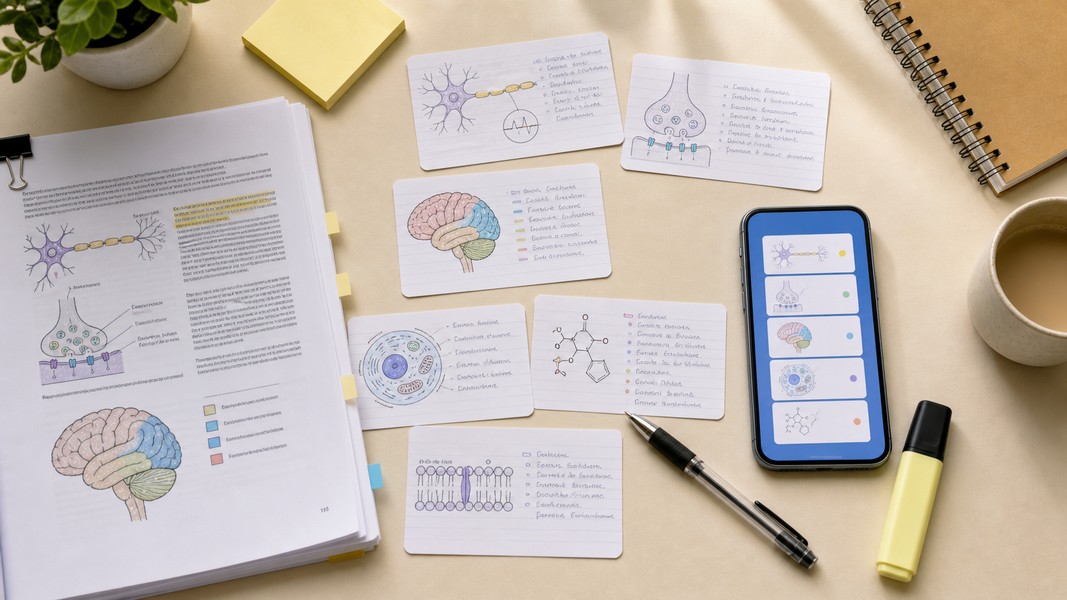
AI flashcard tools can generate these decks automatically from a transcript or PDF, saving hours of manual card creation. Upload a set of IELTS practice transcripts and pull vocabulary grouped by topic area.
Practice in short daily sessions of five to ten minutes, always listening before reading. The listening-first approach trains your ear to recognize words in speech, not just on the page.
IELTS gives you 30-40 seconds before each section to read the questions. Most candidates use this time passively. High scorers use it to predict.
Before the audio starts, scan the questions and underline specific keywords: names, dates, location words. Then think about the grammar: if the gap needs a noun phrase, you won't accidentally write an adjective. If the question asks for an "advantage", you know to listen for synonyms like "benefit", "positive aspect", or "strength".
Predicting also activates your existing knowledge about the situation. If the question setup describes a university accommodation office, you immediately know the topic space and the kind of information that will appear. Your brain listens strategically rather than word-by-word.
This skill develops fast with deliberate practice. After each mock test, review which predictions were accurate. Over time, you'll notice reliable patterns in how IELTS recordings are structured and what types of synonyms the test writers prefer.
Spaced repetition is a review system where you see each item at increasing intervals based on how well you remember it. Cards you struggle with appear frequently; cards you know well appear less often. The system is grounded in decades of memory research and consistently outperforms cramming for long-term retention.
For IELTS listening, this means vocabulary you practice with spaced repetition gets recognized instantly when it appears in speech. The "I know that word but can't process it fast enough" problem shrinks significantly.
The key is feeding the system with your own mistakes. After each transcription exercise or mock test, add the words and phrases you missed to your spaced repetition deck. Voice Memos generates spaced repetition flashcard decks automatically from recorded or uploaded content, which means every transcription session can feed directly into your vocabulary review system.
Set a daily target of 10-20 new cards and five to ten minutes of review. Always include an audio component in each card. Reading a word is not the same as recognizing it in fast speech. The audio element is what connects vocabulary practice directly to listening comprehension.
Section 4 is a single academic monologue with no breaks between speakers. It covers topics like environmental science, history, social research, and technology. Many candidates consider it the hardest part of the exam.
The challenge is not just vocabulary. It is the combination of high information density, complex academic sentence structures, and the need to track an argument across five minutes of continuous speech.
Three strategies work specifically for Section 4. Master signposting phrases: "Turning now to...", "Another key point is...", "To summarize...". These phrases mark transitions between sections of the lecture and often immediately precede the next set of answers. Practice identifying them in real academic talks outside of IELTS materials.
Second, sketch the structure before listening. Section 4 usually follows a predictable pattern: brief introduction, two or three main points with examples, then a conclusion. Use the question layout to map this structure before the audio begins.
Third, train with authentic academic content. Short university lecture recordings and the free listening resources on British Council's website expose you to the density and register Section 4 demands, without the pressure of a practice test.
Targeted drilling builds skills. Only full exam simulation builds the stamina and composure to apply those skills under pressure.
Every week, complete one full IELTS listening test: 40 questions, 30 minutes of audio, no pausing, no replaying. For paper tests, include the 10-minute transfer stage. Convert your correct answers to an estimated band score and log the result.
The review after each mock test is as important as the test itself. For every wrong answer, diagnose the exact cause. Did you mishear a number? Miss an unfamiliar word? Lose focus during a speaker transition? Fall behind while reading the questions? Each error type points to a different practice focus.
Track these patterns across multiple tests. If you consistently lose marks in Section 3 multiple choice, that section needs dedicated drilling. If spelling errors cost you two or three answers per test, that is a faster route to a higher band than general listening practice.
Simulation also trains mental stamina. Sustaining full attention across four sections is a skill that only develops through regular full-length practice.
The most common technical errors on IELTS listening have little to do with language ability. They are procedural mistakes that practice can eliminate.
Writing the wrong word form is one of the most frequent. If the gap requires a noun and you write a verb, you lose the mark even if you heard the correct content. Always check the grammar of the surrounding sentence before and after each answer slot.
Spelling errors invalidate correct answers. Names, place names, and common academic words ("accommodation", "environment", "committee") are frequent culprits. Keep a running spelling log of words you misspell and drill them with dictation until they become automatic.
Writing too many words is another consistent problem. Instructions like "NO MORE THAN TWO WORDS AND/OR A NUMBER" are strict. Three words is wrong even if all three are correct. Underline the word limit for each section before the audio starts.
Finally, most candidates who plateau are practicing passively: playing recordings, checking answers, and moving on. Active review with transcript comparison, error logging, and targeted flashcard drilling is what separates candidates who improve from those who don't.
IELTS listening improvement is predictable when you replace passive exposure with active, targeted practice. Shadowing builds phonological fluency. Transcription review reveals your specific gaps. Vocabulary flashcards with audio close those gaps for the long term. Predictive listening makes you strategically ready for each section. Spaced repetition ensures vocabulary sticks. Dedicated Section 4 work addresses the hardest part of the test. And regular full simulations build the stamina and composure the exam demands.
Apply two or three of these techniques consistently for four to six weeks and track your mock test scores. The pattern of improvement will tell you exactly where to focus next.
Discover more insights and tips to enhance your productivity
Discover the best AI tools for productivity. From automatic meeting capture to action item extraction, see how AI saves knowledge workers hours every week.

Struggling to focus on studying? Learn the common blocks, from distractions to cognitive overload, and the fixes that actually work for students.
The best AI tools to convert any PDF into flashcards instantly, ranked for students who want to study smarter with spaced repetition built in.