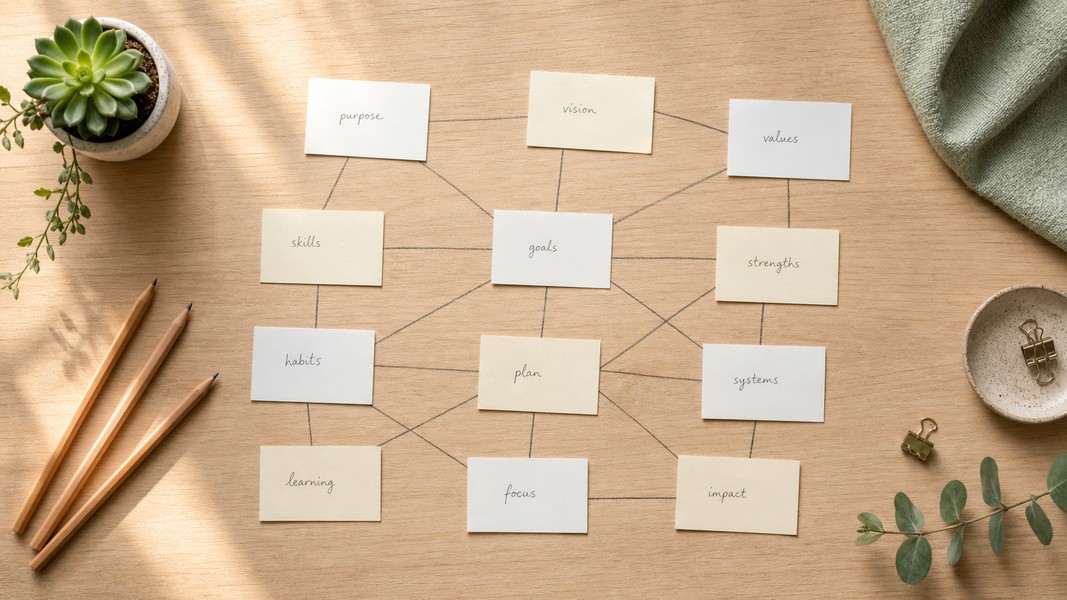
Zettelkasten: How to Build a Knowledge System
July 24, 2026
Learn how the Zettelkasten method works, why linked notes beat linear notebooks, and how to build your own knowledge system from scratch.

May 2, 2026
A KWL chart is a three-column graphic organizer that structures learning around what you already Know, what you Want to find out, and what you ultimately Learn. First published through the International Literacy Association in 1986 by educator Donna Ogle, it remains one of the most widely used comprehension tools in classrooms today.
If you've ever finished reading a chapter and retained almost nothing, a KWL chart addresses that problem directly. It forces you to surface what you already know before you start, set specific questions you want answered, and then close the loop by recording what changed. The result is a fundamentally different kind of reading: goal-driven, self-monitored, and far more likely to stick.
This guide explains each column, shows you how to fill the chart out, walks through examples in two different subjects, and covers the most useful template formats available.
Donna Ogle designed the KWL chart as a strategy for expository texts, the kind of dense, information-heavy material that most students find hardest to process. The insight behind it is simple: reading comprehension improves when you actively connect new information to what you already know, rather than treating each reading session as a blank slate.
The chart consists of three labeled columns on a single page. You fill in the first two columns before reading and the third column during or after it. That sequence is the whole method. There's no scoring, no grading, no right or wrong. The chart is purely a thinking tool that makes your mental process visible and structured.
Teachers use KWL charts for whole-class lessons, small group discussions, and individual study sessions. Students use them on their own for exam preparation, research projects, and processing difficult reading material. The format adapts to virtually any subject or grade level.
The three columns have a specific purpose and a specific order. Skipping a column or filling them out in the wrong sequence undermines the method.
K: What I Know. Before you open any material, write down everything you already associate with the topic. Include facts you're confident about, things you half-remember, and associations that come to mind even if you're not sure they're accurate. This isn't a test; just write everything down. Misconceptions belong here too, because surfacing them early prevents them from being reinforced during reading.
W: What I Want to Know. Look at your K column and identify the gaps, the questions, and the things you're curious about. Then write those down as specific questions. "How did this start?" is better than "history." The more specific your questions, the more purposeful your reading becomes. You're essentially writing your own comprehension guide before you read a single page.
L: What I Learned. Fill this column as you read, not only at the end. When you encounter an answer to one of your W questions, write it down immediately. Add facts that surprised you, even if they weren't in your W column. At the end, compare L with K to see where your prior knowledge was accurate, incomplete, or wrong.
That five-step loop takes under ten minutes to set up but transforms passive reading into a structured conversation with the material.
Seeing the method applied to real subjects makes it much easier to use on your own. Here's what a completed chart looks like for two different topics.
Biology: Cell Theory
| K: What I Know | W: What I Want to Know | L: What I Learned |
|---|---|---|
| Cells are the basic units of life | Who first described cells? How was cell theory developed? | Robert Hooke coined "cell" in 1665 while examining cork under a microscope; cell theory was formalized by Schleiden, Schwann, and Virchow in the 1830s and 1850s |
| Plants and animals are made of cells | Are all living things made of cells? | Yes: cell theory states all living organisms are composed of cells, and all cells arise from pre-existing cells |
History: World War II
| K: What I Know | W: What I Want to Know | L: What I Learned |
|---|---|---|
| The war ended in 1945 and involved many countries | What triggered the war? What were the major turning points? | Germany's invasion of Poland in September 1939 triggered the conflict; key turning points include the Battle of Stalingrad (1942-43) and D-Day (June 1944) |
| The US entered after Pearl Harbor | When was Pearl Harbor? How did it change the war? | Japan attacked Pearl Harbor on December 7, 1941; US entry shifted the balance of Allied resources decisively |
Notice how the L column doesn't just answer the W questions. It also fills in the specific detail that was missing from the vague K entries. That's the chart working correctly.
The simplest format is three columns labeled K, W, and L on a single landscape sheet. You can create one in any word processor in under two minutes. For a printable option, a table with three equal columns and twenty or so rows per column gives you enough space to write freely without cramping.
For digital use, a table in Google Docs, a text note organized by section, or a spreadsheet all work well. The benefit of a digital format is that you can expand cells as needed and copy the L column directly into study notes without retyping.
The most useful templates include a topic header line above the three columns and a "Still Want to Know" row below the L column. The topic header forces precision before you start. The additional row lets you carry forward any W questions that weren't answered during the reading, turning the chart into a continuous inquiry tool rather than a single-use exercise.
If you're already using a Cornell notes template, the two methods pair well together. Use the KWL chart before a lecture to activate prior knowledge and set your focus, then switch to Cornell notes during the lecture itself.
The three-column original has generated several extensions, each adding a step that deepens the learning process for specific contexts.
The original KWL handles most classroom reading situations well. The variations are worth adopting when the learning extends beyond a single text, or when metacognitive planning is explicitly part of the assignment.
The L column is the most time-intensive part of the chart to fill out accurately. You have to locate information, evaluate it, and summarize it in your own words while also reading. AI tools can handle the mechanical side of that process, so you can focus on the thinking.
Voice Memos, for example, lets you upload a lecture recording, a PDF, or a YouTube video URL and automatically generates structured notes from the content. Instead of pausing your reading every few minutes to hand-copy L entries, you get an organized summary at the end that you can review against your W questions. The app detects key facts, extracts action items, and organizes information in a format that maps directly onto what you were looking for.
Voice Memos' quiz mode takes this a step further: it generates questions from your L column content, turning the completed chart into a review session without requiring extra effort on your part. That's where the method connects directly to active recall, the practice of retrieving information from memory rather than re-reading it passively.
Studies on non-linguistic representations in learning, summarized in ASCD research on classroom strategies, show that students retain significantly more content when they use graphic organizers compared to unstructured note-taking. Separate analysis from the Education Endowment Foundation on metacognition and self-regulation strategies found that structured self-monitoring approaches can accelerate learning progress by around seven months.
The KWL chart delivers both benefits at once: it's a graphic organizer that builds metacognitive habit simultaneously. Adding an AI layer to the L column makes the process faster without removing the thinking it requires.
A KWL chart works because it converts passive reading into an active process with a clear before, during, and after structure. The K column surfaces prior knowledge and assumptions. The W column turns vague curiosity into specific questions. The L column closes the loop between what you expected to learn and what you actually did.
The format is simple enough to use for any subject and flexible enough to extend with variations like KWHL or KWLQ when projects demand more structure. Whether you're preparing for an exam, conducting independent research, or trying to make sense of a dense chapter, the KWL chart gives your study session a framework that most reading approaches skip entirely.
Discover more insights and tips to enhance your productivity
Learn how the Zettelkasten method works, why linked notes beat linear notebooks, and how to build your own knowledge system from scratch.
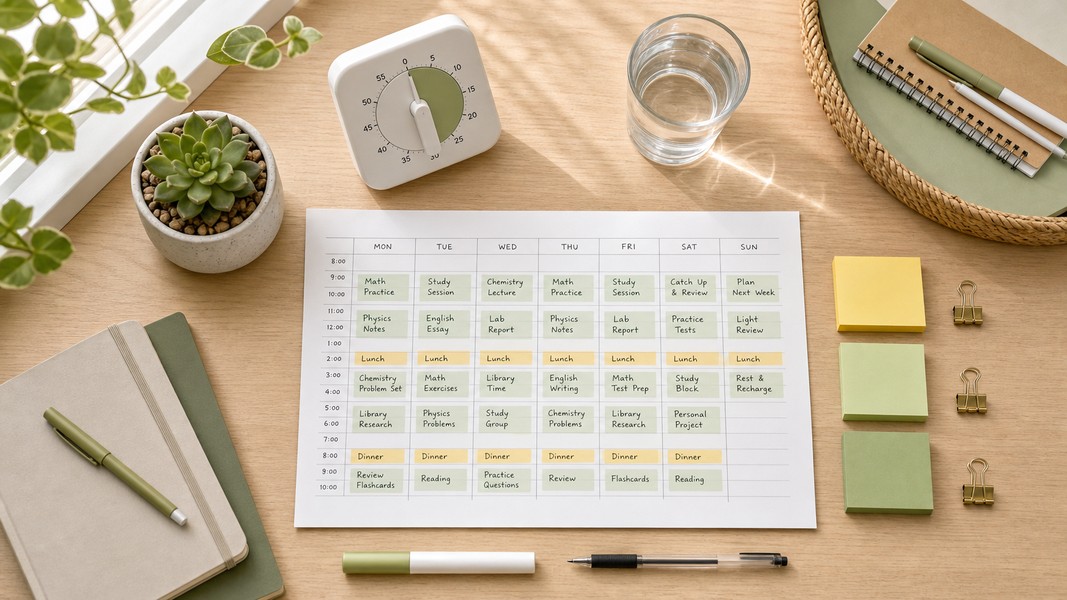
Struggling to manage your time as a student? These 7 evidence-backed tactics fix the real reasons students fall behind and waste hours.

Fathom AI is great for free Zoom notes, but it has real limits. Here are the best fathom ai alternatives for meetings, students, and multi-format capture.